

Collaborative action is probably the best and only way to respond to the disruption that is taking place. –John Lass
ORLANDO—Every credit union has a plan. So do most people. But to put what that really means into perspective, John Lass offers an observation from the great philosopher Mike Tyson: “Everyone has a plan, until they get punched in the mouth.”

Mike Tyson, business strategist
Punches in the mouth are coming more frequently to every credit union, business and person in the world due to the increasing rate of “disruptions,” according to Lass, who is well known from his career at CUNA Mutual and who now leads Lass Advisory Services out of Seattle.
Speaking to NACUSO’s annual meeting, Lass said, “Everything in the world of disruptive innovation is about making life easier for the consumer. This is a tsunami. If somebody else can find a way to take our processes and make it simpler, they will.”
Disruption is nothing new, said Lass, citing a list of innovations have disrupted powerful and established players, but it does come about much more quickly now, throwing out old business models in the process.
Disruption almost always comes from new, often unexpected players. Or, as Lass said, quoting Joseph Schumpeter, “It is not the owner of stage coaches who builds railways.”
In a more modern context, Lass pointed to the observation made by Harvard professor and author Clayton Christensen: “An innovation that is disruptive allows a whole new population of consumers at the bottom of a market access to a product or service that was historically only accessible to consumes with a lot of money or a lot of skill.”
Disrupting The Study of Disruptions
Lass suggested that the whole field of studying disruptions is now at a disruption point.
“There is some thinking now with the smartphone and mobile devices that there is a new way to disrupt,” he said. This is known as ‘Big Bang Disruption,’ (from the book by Larry Downes and Paul Nunes), which is an innovation that from the moment of its creation is both better and cheaper than the products and services against which it competes.”
As Downes and Nunes wrote, “Using new technologies in the Internet, cloud-based computing, and increasingly powerful and ubiquitous computing devices, Big Bang Distruptors can destabilize industries in record time, leaving incumbents and their supply chain partners dazed and, soon after, devastated.”
Lass said credit unions need look no further for an devastating innovation than the iPhone, which devastated industries that include notebooks, flashlights, game players, newspapers, clock, watches, companies, cameras, GPS devices, and more. “Ask yourself if you were in senior management at TomTom or on their board, at what point would you wake up to the fact something different is happening here and we need to rethink our business model. It’s a question that we might want to ask ourselves,” said Lass.
Where is the market headed? Perhaps toward “Uber-fication,” named after the popular and disruptive ride-sharing app, Uber. Lass cited a report in Tech Crunch that asked, “Will there really be an Uber for everything? That model might be applied systematically to all industries, including financial services. Anywhere there is a pain point, that creates the fertile ground for disruption. So you need to ask yourself, are there any pain points you can take out, or, do you see pain points in the market you can eliminate?”
Credit union leaders who are graduates of business school likely need to forget everything they knew about product life cycles, according to Lass.
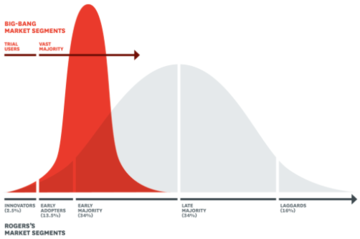
“The new cycle is shaped much more like a shark fin, with small spikes in the stage of innovator buyers, and a huge spike in early adopters. A good example of that is that adoption rate of mobile banking was three times that of online banking. With technology, this adoption curve is changing. And what that means is we need to be very nimble.”
Another business school stand-by, the classic strategy triangle for companies, is also being disrupted. Companies typically were built and inhabited one of three spaces: product innovation leadership, operational efficiency leadership, customer solutions leadership.
That triangle may be becoming obsolete, suggested Lass.
What Does All This Mean?
So what does all this mean to your CUSO or credit union? According to Lass, financial services has always had five sweet spots: Savings, lending, investments, insurance and payments.
“Payments used to be the stodgy and boring one, and today it’s one of the most dynamic pieces in the financial services world,” said Lass. “The battleground includes non-bank competitors, other FIs, retailers, platform players, new entrants, alternative payments, telecoms, card companies and non-bank companies. I would argue that four of those are ripe for disruption, and one is the least likely to be disrupted?”
The one area disruptors have yet to touch much, said Lass, is savings, due to regulation and the need for capital. But even savings are no longer safe.
“One thing the disruptors are good at is what I call regulatory arbitrage. They have figured out ways to act like a bank or credit union without being a bank or credit union,” said Lass. “A good example is Lending Club. They use the term investor member—borrowing a phrase from credit unions—at the bottom are the borrower members. The actual transaction of funding the loan passes through a Utah chartered industrial bank called WebBank, which has about $15 million in capital. On that it originated $4 billion in loans, which is pretty good leverage. How does it work? WebBank doesn’t hold the loan. Utah has no usury laws, meaning the investor-member can fund the loan at whatever rate the market will bear.”
Other disruptors worth watching, according to Lass:
- PayPal Beacon, which offers hands-free payments. Lass pointed to a quote from former PayPal president David Marcus, “We challenged ourselves to find a better experience than swiping a credit card. We figured the only better way to pay would be to do nothing. Just walk in a store and, like magic, when you’re ready to pay money is transferred securely. No wallet. No card. Not even touching your phone.” Marcus has since been hired by Facebook, indicating Mark Zuckerberg wants into payments, said Lass.
- Kabbage, which makes small business loans up to $100,000, online, using the Lending Club model. The company promises approval or denial within seven minutes. “What’s really interesting is they don’t look at your credit score,” said Lass. “Instead they have developed an underwriting engine that’s based upon your social media profile: Linked In, Facebook likes, and PayPal history. Is this going to be an ultimate success? I don’t know. I’m skeptical.”

- DirectAuto, which offers leaderboards for safe driving. “You get measured against your peers.”
- Friendsurance, which offers peer-to-peer Insurance. “You can participate in holding some of the risk of a peer’s auto insurance.”
“Will these all work?,” asked Lass. “Who knows. But all of them are stretching the envelope”
Lass said there are some common themes across disruptors:
- Use technology-driven business models, e.g. platform strategies (also known as ecosystem strategy).
- Have a lower cost structure.
- Find ways to bypass relevant laws and regs.
- Utilize low-cost ways of moving money.
- Aggregate data.
Questions To Be Asked
How should a credit union or CUSO respond? According to Lass:
- Be alert, don’t stick your head in the sand.
- Pay attention to the clock and know where you’re at.
- Use defensive strategies to buy time. These generally don’t work in the long run.
- Build an offensive strategy and become a disruptor yourself.
Lass called on credit unions and CUSOs to ask themselves some questions they need to think about, including:

John Lass speaking to NACUSO meeting.
- Are we prepared to defend our market position versus a truly disruptive bank?
- Will your current value proposition still resonate with our members 10-year from now?
- Do we have a clear vision of what retail financial services will look like in 10 years?
- What can we do to remain relevant to Millennials? (“If you want to remain relevant, hire some Millennials,” said Lass.)
- Where should we position ourselves on the technology adoption curve?
Lass, who opened with a quote from Mike Tyson, closed with an observation from Steve Jobs: “If you don’t cannibalize yourself, someone else will.”