

IRVINE, Calif.–Credit unions have an opportunity to fill the role once filled by libraries to become true community development organizations, which will benefit everyone involved, according to one person.
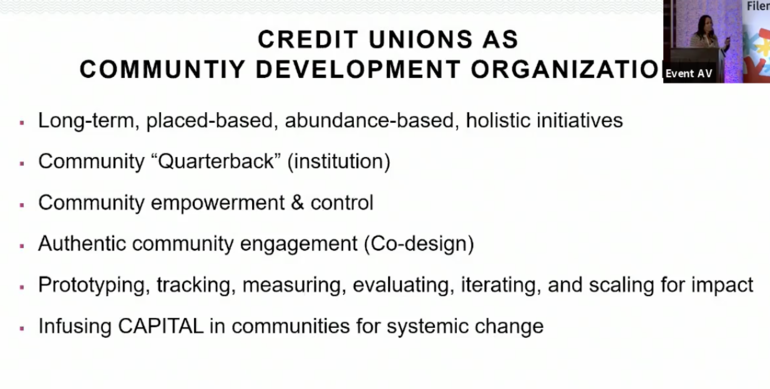
Speaking to Filene’s big.bright.minds. Conference, Dr. Mai Nguyen, director of the Design Lab and professor of Urban Studies and Planning at the University of California-San Diego, and also a Filene Fellow, said there is a desperate need in the country to create “living, thriving habitats and then to scale them up,” and credit unions are ideally suited for helping do just that.
“This is also your value proposition,” Nguyen said. “If you think about yourself as these community-based organizations, I’m confident we can reverse some of these trends we are seeing in inequality. What if I told you that you could work on addressing some of these hardships, this despair, this inequality in these communities and by doing so it would be good for your business, it would be good for your employees, because they would find value and fulfillment in their work and also it would have social impact would be good for the greater community?”
‘We Already Do This’
Nguyen said she could hear credit unions responding by saying, “We already do this, we’re CDFIs,” but she said she believes credit unions should think much more “holistically” and have a “much broader” view of what a community development organization can do.
Nguyen, who also spoke from the experience of coming from a family of refugees from Vietnam, said there is a great role for credit unions to play in underserved neighborhoods when it comes to helping to champion investment. Moreover, credit unions have the opportunity to get ahead of a problem by addressing issues in communities being hit by extreme weather events due to climate change.

Dr. Mai Nguyen
After sharing examples of communities across the country that are struggling, Nguyen asked, “What do all these communities have in common? They all lack capital. And by capital I'm talking about human capital, social capital, and financial capital. They can't climb out of poverty, they can’t get educated, no firms will move into these neighborhoods, so there's a lack of jobs; they can't support small businesses.”
Nguyen explained human capital is about investments in people so they have work experience and skills and the ability to do well in life. Social capital, she said, refers to the relationships that offer resources and opportunities.
And then, finally, she said there is a need for what she called “linking capital,” the ability to link all of the people and resources and social capital together with financial capital in ways that can build communities.
More is Needed
Underserved communities, said Nguyen, have a richness in bonding capital, as the citizens have only each other to turn to in order to get ahead. But they need more.
“An infusion of capital in these communities can really help them,” she said. “Credit unions can really, truly see the social impact of your work by really aligning the different aspects of your work: your busines strategy, your philanthropy, your volunteerism. If you do this these communities will see you as these trusted institutions. What if CUs were thought of as the libraries of these communities? This also makes good business sense. Your employees will feel a sense of purpose. They will feel they are part of something bigger than themselves.”