

MADISON, Wis.—Credit union yield on assets ratio rose to 4.06% in the first quarter of 2023—the highest since 2010—and is approaching the 4.6% long run average, according to TruStage’s June Trends Report, which also predicts CU net income this year will be down over 2022.
The Report also shines a light on the growing interest in adjustable-rate mortgages, as credit union fixed-rate first mortgage loan balances fell 1.6% at a seasonally-adjusted annual rate in April, the first decline in modern history, according to TruStage.
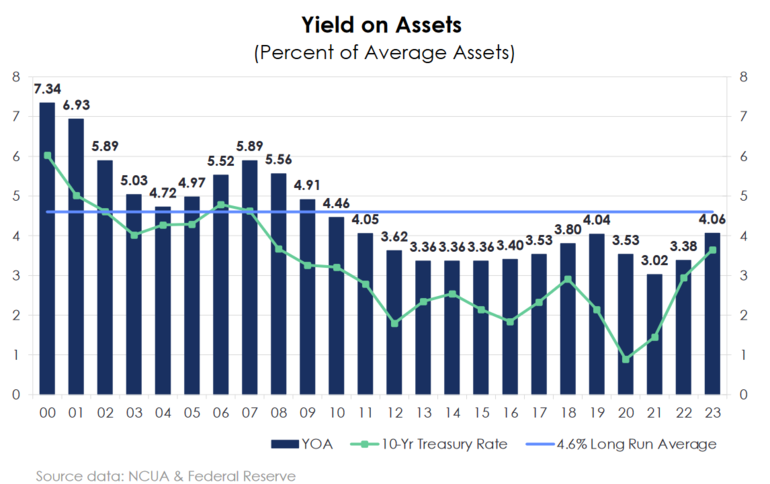
“Over the last 24 years the ‘credit spread,’ or the difference between credit union yield-on-asset ratios and the 10-year Treasury interest rate, averaged around 1.25 percentage points. The yield on asset ratio increased 104 basis points from the record low of 3.02% set in 2021. This 34% rise in interest earnings as a percent of assets is good news for credit unions since 72% of their total revenues come from interest revenues,” the Trends Report states.
“Expect the yield on asset ratio to rise to 4.65% by the end of the year as the Federal Reserve raises the Fed Funds interest rate to 5.6% by year end, from 5.1% today, and loan growth exceeds investment growth, shifting the mix of assets to higher yielding loans,” stated by TruStage Chief Economist Steve Rick, author of the Report.
Total Credit Union Lending
Credit union loan balances rose 0.6% in April, almost a third of the 1.7% pace reported in April 2022 and 16.2% during the last 12 months. April is historically the beginning of the credit creation season with seasonal factors typically adding 0.2 percentage points to the underlying trend loan growth rate, the Report states.
During the first four months of 2023, loan balances rose 2.5%, similar to the 10-year average growth rate of 2.4%. Every real estate loan category (except adjustable-rate loans) and every consumer loan category reported positive loan growth. Home equity loan balances grew 2.5% in April, the fastest growing loan category, and increased 35% during the last year.
Credit union total loan balances rose 17.4% in the year ending in the first quarter of 2023. Credit unions with assets exceeding $1 billion reported loan balances growing 18.3%, while credit unions with asset less than $20 million reported loan growth of 13.4%, according to the report.
“Expect credit union loan balances to rise 7.5% in 2023, and 8% in 2024 which will be above the long run average rate of 7.2%. Loan growth will decelerate this year and next as interest rates rise, job growth slows, worries about recessions increase and consumer confidence declines,” said Rick.
Consumer Installment Credit
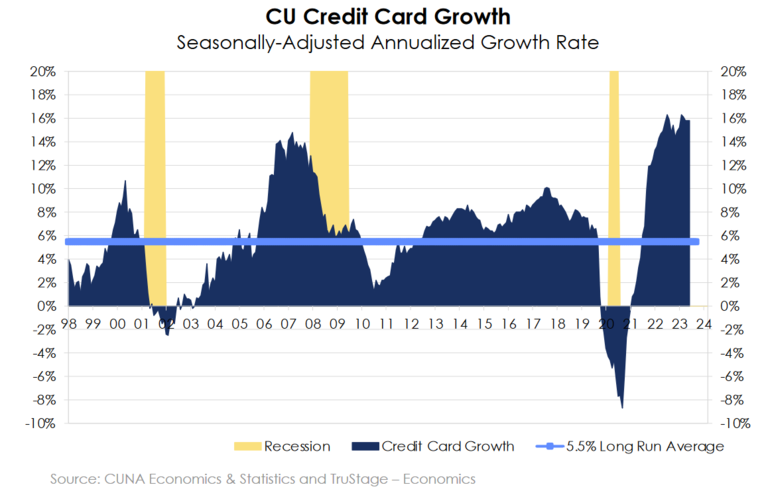
Credit union credit card loan balances rose 1.3% in April, a “nice” increase compared to the 0.9% increase reported in April 2022. On a seasonally-adjusted annual rate, credit card balances rose 15.8%, above the long run average of 5.5% and the fastest pace since 2007.
“As the pandemic recedes, we are seeing consumers increase their spending on travel and leisure and using debt to finance these purchases,” the Report states.
Total consumer credit by all lenders in the U.S. rose by 0.5% ($25.5 billion) in April and 6.4% at an annualized rate. Revolving credit rose 1.3% ($15.4 billion) and nonrevolving credit (auto and student debt) rose 0.2% ($10 billion). Total consumer loan balances rose 6.7% over the last 12 months, above the 6% average reported over the last decade. With strong job growth and household balance sheets in generally a favorable position, consumers demand for consumer credit remains strong, TruStage said.
Revolving credit balances (which include credit card spending) grew an annualized pace of 3.3% in April. Retail sales are slowing, however, as consumers may have satiated much of their demand for goods. The outlook remains favorable as demand for services remain high and wage growth is strong.
Vehicle Loans
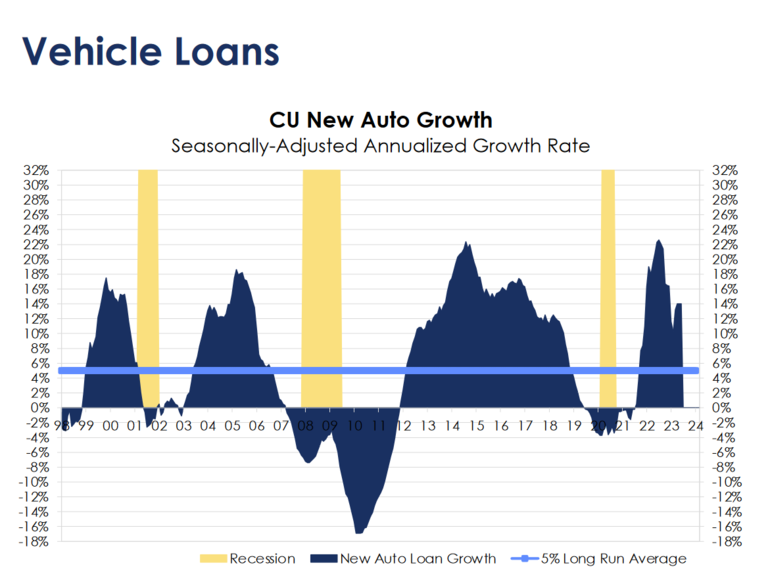
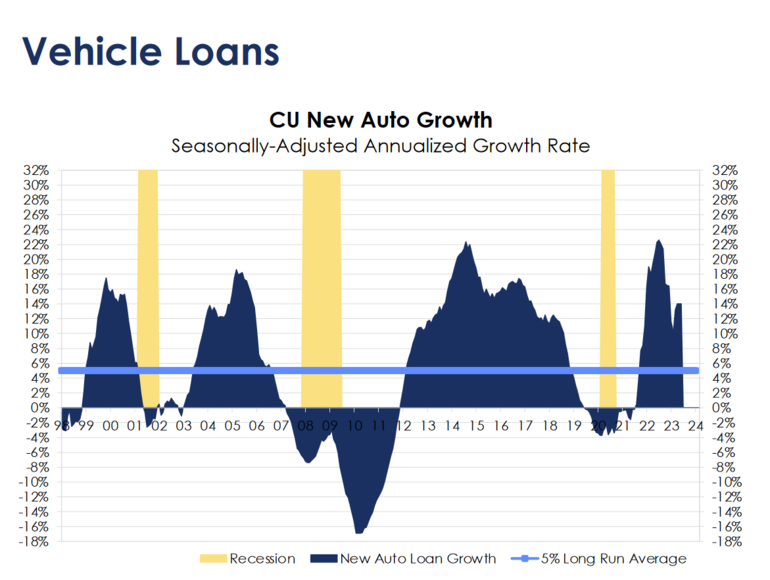
According to the report, credit union new-auto loan balances rose 0.3% in April, a big decrease compared to the 4.2% gain reported in April 2022. On a seasonally-adjusted annual rate new-auto loan balances rose 14% in April twice the normal 7% pace.
“Looking forward, the month of May is historically the beginning of the new-auto lending season, so we expect credit union new-auto lending to accelerate through October. New-auto loan balances rose 1.5% year to date, less than the 6.4% jump reported during the first four months of 2022,” Rick said.
Vehicle sales rose in April to a 16.1 million seasonally-adjusted annualized sales rate – up 7.9% from March, and 13% above the pace set in April 2022.
“The improvement in sales is because there are more vehicles available to buy. Inventories of vehicles as measured by the days’ supply of new-vehicle inventories were up 47% from last year,” the Report states.
“This increased inventory helps to meet some of the pent-up demand from potential buyers who have delayed purchases in recent years. However, the extent of this pent-up demand remains uncertain. Despite new-vehicle sales being well below the 17 million equilibrium sales pace for the past three years, many people are driving their cars longer, putting more miles on older vehicles rather than getting a new one. The ‘driving through’ of demand has meant a surge in repair work and the aging of U.S. vehicles,” Rick stated.
Real Estate
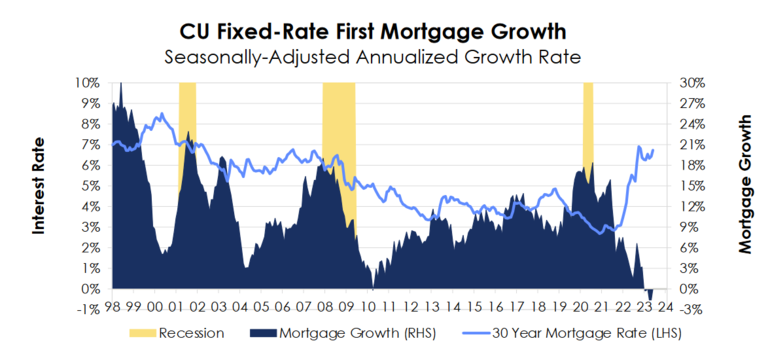
The report further found Credit union fixed-rate first mortgage loan balances rose 0.3% in April, below the 1.8% increase reported in April 2022. Credit union fixed-rate first mortgage loan balances fell 1.6% at a seasonally-adjusted annual rate in April, the first decline in modern history.
Adjustable-rate first mortgage balances fell 1% in April, below the 2% gain reported in April 2022.
Fixed-rate first mortgages now make up 83% of all credit union first mortgage loan balances, down from 86% last April which was the highest in credit union history. This high proportion of fixed rate debt raises concerns for interest rate risk as market interest rates rise.
The contract interest rates on a 30-year fixed-rate conventional home mortgage fell to 6.34% in April, down from 6.54% in March but higher than the 4.98% reported in April 2022. Mortgage interest rates rose over the last year (see figure below) as the Federal Reserve reduced its holdings of Treasury securities ($60 billion per month) and agency debt and agency mortgage-backed securities ($35 billion per month). The 20-basis point decrease in mortgage interest rates in April versus March coincided with a 20-basis point decrease in the 10-year Treasury interest rate, which fell to 3.46% from 3.66% in March.
“The 20-basis point decrease in long-term interest rates was caused by a 17-basis point decrease in real interest rates (due to the Federal Reserve’s injection of liquidity into the banking system after the failure of a few banks) and a 3-basis point decrease in inflation expectations (due to falling actual inflation),” the Report states.
Single family home prices rose 0.4% in April from March, according to the Moody’s Analytics Home Price Index. During the last 12 months home prices rose 0.7%, due to a persistent lack of supply of homes for sale. Restricting supply is the current spread between the average rate on all outstanding mortgages (the effective mortgage rate) and the current mortgage rate.
“This spread is now 300 basis points, which reduced the incentive for current homeowners to list their homes for sale and buy something else,” Rick said.
Savings and Assets
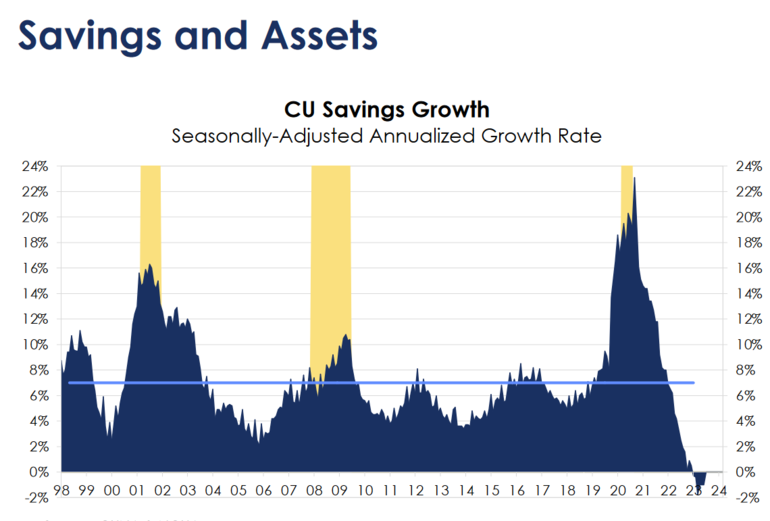
Credit union savings balances fell 0.7% in April, lower than the 0.7% surge reported in April 2022, and worse than the long run average decline of 0.5%.
“April is typically one of the weakest months for savings growth as members use deposits to pay tax liabilities. Savings balances fell at a -1.0% seasonally-adjusted annual rate in April, significantly below the 7% long run average. The total household savings market fell 9% over the last year, from $15.758 trillion to $14.328 trillion today.
“Fortunately, credit unions are getting a bigger piece of a shrinking pie. Credit unions now hold 13.2% of the total household savings market in April, the highest in credit union history and up from 12% one year ago, 9.6% twenty years ago and 4.6% forty years ago. Banks currently hold 70.2% of total household savings, down from 76.1% one year ago. Savings and loan associations and mutual savings banks hold only 1.0%, down from 3.3% one year ago. Household savings is defined as the sum of checkable deposits, savings accounts, small time deposits, money market deposit accounts, money market mutual funds and savings bonds,” the report states.
Savings growth for the first four months of the year came in at 1%, below the 4.1% average pace set during the last 20 years.
“Expect savings balances growth to be nonexistent this year as low-income members withdraw savings to maintain spending in the face of high inflation, middle income members spending on leisure services, and high-income members withdrawing funds in the search for higher yielding investments elsewhere,” the report states.
Capital and Other Key Measures
According to the Report, credit union return-on-asset ratios averaged 0.80% in the first quarter of 2023, seven basis points lower reported in the first quarter of 2022, due to rising net interest margins more than offset by rising provision for loan losses, higher operating expense ratios from slowing assets growth and lower fee income.
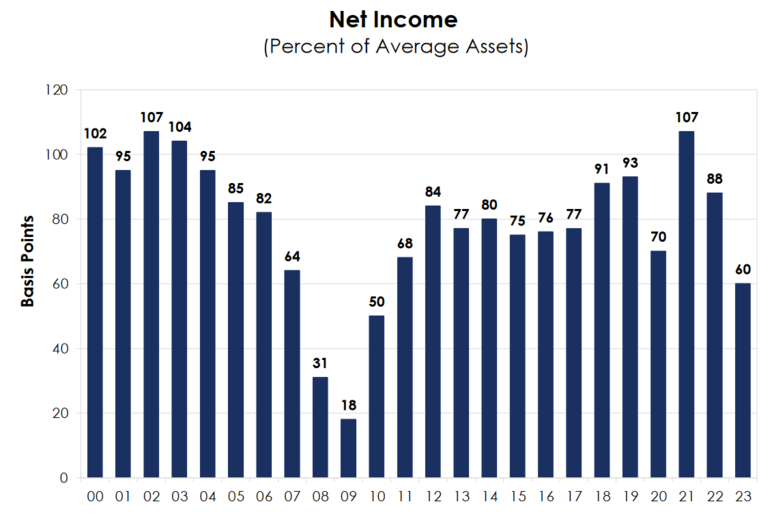
“The big negative line item was a 26-basis point jump in the provision for loan loss ratio, which rose from 0.14% in March 2022 to 0.40% today. On a positive note, net interest margins rose from 2.57% last March to 3.01% today, as yield on asset ratios rose faster than cost of fund ratios. The net interest margin ratio measures the profitability of financial intermediation, i.e., taking in deposits and originating loans,” the Report states. “For the full year we now expect credit union net income as a percent of average assets to fall to 0.60% in 2023 from 0.88% in 2022. Earnings will be lower due to credit unions experiencing higher operating expense ratios from rising wages and inflation, rising provision for loan losses as the economy moves into recession, and rising cost of funds as market interest rates move higher.”
Credit Unions and Members
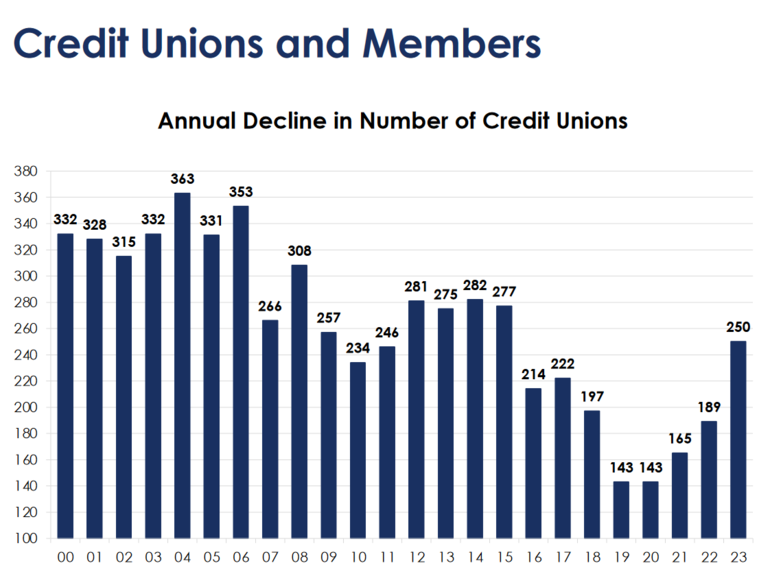
As of April 2023, CUNA estimates 4,889 credit unions were in operation, two fewer than in March. During the first four months of 2023, approximately 74 credit unions ceased to exist because of mergers, purchase and assumptions or liquidation. This rate is above the 51 credit union decline reported during a similar time period in 2022. In 2022 the number of credit unions declined by 189 with 90 occurring during the first half and 99 taking place in the second half of the year.
“Expect the pace of credit union consolidation to accelerate in 2023 and 2024 due to some credit union managers focusing on possible merger opportunities as rising interest rates reduce credit union deposits, equity levels and net interest margins. We expect the number of credit unions to decline by 250 in 2022, the fastest pace since 2015," the report forcasts. "This acceleration in the pace of consolidation is what happened in the wake of the Global Financial Crisis in 2009-2011 when the number of mergers dipped in 2010 and 2011 but surged in the four years following the crisis. With rising interest rates stressing some credit unions to the point of considering a merger, expect a surge in mergers during 2023-2026 as smaller credit unions with limited asset growth, capital growth and digital capabilities with look for merger partners to increase the products and services offered to their members."