

ALEXANDRIA, Va.–Credit unions now have a firm number on just how much more in deposits flowed into credit union accounts during 2020 that flowed out in the form of loans. According to year-end 2020 data from NCUA, member deposits were up $242 billion, while loans increased by $55 billion.
Perhaps more troubling, however, is the NCUA data show lending and membership growth was negative in CUs in all asset categories below $500 million.

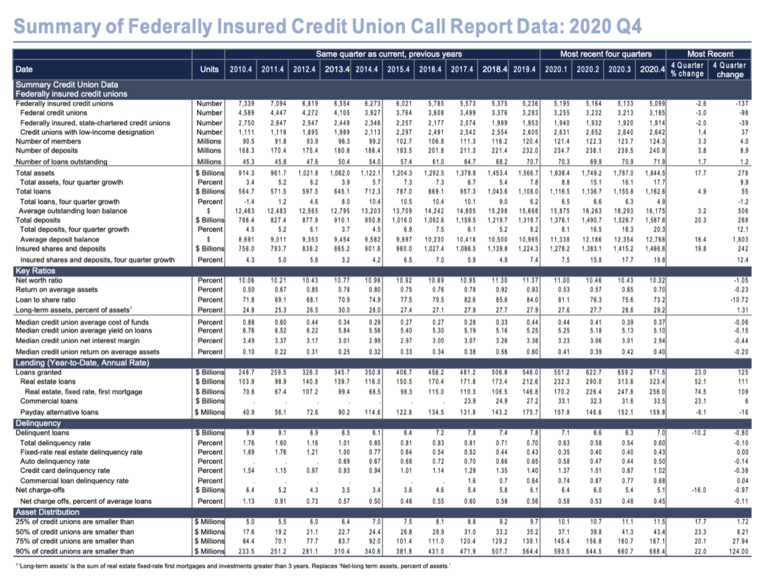
Here’s what else NCUA reported in its Q4 2020 Quarterly Credit Union Data Summary, which is based on call report data as of Dec. 31, 2020 from 5,099 federally insured credit unions representing 124.3 million members.
Overall Numbers
- Totalassets in federally insured credit unions rose by $278 billion, or 17.7%, over the year ending in the fourth quarter of 2020, to $1.84 trillion.
- Totalloans outstanding increased $55 billion, or 4.9%, over the year to $1.16 trillion. The average outstanding loan balance in the fourth quarter of 2020 was $16,175, up $506, or 3.2%, from one year earlier.
- The delinquency rate at federally insured credit unions was 60 basis points in the fourth quarter of 2020, down 10 basis points from one year earlier. The net charge-off ratio was 45 basis points, down from 56 basis points in the fourth quarter of 2019.
- Insured shares and deposits rose $242 billion, or 19.8%, over the year ending in the fourth quarter of 2020, to $1.47 trillion.
- The loan-to-share ratio stood at 73.2% in the fourth quarter of 2020, down from 84.0% in the fourth quarter of 2019.
- The credit union system’s net worth ratio was 10.32% in the fourth quarter of 2020, compared with 11.37% one year earlier.
- Net income totaled $12.0 billion at an annual rate in the fourth quarter of 2020, down $2.1 billion, or 14.9%, from the same period a year ago. The decline was due primarily to a jump in provisioning for loan and lease losses or credit loss expenses.
- The net interest margin for federally insured credit unions was $48.1 billion in the fourth quarter of 2020, or 2.82% of average assets. That compares with $47.8 billion, or 3.16% of average assets, in the fourth quarter of 2019.
- The return on average assets for federally insured credit unions was 70 basis points in the fourth quarter of 2020, down from 93 basis points in the fourth quarter of 2019. The median return on average assets across all federally insured credit unions was 40 basis points, down 20 basis points from the fourth quarter of 2019.
- The number of federally insured credit unions declined to 5,099 in the fourth quarter of 2020, from 5,236 in the fourth quarter of 2019. In the fourth quarter of 2020, there were 3,185 federal credit unions and 1,914 federally insured, state-chartered credit unions. The year-over-year decline is consistent with long-running industry consolidation trends.
- The number of credit unions with a low-income designation rose to 2,642 in the fourth quarter of 2020 from 2,605 one year earlier.
- Federally insured credit unions added 4.0 million members over the year, and credit union membership in these institutions reached 124.3 million in the fourth quarter of 2020.
Balance Sheet Details/Assets
- Cash and equivalents (assets with maturity of three months or less) increased $119.2 billion, or 98.3%, to $240.5 billion.
- Totalinvestments (instruments with maturities in excess of three months) rose $90.7 billion, or 34.5%, to $353.8 billion.
- Investments with maturities less than or equal to one year rose $19.4 billion, or 24.3%, to $99.0 billion.
- Investments with maturities of one to three years rose $21.6 billion, or 23.5%, to $113.6 billion.
- Investments with maturities of three to five years increased $19.4 billion, or 35.5%, to $74.1 billion.
- Investments with maturities of five to 10 years rose $22.7 billion, or 72.7%, to $53.8 billion.
- Investments with maturities greater than 10 years increased $7.6 billion, or 135.1%, to $13.2 billion.
- Totalloans outstanding increased $54.7 billion, or 4.9%, over the year, to $1.16 trillion. Credit union loan balances rose in most major categories, compared with the fourth quarter of 2019.
- Loans secured by 1- to 4-family residential properties increased $30.4 billion, or 6.3%, to $511.1 billion in the fourth quarter of 2020.
- Auto loans increased $5.0 billion, or 1.3%, to $380.0 billion. Used auto loans rose $10.3 billion, or 4.5%, to $237.9 billion, while new auto loans fell $5.4 billion, or 3.7%, to $142.2 billion.
- Credit card balances declined $4.2 billion, or 6.4%, to $61.8 billion.
- Non-federally guaranteed student loans rose $0.5 billion, or 9.0%, to $6.0 billion.
- Commercial loans, excluding unfunded commitments, increased $12.5 billion, or 15.2%, over the year to $94.3 billion in the fourth quarter of 2020. Commercial loans are not directly comparable to member business loans.
Delinquencies
According to NCUA, the delinquency rateat federally insured credit unions was 60 basis points in the fourth quarter of 2020, down 10 basis points compared with the fourth quarter of 2019. Loan performance improved or was little changed in most major categories.
- The delinquency rate on fixed-rate real estate loans was 43 basis points in the fourth quarter, unchanged compared with the fourth quarter of 2019.
- The credit card delinquency rate fell to 102 basis points from 140 basis points one year earlier.
- For auto loans, the delinquency rate declined 14 basis point to 50 basis points in the fourth quarter of 2020.
- The delinquency rate for commercial loans, excluding unfunded commitments, was 68 basis points in the fourth quarter of 2020, compared with 64 basis points in the fourth quarter of 2019.
- The net charge-off ratio for all federally insured credit unions was 45 basis points in the fourth quarter of 2020, compared with 56 basis points in the fourth quarter of 2019.
Liabilities and Net Worth
■ Credit union shares and deposits rose by $267.8 billion, or 20.3%, over the year to $1.59 trillion in the fourth quarter of 2020. Regular shares increased $123.5 billion, or 27.8%, to $568.1 billion. Other deposits increased $60.7 billion, or 9.1%, to $727.9 billion, led by money market accounts, which were up $66.9 billion, or 24.4%.
■ The credit union system’s net worth increased by $12.1 billion, or 6.8%, over the year to $190.3 billion. The aggregate net worth ratio — net worth as a percentage of assets — stood at 10.32% in the fourth quarter of 2020, down from 11.37% one year earlier
■ Net income for federally insured credit unions in the fourth quarter of 2020 totaled $12.0 billion at an annual rate, down $2.1 billion, or 14.9%, from the fourth quarter of 2019. Interest income declined $1.1 billion, or 1.8%, over the year to $60.2 billion. Non-interest income increased $2.4 billion, or 11.3%, to $23.6 billion, mainly due to growth in other operating income.
- Interest expense totaled $12.0 billion annualized in the fourth quarter of 2020, down $1.5 billion, or 11.0%, from one year earlier. Non-interest expenses grew $2.9 billion, or 6.0%, over the year to $51.3 billion in the fourth quarter. Rising labor expenses, which were up $1.9 billion, or 7.8%, accounted for roughly two-thirds of the increase in non-interest expenses.
- The aggregate net interest margin widened by $0.4 billion, or 0.8%, over the year to $48.1 billion at an annual rate in the fourth quarter of 2020.
- The credit union system’s provision for loan and lease losses or credit loss expense rose $2.0 billion, or 30.8%, over the year, to $8.5 billion at an annual rate in the fourth quarter of 2020.
Performance By Asset Category
NCUA noted that consistent with long-running trends, credit unions with assets of at least $1 billion reported the strongest growth in loans, membership, and net worth over the year ending in the fourth quarter of 2020.
- The number of federally insured credit unions with assets of at least $1 billion increased to 370 in the fourth quarter of 2020 from 330 in the fourth quarter of 2019. These 370 credit unions held $1.3 trillion in assets, or 71% of total system assets. Credit unions in this category reported loan growth of 9.2%. Membership rose 9.7%. Net worth increased 11.8%.
- The number of federally insured credit unions with assets of at least $500 million but less than $1 billion rose to 279 in the fourth quarter of 2020 from 247 in the fourth quarter of 2019. These 279 credit unions held $197.0 billion in total assets, or 11% of total system assets. Credit unions in this category reported a 3.5% increase in total loans outstanding over the year. Membership rose 1.8%, and net worth increased 3.6%.
- The number of federally insured credit unions with at least $100 million but less than $500 million in assets increased to 1,063 in the fourth quarter of 2020 from 1,018 in the fourth quarter of 2019. These 1,063 credit unions held $237.5 billion in total assets, or 13% of total system assets. Credit unions in this category reported an 8.6% decline in total loans outstanding. Membership fell 9.5%. Net worth fell 5.9%.
- The number of federally insured credit unions with at least $50 million but less than $100 million in assets rose to 687 in the fourth quarter of 2020 from 677 in the fourth quarter of 2019. These 687 credit unions held $49.4 billion in total assets, or 3% of total system assets. Credit unions in this category reported an 11.1% decrease in total loans. Membership fell 11.3%. Net worth declined 6.3%.
- The number of federally insured credit unions with assets of at least $10 million but less than $50 million declined to 1,541 in the fourth quarter of 2020 from 1,635 in the fourth quarter of 2019. These credit unions held $39.5 billion in assets, or 2% of total system assets. Credit unions in this category reported an 18.2% decrease in loans. Membership declined 15.7%. Net worth fell 12.3%.
- The number of federally insured credit unions with less than $10 million in assets declined to 1,159 in the fourth quarter of 2020 from 1,329 in the fourth quarter of 2019. These credit unions held $4.8 billion in assets, or 0.3% of total system assets. Credit unions in this category reported a 24.5% decline in loans. Membership fell 19.3%. Net worth declined 17.5%.