

PARADISE ISLAND, Bahamas–Credit unions looking to compete in the 21st century were offered lessons from at least the fourth century BCE.
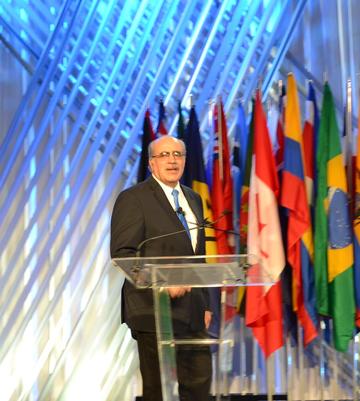
Brian Branch addresses the meeting
World Council of Credit Unions’ CEO Brian Branch shared the writings of Lao Tzu, the ancient Chinese philosopher and writer who is the reputed author of the Tao Te Ching and founder of Taoism, in his opening remarks to the World CU Conference here to frame the challenges to and responses from credit unions.
Lao Tzu 1: Without Leaving Home, One May Be Acquainted With the World
“People want their children to have more prosperous lives than they do,” said Branch. “This is the work credit unions do in 117 countries around the world. We share with each other a common DNA of being member-owned and controlled. What makes us different in our marketplaces is the common DNA we share. Economic empowerment is what generates loyalty.”
Lao Tzu 2: All Difficult Things Have Their Origin in That Which is Easy and Great Things in That Which is Small
“As we find refugees entering new communities we find refugees often turning to their credit unions to provide greater economic stability going forward,” said Branch. He later added a top-of-mind challenge to credit unions around the world today is regulatory burden. “If the cost of regulatory accumulation–$4 trillion–were a country, it would have the fourth largest GDP in the world,” he said
Lao Tzu 3: Respond Intelligently Even to Unintelligent Treatment
In 2014, noted Branch, the World Council heard from many of its member countries that their top challenge was membership growth, and that CUs specifically needed people between 18 and 35 years of age. In response, WOCCU created Challenge 2025 with a goal of adding 50 million new members. Credit unions internationally currently have approximately 260-million members.
“The challenge for 2025 is the digitization of the global credit union system,” said Branch.
Lao Tzu 4: The Key to Growth is the Introduction of Higher Dimensions of Consciousness into Our Awareness.
“We look at what is going to drive that growth, and that’s what we work on,” said Branch. “One hundred years ago, we were the disruptors. We found ways to serve the underserved or just the not served at all, the people banks didn’t want or thought to risky. Today we are in the Information Age and what drives technological disruption is increasing access to the Internet. At end of 2018, 4.2 billion people had access to the Internet. People have gotten used to accessing services and making payments using mobile phones. We call it reducing friction for the consumer; consumers call it making life easier.”
Branch said the advantage of being a cooperative movement is allowing small institutions to share in the high costs of technology.
“Today’s challenge is more about data analytics. What are members doing? What are their demands? How do we use that information as feedback and to drive new product development, innovation and new channels?” asked Branch. “More importantly, it provides us with an opportunity to create more trusted relationships with our members. We use data analytics to find what is in the best interests of our members and to provide them better alternatives. That’s what builds trust.”
Lao Tzu 5: New Beginnings are Often Disguised as Painful Endings
“We have new opportunities as a cooperative system to give members the best options for their economic well-being,” said Branch.
Lao Tzu 6: There is Nothing Softer Than Water, and Yet There is Nothing better.
“We are flexible and we bend around obstacles,” said Branch. “We overcome the greatest disruptions. We wear through some of the greatest obstacles. It’s 2019, and the state of our movement and the future looks great.”