

BELFAST, Ireland–A man who went from doing time in prison for alleged acts of terror in Northern Ireland to renouncing violence and helping lead historic peace talks shared with credit unions the lessons he has learned—and offered thoughts on what might be ahead.
Now the Deputy First Minister of Northern Ireland, Martin McGuiness was at a young age an admitted and proud member of the Irish Republican Army (IRA) during its bitter and deadly fight with the British government and was identified in one government report as being engaged “in paramilitary activity.” By the early 2000s McGuiness was a key player in the peace process that led to the Good Friday Agreement between Northern Ireland and Britain, and he has since served in Parliament.
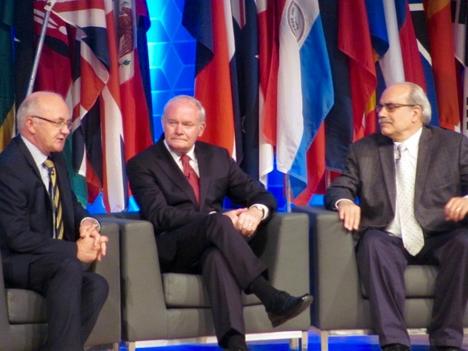
From left, Brian McCrory, Martin McGuiness and Brian Branch.
During the World Council of Credit Unions’ World CU Conference here McGuiness appeared as part of a panel featuring WOCCU Second Vice Chair Brian McCrory (of Ireland) and WOCCU CEO Brian Branch.
Here’s a look at the Q&A.
McCrory: Tell us about some of the challenges you’ve faced, as we face challenges in cooperation among cooperatives.
McGuiness: We had a vicious cycle of conflict for 25 years, and as a young man in the city I became involved in standing against the injustices that existed, but I was always very passionate about peace and bringing about (a resolution between) what many people thought were irreconcilable forces. I was part of Sinn Fein leadership and decided that something had to be done to bring that conflict to an end. In 1984, I was able to get the IRA to call a cease fire. It was the election of the (U.K. Prime Minister Tony) Blair government in 1997 has changed everything, and it’s now accepted as one of the most successful peace processes in the world, and I’m proud of it. It required compromises, and compromise is something in Irish history that was always frowned upon. We’re now in a far, far better place. You would not be here for this event were it not for the success of the peace process.
McCrory: What is the first step in the peace process?
McGuiness: There were so many people on all sides of this, including innocent civilians losing their lives. At that time, I was very interested in reading theses by British army generals that conceded they could not defeat the IRA. At the same time, the IRA didn’t believe it could defeat the British army. That really became part of the peace process. At that time, we began a lot of discussions, including behind-the-scenes discussions. Everything changed after the cease fire was called, and that challenged the British government and showed we were prepared to go into the peace process.
McCrory: Brian, from an international perspective, tell us more about credit unions in these types of conflicts?
Branch: One of the captivating things about the credit union system around the world is that often in societies in conflict credit unions continue to operate at the grassroots level, because people still need access to financial services, which we are seeing in Columbia today. At the community level the work the Irish CUs did during the conflict in Northern Ireland has inspired credit union movements around the world.
Branch: What examples of CUs doing this work have you seen?
McGuiness: In the city of Derry—which you may know as Londonderry, but it’s Derry—it was a very poor city, with social deprivation and terrible housing, and I have no doubt whatsoever what saved the vast number of people in that city from having even worse lives was the formation of the credit union. It probably was the single most important agency, and I include government agencies in that, in assisting people out of poverty. A faith in the credit union and repaying loans has become almost a religion.
McCrory: In many parts of world CUs have become very sophisticated operations. And here in Ireland, while we aspire to that, it’s been slightly slower. What would you like to see in the credit union movement moving forward in Ireland? More than just simple savings and loans?
McGuiness: I would like to see that. I would like to see the ethos of the credit union movement remain the same. It’s an organization ordinary people have tremendous faith in. If we end up in the situation where credit unions are seen as the equivalent of banks, that could be very damaging. I think the best judges of that are yourselves. You are the people who have remained true to the founding principals of credit unions. You are seen as a force for good.
McCrory: Credit unions have endured and still managed to keep a foot in all of our communities. We feel somewhat challenged as to what the future might pose as a result of Brexit. It’s not just a challenge on political level, it’s a challenge around what MIGHT happen. What is your view?
McGuiness: I have a very strong view on the Brexit situation. It won’t just affect credit unions, but the entirety of our lives. I was very much in the ‘Remain’ camp. For Ireland as a whole, clearly our future is Europe. There are issues, but that is not a reason for leaving Europe, but a reason for finding resolution. There is alarm at what might lie down the road for us. I was involved in many meetings with (former British PM) David Cameron prior to referendum, and I said, ‘I think holding this referendum is the biggest mistake you’ll make. You’re essentially sleepwalking us out of Europe.’ And that came to pass. We find in Northern Ireland that we often first get a cold before U.K gets the flu. Obviously there are huge challenges ahead for all of us, and quite a lot of alarm in the community about where this is going to end up.