

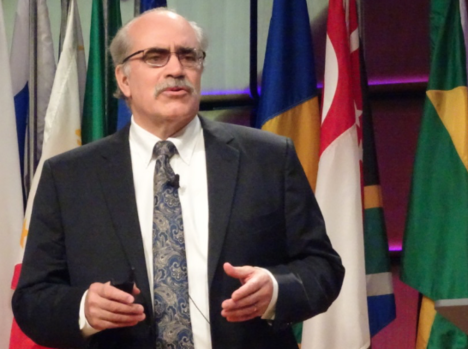
Brian Branch
VIENNA, Austria–They may call themselves credit unions. Or Saccos. Or savings houses. Or caisses populaires, SKOKs, or Sicredi. But they all have two things in common: the same cooperative DNA, and increasingly around the world, the same challenges as well as opportunities to meet them.
In remarks to the World Council’s World Credit Union Conference, it’s president and CEO, Brian Branch, told representatives of the 58 countries on hand for the meeting that credit unions (by any name) around the world are often asked the same question: “Why do you call yourselves a movement?”
“We are part of the financial services industry and sector. But we are values driven and a global network and that’s why we call ourselves a movement,” said Branch. “We articulate those values as member-owned and member controlled. Today, we talk about service to members, which means financial inclusion, financial sustainability and maximizing member economic benefit. Today we talk about economic sustainability to be in a strong financial position to be able to provide the service.”
Here are some of the issues Branch touched on in remarks to the approximately 1,500 attendees on hand in the Austria Center:
Evolution in Terminology
“We used to talk about education to members,” he said. “Today we are more specific and talk about financial literacy and helping members to make better decisions on their financial health. So, our values are about financial relationships. We are dedicated to the financial empowerment of our members.”
A Smaller World
“In 2012, we said we operate locally, but are challenges have globalized,” said Branch. “Our challenges are now dictated by global events and trends, and what was true then is even more true now. Regulations are written now to be applied across borders. And unless you live in the Hermit Kingdom, technology applies everywhere. The challenges that we face are challenges that know no borders.”
Membership Growth
“In 2012, 2013, we heard your top challenge was attracting young adults,” said Branch, noting that remains true. To drive membership growth among young adults, Branch said credit unions need to be better attuned to life events as well as making better use of language that “articulates how what we offer is relevant to their needs.” That includes an increased focus on mobile.
Advocacy
Branch said WOCCU has worked to catch any proposed regulations that would be negative in one country before they become a precedent for other countries.
Disruption
“We talk about how this is a period of disruption and so often I hear that the future is tougher,” said Branch. “And technological change certainly drives that disruption. Digital is the new normal. Online and mobile access is now expected. Fintech drives much of the changes in the financial services model. Really, the disruptors are those that appeal to consumer convenience so that there is an overwhelming take-up of those services.”
Cybersecurity
Credit unions around the globe are being targeted by the same threats, as online there are no borders. He quoted a statement by Thomas Friedman, writing in The New York Times, that “Global flows of commerce, finance, credit, and social networks has meant the weaving together of markets, media central banks, companies, schools, communities and individuals more tightly… Everyone everywhere is now more vulnerable to the actions of anyone anywhere.”
“Credit unions no longer work as standalone institutions,” said Branch. “They are part of an ecosystem. They have alliances and networks and work with third-party service providers. The portals of entry for cyberattacks are now multiple. We can expect more regulatory pressures and standards across borders in terms of cybersecurity regulations.”
Global Membership Growth
WOCCU has set a goal of 260 million credit union members around the world by 2020. At the end of 2016, there were 231 million members, and Branch said WOCCU “would like to see this expand a little faster.”
He also pointed to the acceleration of financial consolidation across all developed movements, including U.S., Canada, Australia, and Ireland.
Cooperation Among Cooperatives 2.0.
“In old days, we talked about cooperation among cooperatives,” said Branch. “These days we talk about networking to share resources and gain greater efficiencies.”
He pointed to Poland and Brazil, where the respective credit union movements have been cooperating on HR, and to the U.K. and the Philippines where the respective movements have focused on joint payment platforms.
“Tomorrow is about blockchain and cloud computing, and we need to think about how we will work with that in the future,” said Branch.
The Future & Disruption
“What has always struck me is our cooperative structure makes a difference,” Branch told the meeting. “To be in this game we have to offer the services consumers are looking for and we have to save them money. We knew this back in 2011-12, but that’s not enough today. We have to provide them with the channels of access they want. What makes us different is the experience these people have with their credit unions. If this is a period of economic disruption, that’s our bread and butter. This is when the value of member-owned financial institutions really shows in communities.
“We are privileged to know that unlike many players in financial markets, we have two advantages,” he continued. “One is we talk with a common voice, or we have voices with a common message. We are here for the economic betterment of our members. And our other advantage is because we’re cooperatives and a global community, the old notion of cooperation among cooperatives becomes today’s survival strategy. If credit unions can solve some of the big strategic and popular problems in our national economies, that puts us in a place to tell our story and to drive change from a position of strength. That’s one of the great opportunities we have ahead of us today.”
WOCCU Ambassador Award
Rudy Hanley, the retired president of SchoolsFirst Credit Union who was long active with the World Council, received the association’s Ambassador Award.
“No major accomplishment that has taken place is the result of one person,” said Hanley. “The person who receives the honor is really there to represent all the people who made it possible. I certainly fall into that category. The team at Schools First, my family, my peers and the World Council, and the people who are in this room and the people you represent, including the hundreds of thousands of credit union workers who are there doing the work.”
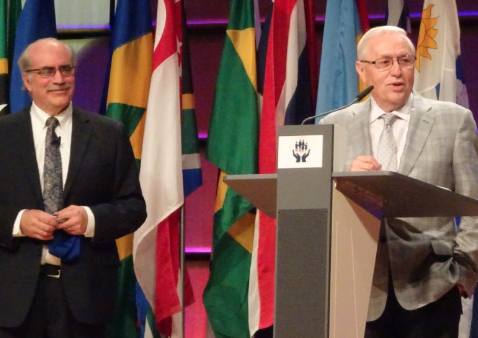
Rudy Hanley accepts award at WOCCU meeting in Vienna.