

VANCOUVER, B.C.–In a country where retail banking is dominated by four big banks, two member-owned institutions have merged with a goal of creating a “real banking alternative for all Australians.”
During the World Council of Credit Unions’ World CU Conference here, Peter Lock, CEO of Heritage and People’s Choice, outlined why his institution recently merged and the ambitious goal it has set for itself. The institution is seeking to “reimagine mutuality.”
The merger took place between Heritage Bank (a customer-owned, mutual bank) and People’s Choice Credit Union. The ultimate objective, said Lock, is to create an institution that retains the mutuality of the two organizations as well as the customer/member focus.
First, some background. As the graphic shows, Australia’s retail banking market is dominated by four major banks.
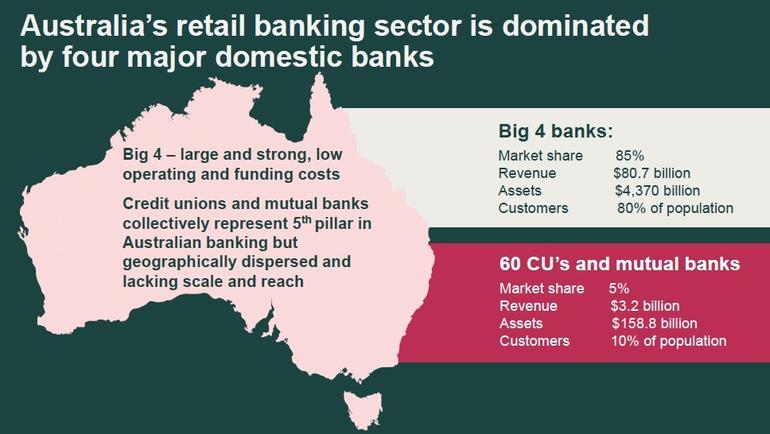
“Credit unions together are the fifth pillar in the Australian market,” said Lock. “But because they are geographically dispersed and some are bonded (to certain fields of membership), they are quite diverse in how they go about their business. The dominance of the big four is quite dramatic and that leads to a lot of what we think of as inequities in the market. Their scale and operating costs are an advantage, and it also gives them an implied (federal) guarantee due to their size.”
One Regulator for All

Peter Lock
Lock explained there is no separate regulator for Australia’s CUs and it’s a “one size fits all model” with very few exceptions. In addition, there is no tax exemption for Australian credit unions (the tax exemption was lost in the 1990s).
“We are up against it,” Lock said. “The biggest of the customer-owned banks is still one-fiftieth the size of the smallest big bank. It really is David vs. Goliath. Credit unions sprung up as they did in rest of the world as the original peer-to-peer lenders. And that is something we are looking to again gravitate to and use as a purpose-driven reason for being.”
The Merger Drivers
As in the U.S., Lock said mergers are being driven by the shift to digital, the soaring costs of regulation and technology, and the lack of scale.
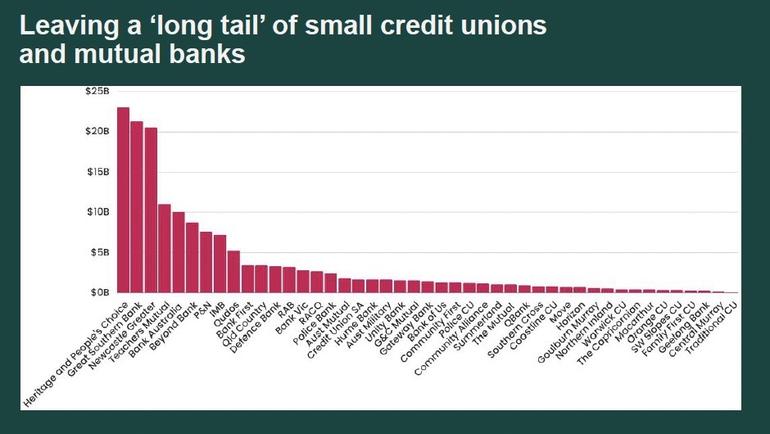
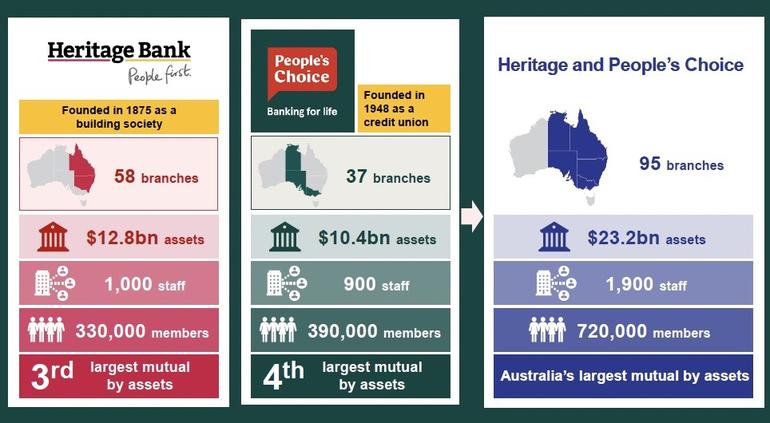
The merged Heritage and People’s Credit Union is now the largest mutual in Australia.
“What we saw in this merger was a unique opportunity to reimagine customer-owned banking in Australia. We saw the merger of the number two and three credit unions in Australia as a merger of equals that would give us a national platform we could springboard off of to be an alternative to the national banks,” Lock told the meeting.
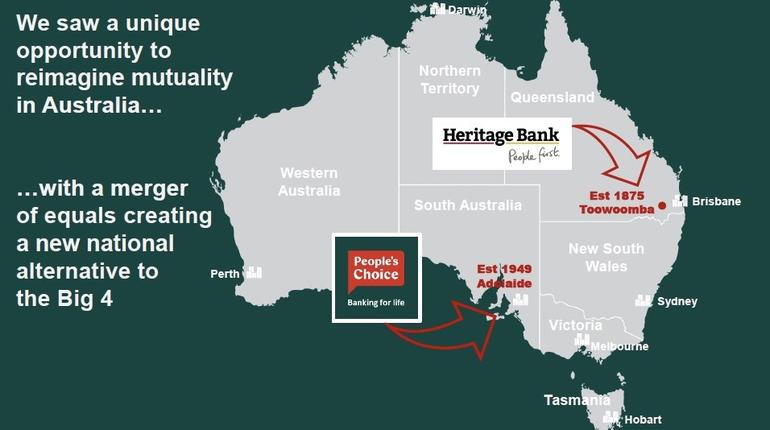
Lock was CEO of Heritage Bank, which is 150 years old and based in Toowoomba, Queensland about 90-minutes west of Brisbane. People’s Choice Credit Union was founded in 1948 some 4,000 kilometers to the south in Adelaide.
Taking It To The Big Guys
Lock said the merger “gives us the ability to start taking the competition to the majors. We did that purposely. We can collectively start to get the mutuality message to the Australian population. No one has been able to do that in Australia.”
Lock noted that the country had a number of “iconic” mutuals up until the 1980s, when many started to “demutualize” from credit unions to become for-profit banks.
“Demutualization didn’t go well for shareholders, customers or communities,” he said. “We haven’t seen a national mutual since. We believe the time is right for value-based banking.”
Why Merger Made Sense
Why did the merger make sense? According to Lock, it provided:
- Equality of size
- Complementary geography
- Shared strategy and vision
- Complementary strengths
- Aligned culture and values
- Aligned technology vision
- Achieved scale
Lock said there was no overlap in branches or markets.
The Most Important Thing
“Most importantly, we had a shared strategy and vision. You needed to believe in the same things for this to work. We both had very, very similar visions. We had a commitment to the credit union philosophy,” he said. “We are almost evangelical about spreading that to more Australians. If you had put the two brands together you would not have seen any difference…We had complementary strengths. Mergers don’t work if you don’t have an aligned culture. It’s been four months since this merger and you can’t see any differences in the culture at all. This was member-driven. We looked at member benefit throughout this merger.”
By coincidence, Lock noted Heritage Bank had just moved to change out its 40-year-old core system to a new core by FIS as well as a solution from Salesforce, which are the same solutions being run by People’s Choice.
Not a ‘Quick Process’
Lock stressed the merger has not been a “quick process.” He said he and the CEO of People’s Choice, Steve Laidlaw, first met at a World Council of Credit Unions meeting in Belfast in 2016. Initial discussions were held in February of 2021, a public announcement of the merger proposal was made in August of 2021, regulatory approval was received in June 2022, the federal government signed off on the deal in August of 2022, and successful member votes were conducted in November of 2022.
Given the pandemic, many of the merger-related discussions had to take place via Zoom.
Policies Rewritten, Reviewed, Resubmitted
He further explained that new policies had to be rewritten and approved by both boards and then submitted to the regulator and then ratified by the new board.
Lock said a new brand will be announced on March 1, 2024 and the “really hard work” of integration work is expected to continue through 2025.
Lock expects there will be pushback when the new brand—which he said he does not yet know what it will be—is unveiled.
“It’s a big change and we know that our members who love both brands are going to find that new brand fairly difficult,” said Lock. “But the new brand is an opportunity to excite the Australian people that there is a new icon that acts as a counterbalance to the big four. We want our new brand to be the dominant bank in the credit union space.”
A Decision to Hold Off
He added it was careful not to announce a new brand ahead of time.
“We told people a new brand is coming, but we didn’t put a new brand up because members would have voted on the brand and it would have been much more difficult to get the vote,” Lock explained.
Lock said most mergers fail because of a lack of agreement at the front-end of the process. In the case of the Heritage Bank/People’s Choice CU merger, it began with an agreement to a list of non-negotiables, as seen below.
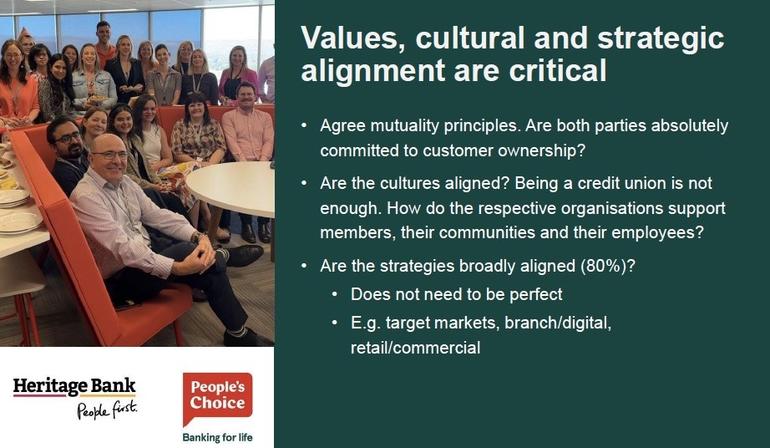
“You’ve got to make the hardest decisions first. All those have to be agreed to or otherwise mergers are likely to fail,” Lock stressed.
The Board & Other Issues
Each CU had six board members that are now part of a 12-person combined board, and a mechanism is in place to get that number down to eight. In addition, the merged institution will operate with dual headquarters as a demonstration to members of commitment to the respective communities, he said. No staff positions will be eliminated and no one will be required to move, something he said must be constantly communicated.
Three Areas of Focus
During the merger process, Lock said there were three areas of focus. The institutions:
- Tackled issue of self-interest up front where mergers often fail
- Worked hand-in-glove with regulators
- Made communication the key
The size increase to a “significant financial institution” meant a higher level of regulatory review, which Lock jokingly referred to as “fantastic.”
Proof Points
According to Lock, the combined organization is closely managing risk and expects to spend hundreds of millions of dollars on related costs.
“We really believe we are creating a real banking alternative for all Australians, something that gives members a choice,” Lock said.