

PARADISE ISLAND, Bahamas—A tiny $7-million CU on the brink of conservatorship in 2010 has grown to $37 million in assets today with 2.67% annual ROA and 27% annual loan growth.
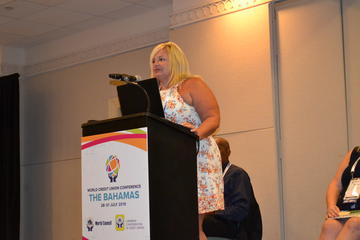
Terri Robinson discusses how her CU made big turnaround
Terri Robinson, CEO of Ironworkers USA FCU, said the credit union was able to not only pull itself out of its nosedive—caused by the Great Recession and many members losing their jobs—but also become a strong credit union that recently was approved by NCUA for a nationwide charter.
Robinson said the only way the credit union was able to transform itself was through collaborating with several other small, local credit unions.
“We had to look at collaboration, I knew that when I took over in 2010,” Robinson told WOCCU’s World Credit Union Conference here. “It was a dire situation. NCUA had made us a CAMEL 4, had us under a net worth restoration plan as well as a Letter of Understanding and Agreement. The world had come crashing down around us. Our members were losing their jobs—35% were without work in 2010. They stopped paying their loans. We had to write off $240,000 in bad loans, which was a ton for a credit union of our small size then.”
Can’t Cut, Cut, Cut
Robinson recalled NCUA was directing the credit union to “cut, cut, cut,” including looking for ways to reduce staff and branches.
“But cutting much further was very difficult,” Robinson explained. “Through attrition we had already cut down to five people running three branches. We knew, too, that we needed to survive, and that just cutting was not going to help us grow. So, our board and I made the decision to survive.”
That decision involved finding resources beyond its own.
“I said we have to collaborate with other credit unions in the area that are doing well. And they had to be local, as I could not afford to travel,” she said.
Partnerships Formed
Robinson said a group of several small CU leaders agreed to partner to help each other. She emphasized that the meetings—which took place at lunch, over drinks, anytime and anywhere the group needed to meet—were “safe places.”
“These meeting were very open. We shared our weaknesses and strengths, problems and successes, and we did so knowing that no one was trying to take advantage of another credit union, looking to bring about a merger,” she said.
Adding Shared Branching
One of the first steps taken by Ironworkers USA FCU was to move to shared branching. “That gave us greater reach and our members more convenience,” she said.
The group of fellow CUs also shared an internal auditor.
“That was a big relief to us, because compliance is such a big concern,” Robinson said. “That got a big regulatory burden off our back, because otherwise we could not have afforded to pay for an auditor just for our credit union.”
Marketing Materials Shared
Ironworkers USA FCU then partnered with a small, local marketing firm that produced a great deal of materials that could be shared by all the credit unions with minimal repurposing, Robinson explained.
“We did not have to recreate the wheel, just change the massage slightly. We even could share a great deal of the artwork,” she said.
According to Robinson, net income got a big boost when the credit union partnered with another small shop to use their mortgage origination expert.
“That really helped us a great deal, and it generated instant income for us,” Robinson said.
But Ironworkers USA FCU also knew it needed capital to truly turn things around.
“So we got a secondary capital loan from a local credit union,” Robinson said. “That additional $250,000 on our books, which was a non-insured investment by the lender, gave us the capital that allowed us to invest in the credit union and grow. It also got us immediately out of the net worth restoration plan.”
Collaboration Continues
The group of credit unions continues to collaborate on staff and board training, hiring one consultant to do the work for all.
Robinson said Ironworkers USA FCU’s Call Report numbers clearly reflect what collaboration can do for small credit unions. The CU made $501,066 in 2015, $496,349 in 2016, $504,252 in 2017, and $613,078 last year. The CU grew assets by nearly $3 million in 2017, almost $6 million in 2018, and through Q1 2019 had increased assets by more than $4 million.
“And all that is from what once was a little itty bitty credit union,” she said.