

GLASGOW, Scotland–Credit unions here were given first-hand accounts of the extreme challenges to, the reality for, and the even the defiance exhibited by credit unions in Ukraine six months after Russia’s invasion.
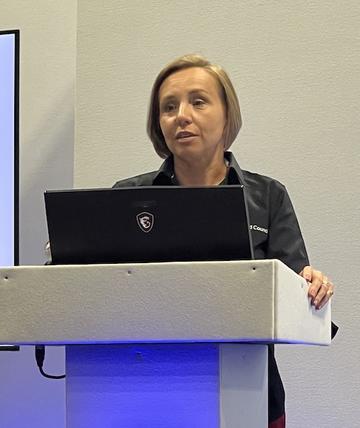
Ewa Sierzylnska
The country’s credit unions face issues unlike those that have ever faced a modern credit union community, with one person who has been working in the country noting that before many Ukrainian credit unions can reopen their doors, they will need to get actual doors first.
In an update on events in that country where a fledgling credit union movement has been upended by the invasion, three people—including one person who is a native of Ukraine and another who has been working in the country—shared what life is like and what credit unions are doing—or trying to do—in Ukraine.
Ewa Sierzylnska, chief of party with WOCCU’s Credit for Agricultural Producers Project (CAP), said she had been living and working in the country’s capital, Kyiv, since 2016.
“I am now working in a war environment,” she said. “The message to take away is not just what we see in the news. Life goes on, the war goes on, and credit unions continue to serve their communities and the people.”
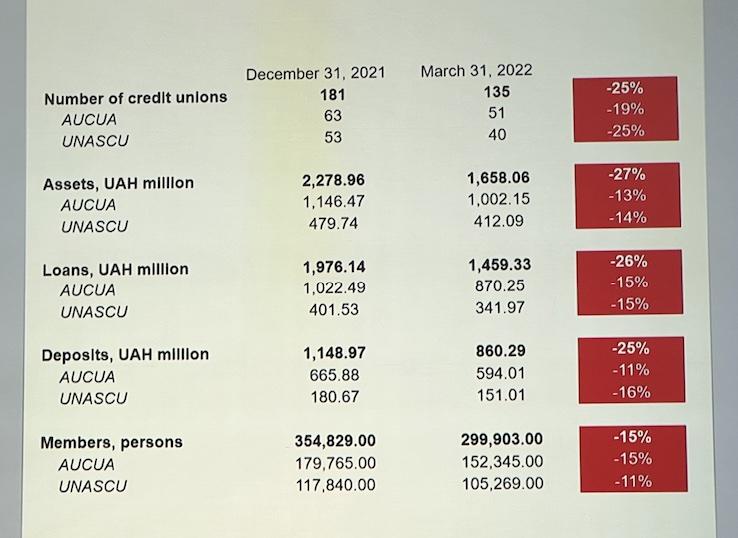
Sierzylnska shared the chart below to illustrate how the invasion has changed the credit union landscape in Ukraine.
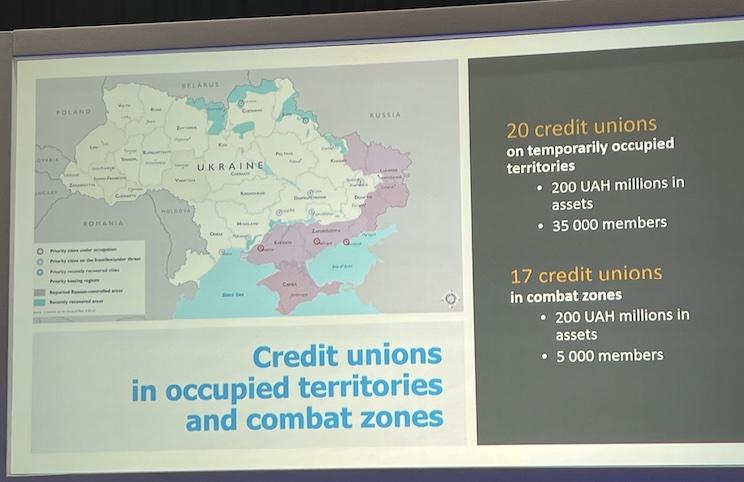
According to Sierzylnska, there are 20 credit unions in what Ukraine’s credit unions defiantly refer to as “temporarily occupied territories,” while there are 17 credit unions in active combat zones.
The Challenges
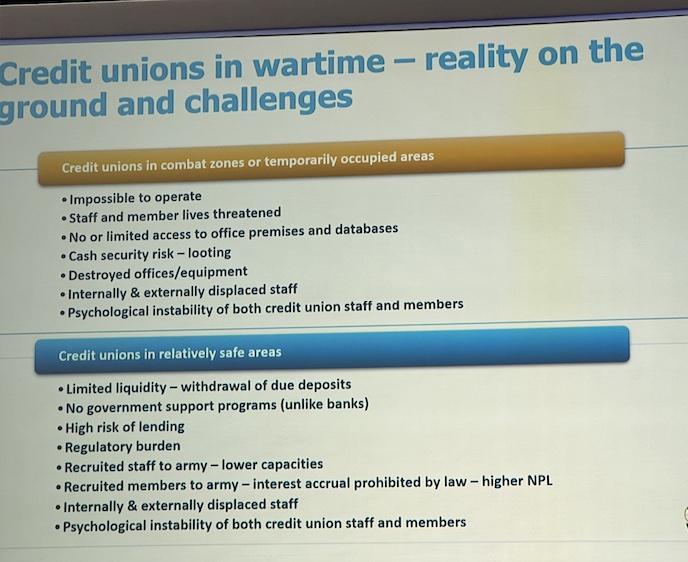
Not surprisingly, Sierzylnska said there is no shortage of challenges operating in combat zones and temporarily occupied territories, including that it is “impossible to operate,” the lives of staff and members are threatened, and there is no or limited access.
Moreover, Ukrainian credit unions in the Russian-occupied areas are being forced to use that country’s currency, the ruble.
‘Very Different Realities
“Although they are operating in one country (credit unions) have very different realities,” said Sierzylnska. “When we talk about post-war recovery, we think about systems. But before the restoring of data on clients, credit unions need windows and chairs. Everything has been stolen in some areas. Hard disks have been stolen. When we talk about recovery, it is many things. To open the doors, they need a door.”
Sierzylnska said four goals established by the World Council’s project in Ukraine in 2016 remain and are “valid” even in the “very different reality.”
She added that Ukraine’s credit unions have also been working to back up data on physical servers outside the country.
Working Day & Night
The CAP project, she said, involves 15 people who continue “working day and night to help credit unions and their members.”
“For the first two weeks of the war we were stuck underground. We were making sure families were safe,” Sierzylnska said. “Now, we are trying to restore our operations. We are still going on with our goals. It looks different. We are all displaced. But those four goals continue. We are working with the regulator on providing relief and helping credit unions.”
Much of that work has been in the form of agricultural loans and assistance to farmers.
“We have to recognize the farmers who are taking risks and getting a loan and farming, and the credit unions that are lending and supporting their members,” she said.
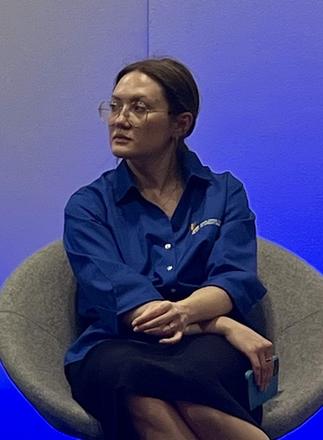
Alisa Stetsyshyn
A First-Person Account
Alisa Stetsyshyn, a communications and support consultant with the CAP Project, is a native of Ukraine’s east, which has been hardest hit by the Russian invasion, and devastation has been widespread. Although her hometown has been heavily shelled, she said her home is still standing, although, “I don’t know if it will be there later.”
But, she said, her family is safe.
The Other Family
“I have been in the credit union sector for five years and it is another family you have,” she said. “ So, I also have another part of my family all over Ukraine. I keep checking with them, as well. Credit unions all over Ukraine continue to do things to help people, even in the occupied areas. They try to whatever they can.”
That assistance has included organizing fundraising and using interest earned on deposits in support of the military and its needs.
In addition, one credit union has established a call center through which staff are providing consultancy support to internally displaced people, while CUs are also serving as collection points for humanitarian aid.
A Visit to Kyiv
“Despite the war, I was in Ukraine after the war started and I am planning to go to Kyiv again,” Stetsyshyn said. “Once you are there you see the reality of what is happening, but on other hand you see people willing to fight, to live on. I have talked to farmers who have applied for loans and asked, ‘Do you dare take the risks?’ And they say the risk is not just for security of Ukraine, but for security of the world.
“People will fight and we need your support,” continued Stetsyshyn. “I hope all the civilized world will stand with Ukraine and for Ukraine. We do really appreciate your help.”
Nearly $2 Million Raised
The third person addressing the audience was Mike Reuter, executive director of The Worldwide Foundation, WOCCU’s charitable arm. Reuter offered an update on the Ukrainian Credit Union Displacement Fund, which has been raising and distributing money to credit unions affected by the war.
According to Reuter, some $1.7-million has been raised to date from approximately 1,500 donors.
To date, he said, $650,000 has been earmarked and some of it deployed. Loans of approximately $1,700 each have been made to farmers, while coupons are being provided so farmers can make purchases from the 75,000 gallons of fuel the fund has allocated for.
For more information, go here.