

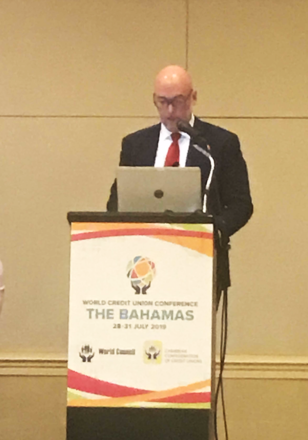
PARADISE ISLAND, Bahamas–Three very different perspectives and scenarios related to the regulation were shared here by people from three different parts of the world. The remarks and insights were shared during WOCCU’s World Credit Union Conference here during a session titled “Next Generation Regulation.”

Dennis Felix
Below is a look at what credit unions were told:
A Long Way From Days Regulator Was Part of Ministry of Sport
Think NCUA sometimes doesn’t understand your credit union? Credit unions in Grenada may be one up on you, as regulation of credit union on the island used to fall under the Ministry of Sport. Much is changing, according to one person who spoke to the World CU Conference here.
During a panel discussion on Next Generation Regulation, Dennis Felix, executive director of Grenada Administration for the Regulation of Financial Institutions, said significant advances have been made across the Caribbean to strengthen regulation. But it wasn’t that long ago that wasn’t the case, he said.
“All general legislation was outdated from the 1950s. Some used the motto used to be, ‘Follow along and you can’t go wrong.’”
Felix said regulators and credit unions—many using the World Council’s PEARLS system––have both improved their games, both in Grenada and across the Caribbean. While CUs in the Caribbean have been slow to respond to any of the Basel standards, he said that is also changing. Regulators have also put into place guidelines for the application of proportionality, including whether the institution has cross-border operations, the complexity of its assets and liabilities, and the asset size of the institution.
Other Measures
Felix said measures under consideration include monitoring of credit unions’ performance by international agencies, such as IMF, and the development of a risk-based supervisory framework for credit unions. He said the establishment of new prudential regulators, establishment of financial crisis resolution plans (with assistance from World Bank) are also spreading across the Caribbean.
In the U.K., Most CUs Never See An Examiner
There are 440 credit unions representing a total of $5 billion in assets in the United Kingdom and Northern Ireland supervised by the Bank of England—which regulates CUs–and just nine people at the BoE responsible for oversight. The result is the majority of credit unions–approximately 360–never see a regulator or examiner in their offices, said Chris Donald, senior manager of Credit Unions with Bank of England.
Many of the 440 are very small and it “can be difficult” to supervise those institutions. “We do see six to eight small credit unions fail each year,” said Donald.

Chris Donald
Donald said the regulator does not supervise credit unions below approximately $20 million in assets.
“If there are problems, we react. I believe we are proportionate and flexible, and able to do that because we do tolerate failure with some of our smaller credit unions perhaps in ways other regulators do not,” said Donald.
Donald said the Bank of England has two statutory objectives: safety and soundness and facilitating competition.
What CUs Contribute
“Credit unions offer diversity to any financial system. Many in U.K. serve members of society who might not have access to banking,” he told the World CU Conference audience. “We want safety and soundness as regulators, and I assume that’s what credit unions want, as well. It means being financially sustainable and being run by qualified management teams and boards. I think financial soundness can coexist with the ethos of credit unions. The volunteer ethos does not conflict with having a professional mindset. What we need to do as regulators is make sure we have a framework that does not stifle innovation or get in the way of growth.”
In the U.K., he said the risks to the credit union sector are similar to those in other countries and include:
- Credit risk
- Vulnerability of small CUs to an idiosyncratic event
- Profitability in the current external environment
- Governance standards
- Relevance (technology being one part of that)
“There is a low level of participation among young people in the U.K. in credit unions. Without attracting young people, there could be hard times ahead,” he said.
In the U.S., Lack of Proportionality
While credit unions and banks share the same regulator in many countries, Ryan Donovan, chief advocacy officer with CUNA, explained how the U.S. system works, with credit unions paying fees to cover the operation of the National Credit Union Administration. Donovan related how some in the U.S. have expressed fears NCUA will be merged into the banking regulator, the FDIC, but said he believes “as long as credit unions continue to pay for their regulator, they will have a separate regulatory scheme.”
Ryan Donovan
As the subject of the breakout session was proportionality of regulation, Donovan offered an update saying rules applied to credit unions have been anything but proportional. He noted U.S. banks control $18 trillion in assets, which is 13 times larger than U.S. credit unions.
“Each of the four largest banks in the U.S. is larger than the entire U.S. credit union system,” he said. “And if you take the top 10 banks, the 10 largest credit unions combined represent 3% of their assets, and are roughly the same in assets as the 10th-largest bank in the United States. And yet the NCUA imposes some of the same regulatory requirements on these institutions, including a relatively new stress-testing requirement.”
Other Points Made
Other points made by Donovan:
- When it comes to risk profile, over the past 30 years the bank fund has been insolvent twice, while the National Credit Union Share Insurance Fund has remained consistently well-funded over that time.
- Donovan said over past 10 years there have been two and a half times the number of bank failures as CU failures, costing the bank fund 50x what failures has cost the CU fund.
- Over last decade U.S. banks paid $260 billion in fines, vs. $26 million for one CU settlement.
- Donovan said the estimate is it costs credit unions about $6.1 billion to comply with regulations every year. “Increased costs is the chief driver of credit union and bank consolidation. In years when the CFPB was most active, from 2012-2017, we saw the highest rate of credit union consolidation in 20 years. Some would say correlation is not causation, but the evidence is unmistakable–nearly all the credit unions that have merged are under $250 million in assets.”
- “The Basel standards are the gold standards of banking regulation, yet so often I think they’ve missed the complete message the Basel Committee has delivered from the beginning, that regulation needs to be commensurate with the risk profile of the institution,” he said.