

GLASGOW, Scotland–Empathy isn’t about being nice. But it is about good business, according to one expert.
In remarks to the World Credit Union Conference here, Belinda Parmer, CEO of the Empathy Business, which consults with companies that are bringing greater empathy to their organizations, addressed a number of issues, including “We are like company doctors. We hold the mirror up to organizations,” she said.

Belinda Parmer addresses the meeting.
Empathy is frequently discussed, and Parmer said she defines the term as the “emotional impact a company has on its employees and its clients.”
Three Types of Empathy
She said there are three types of empathy:
- Cognitive Empathy, which is understanding someone’s perspective. “This is where psychopaths are brilliant,” she said.
- Affective Empathy. “When I feel your pain.”
- Behavioral Empathy. “This is when empathy spurs you to act.”
‘Emotionally Exhausted’
Empathy is particularly important after two-plus years of pandemic conditions, she said.
“People are emotionally exhausted. People even use the word ‘battered’,” Parmer told the meeting. “There is burnout. There is emotional exhaustion and there is cynicism. And they are very, very different.
“And now we have this new generation, Gen Z, coming into the workforce, and the number-one thing Gen Z wants is they want to feel recognized, valued, and that they have a voice,” she continued.
According to Parmer, organizations that have prospered during the pandemic have had CEOs who focused on empathy and have driven it across the organization.
“All of us have had to find a new way of leading,” Parmer observed.
The Myths
According to Parmer, there are many myths when it comes to empathy, including:
Myth #1: Empathy is Sympathy
“This is the biggest myth I see. Sympathy is pity. It’s about feeling sorry for someone. Empathy is about me supporting you and supporting you. Sympathy is feeling about, empathy is feeling with.”
What empathy is not about, she said, is “fixing” people or problems. “The act is in the connection and in the listening.”
Myth #2: Empathy is a Commercial Trade Off
“More empathic companies make more money in terms of growth, earning and productivity,” said Parmer. “Empathic leadership also improves engagement, reduces burnout and increases diversity.”
Myth #3: You Can’t Measure Empathy
“You can measure empathy,” she said. “There is a lot of collaborative software that can show, for instance, the amount of time people speak in meetings, who is interrupted the most, the percentage of time senior people vs. junior people speak. You don’t want to be creating cultures of deference.”
Myth #4: Being Smart is Enough
“Technical expertise will only get you so far. Research has found people with an IQ of 100 are managing people of IQ of 160. It’s emotional intelligence that gets you to the top. The bad news is in terms of IQ none of us in this room is getting any smarter. But our (emotional quotient—EQ) is malleable, and that’s the thing you’ve got to work on.”
Myth #5: Change Starts with Big Gestures
“Yes, in aggregate they have to be big, but change starts with small gestures,” said Parmer.
Among those small but critical gestures is language, according to Parmer.
“Using social norms can really drive changes in behavior. Every time I work with a company or big corporation, they have their own BS Bingo. Corporate language shapes our thinking and behavior.”
She said words and phrases that have no meaning include “people are resources,” “optimize” and “mobilize.”
“Changing the language will change the impact you are having on your people,” Parmer said.
As one example she cited a company that changed from the unempathetic term “head office” to the more empathetic “support hub.”
How to Drive Change
Driving any kind of change isn’t easy, Parmer acknowledged.
“Change will only come through difficult conversations,” she said. “The thing is it doesn’t matter what culture you come from or how senior you are, none of us are very good at this. Often, what happens with conflict is we have a physiological response, our body draws us away from conflict. I want you to start facilitating difficult conversations. People need these conversations now. They need to tell you how they feel.
“One of the things about conflict we always get confused between task conflict and relational conflict. The latter is the much more difficult of the two,” she continued. “If you can start conversations with what you agree on, then move to what you disagree on, you can fundamentally change how you deal with conflict.’
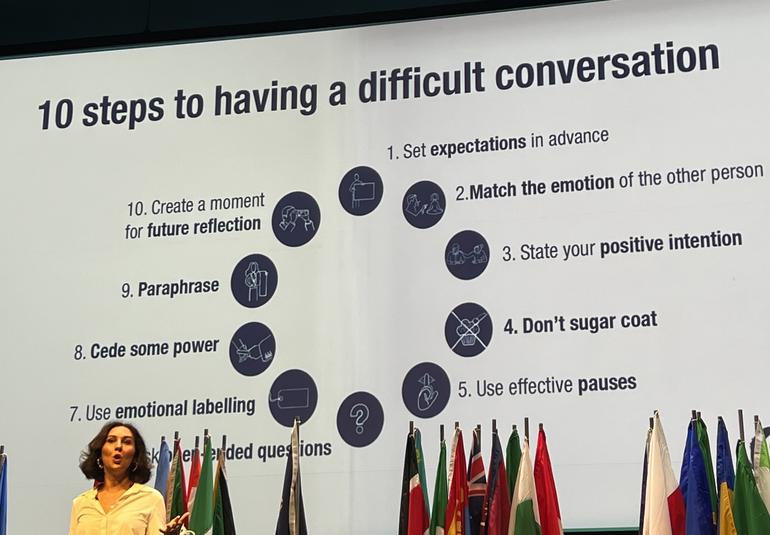
Parmer said practicing empathy does not mean agreeing with the other person. It means acknowledging they have been hard and that you are giving their position some visibility.
Things to Focus On
Moving forward, Parmer said things credit union leaders should focus on when it comes to empathy include:
- Depth not Breadth. “Take a few tangible areas and relook at them through lens of empathy.”
- People Above Process. “The process is a means to an end. You are there to be a force for good for your colleagues and customers.”
- Start with You. “Change something today.”
The Very Best in CU Reporting. For You. For Free. Or Your Money Back
Don’t forget to check your Spam/Junk email folder if you haven’t been receiving your free, popular and daily CUToday.info news headlines.
And if you haven’t yet signed up for the new email solution on which CUToday.info has partnered with ResponseGenius, you can do so here. Signing up requires less than one minute of your time.
CUToday.info has received very positive response from readers following the move to an improved provider of the daily headlines, but many also noted they did need to go to their Spam/Junk folder and mark it as safe.
The new email solution has not only improved every reader’s delivery experience, but it also features a fresh, new format that is easy to read, especially on mobile devices.
Please note and/or make your IT department or email administrator aware the emails will be coming from the domains CUTodayinfo.com and CUTodayinfoReply.com.