

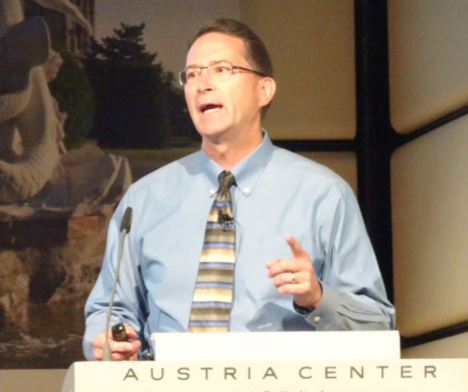
Dan Strandy
VIENNA, Austria–A credit union board member who also runs a company that offers succession planning consulting offered direction to credit unions here on how they can plan for hiring their next CEO.
Dan Strandy, a board member with Seattle-based Verity Credit Union and CEO of Essential Elements Consulting, told WOCCU’s World Credit Union Conference here that the best definition he has heard for succession planning is this: Succession planning is a process for identifying and developing potential successors for key positions in an organization, through a systematic evaluation process and training.
“I like this definition the most because it focuses on a systematic evaluation process and training, but also mentions key positions,” said Strandy.
A Key Duty
Strandy told his audience that succession planning is a key fiduciary responsibility of board members, and by a show of hands many in the large room indicated they are expecting a CEO change in the next three years. He said research shows the average age of a CEO today is 56.
The first thing to do, said Strandy, is to avoid common mistakes in the succession planning process. Using Dr. Thomas Saporito, chairman and CEO of RHR International, as his source, Strandy said common mistakes in CEO succession planning include:
- Starting the process too late. Board needs to take ownership early (as far as two years out)
- Not getting future leadership requirements known upfront
- Inadequate evaluation and vetting of CEO candidates.
- Mishandling the transition to the new CEO
Succession planning, said Strandy, requires dialogue amongst the board, the board and CEO, and the CEO and the executive management team. It’s an important part of board governance, according to Strandy.
He said annual the review of CEO succession should include:
- Likelihood of CEO transition in the short term
- The plan for succession (make sure to have one!)
- Developing scenario strategies
Inside the Numbers
The most common types of succession include planned (such as retirement or scheduled relocation), and unplanned (such as health-related or recruited out).
CEO successions have increased 53% in the last six years, according to Strandy. Forty-one percent of successions are planned, while the remaining 59% are not. Twenty-percent of CEOs who leave are recruited out, with Strandy telling board members if they have a really good CEO they need to ensure he or she is well compensated.
“Unplanned successions are the underlying reason for ongoing review and update by the board,” said Strandy.
Responsibility for Leading the Succession Planning Process
The responsibility for succession planning lies with the board, stressed Strandy, adding boards may create a committee to oversee the process. They should also use the CEO as a resource, he said.
The first action in developing a succession strategy, according to Strandy, is to assess likely changes over the next three to five years, including changes in the economy, changes in financial services, and technological changes. Another change he urged boards to watch is changing CEO compensation strategies, especially as it relates to benefits.
He said credit union boards need to establish a list of desirable CEO attributes in order to create a candidate profile. That profile can also be used for internal candidate development, he added. In fact, Strandy recommended the CEO have an internal candidate development plan in place with annual progress reports, and that he or she be incentivized for having that plan.
Key CEO Attributes to Consider in a New CEO
According to Strandy, credit unions should look for CEO candidates who have:
- High intelligence to understand challenges and opportunities facing the credit union over next three-to-five years
- Energy and passion
- Strong communication skills
- Ability to develop and lead a competent executive management team. “This is where leadership sharing comes into play. You want a CEO who is comfortable delegating to EMT members. It’s important that CEOs do that”
- A visionary with an upbeat, optimistic attitude
- Credibility and sound judgement. “It’s important not to get caught up in analysis paralysis”
- Commitment for the long haul. “CEO tenure in a credit union in the U.S. tends to be much longer than other industries”
- Community focus. “One of the things I’ve found is that more and more credit unions have a community focus and a community charter”
- Hard and soft skills. The latter needs to be discerned through a face-to-face interaction
- Be a good person. “People want to work with and for someone who is a good person,” said Strandy
CEO Candidate Pools
Obviously, noted Strandy, there are two sources for new CEOs:
- Internal candidates (identify them and ensure they are being groomed)
- External candidates
“I submit to you it’s best to keep both sources open. By doing so it can validate the legitimacy of an internal selection and/or enable a change process to occur.”
Sixty-percent of credit union CEOs are selected from an external source, according to Strandy.
Planning, said Strandy, is the key to timing of succession.
- Determine most likely timing of CEO transition
- Determine which candidate pool to conduct search
- Establish CEO attributes/profile
- Determine how long the recruitment process will take. (“Two years is not unreasonable,” said Strandy)
- Consider use of an outside consultant to conduct search. “This screens candidates to a ‘success pool’,” said Strandy. He said credit unions should also secure an employment guarantee, say two to three years, from the recruiter
- Boards should track high-performing credit unions within their peer group as a source of candidates
- Support investing in the grooming of EMT for CEO
Culture vs. Change
Internal candidates can be better equipped to maintain continuity and the credit union’s corporate and community culture. But external candidates can be better equipped to bring about change, new ideas, and diversification of thought. The board needs to determine which is the primary driver for new CEO selection.
Once a new CEO is in place, a good CEO transition plan spans a year and contains several phases, according to Strandy.
- Intensive knowledge sharing
- Communicating with stakeholders
- Drafting a written transition plan
- Sharing the transition plan