

PARADISE ISLAND, Bahamas–Four people representing credit unions on four continents shared their perspectives on how credit unions can step up to support sustainability.
Three of the four people sharing their stories with the World Council of CUs’ World CU Conference here spoke specifically to credit unions’ roles following disasters.
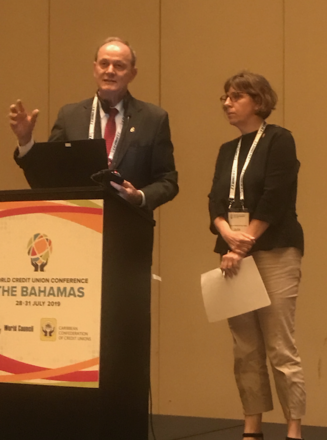
Manfred Dasenbrock and interpreter at WOCCU meeting.
Here’s a look at what each person had to say:
Special Emphasis on 2 Groups
Manafred Dasenbrock, chairman of the board, of Brazil’s SECREDIT movement, said the SICREDI credit unions have placed a special emphasis on reaching out to women and young professionals in Brazil as key elements to credit unions’ sustainability in his country.
Dasenbrock said supporting financial literacy has been critical to building loyalty in members, especially among its youngest members and community members. The good work done has led to support from other industries, he said.
“We also have an international cooperation day, and on this day we specifically attracted young professionals and women to come in and talk about these things,” said Dasenbrock.
Credit unions in Brazil have also worked to drive greater attendance and involvement in annual general meetings. In one case, he said a credit union in a city of 15,000 people drew nearly every member to its AGM.
“Here, again, when the delegates bring forward the votes of the communities you can see the presence of everyone there—young people, families—so everyone can see how important this is,” said Dasenbrock.
Not Operating in Isolation
Credit unions are part of a larger movement of cooperatives that have a heritage in common, according to Leni San Roque, CEO of the Asian Confederation of Credit Unions.
“We are a movement of people helping people and a movement committed to promote social justice and to help the poor and disadvantaged,” she said. “We are a vital part of the whole and not just isolated units with no relationship or bearing to the world.”
Credit unions and their management and volunteers need to reach beyond just financial services, San Roque said. “We cannot just fold our arms and look at what is happening with our members who are victims of disasters.”
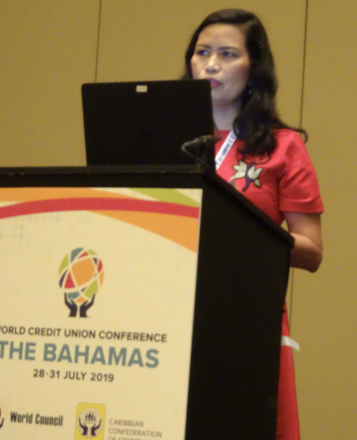
Leni San Roque at WCUC.
As examples of disasters that have struck the region represented by the Asian Confederation, San Roque pointed to the 2005 tsunami that struck Indonesia, Thailand, Sri Lank and India, as well as a 2013 typhoon in the Philippines and a 2015 earthquake in Nepal. She said credit unions have stepped forward after each calamity to provide assistance.
The Asian CU Rehabilitation Fund built 20 houses for members in India, and rebuilt 10 credit unions in Indonesia, for example, and provided a revolving fund to support members. “The purpose of the fund is to help rehabilitate credit unions and to help people to rise up again,” she said.
The Asian Confederation has partnered with WOCCU and The Irish CU League to help rebuild 173 credit union s in Nepal following the earthquake.
“Helping others in need is not only a responsibility of life, it is what gives meaning to life,” said San Roque.
‘You Are Privileged’
Much like San Roque, George Ombado, CEO of the African Confederation of Cooperative Savings and Credit Associations, which represents credit unions in 28 countries, challenged CU leaders to think beyond just their role in finance when it comes to their communities, and further called on attendees to realize just how “privileged” they are.
“When we talk about sustainable development, it means we must try to balance the needs of the economy and society with our living environment,” said Ombado. “What is the objective of the credit union? That is a question we must ask ourselves. Is it to make profit? I think no. It is to meet the needs of the people. We cannot avoid the pain, but we can help to make it less painful.”
Many of the problems the world faces can be resolved in part through the 7 Cooperative Principles, according to Ombado, but not if they are not put into practice.
“Cooperation among cooperatives–we don’t seem to do so well in this particular area,” he said.
When cooperatives do cooperative, Ombado said it is imperative to also put inclusion into practice, but he stressed the word to him means more than one thing.
“For me, my own definition, sustainable development must be inclusive,” he said, citing gender disparity, generational balance, and rural communities as areas where inclusion must be considered.
Could Be Dire News
He noted, for instance, Africa is the youngest continent in the world, with half its population, some 750 million people, below age 19. Not successfully reaching those younger people will mean dire news for credit unions, he said.
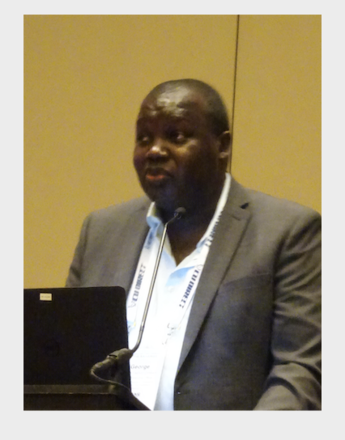
George Omadao at WCUC.
In many of the countries the African Confederation represents, he said credit unions have been active on issues that include addressing poverty, food insecurity, health and sanitation issues, and more. That includes the planting of trees to deal with mud and landslides.
“We don’t have to wait until our members are in desperation mode. We should develop mechanisms of intervention,” said Ombado. “This room is full of some of the most privileged people in the world. You may not think you are privileged, but if you think about the billions of people in this world, you are among the most privileged. And you need to thank God for that. As credit unions, perhaps it’s high time we bring our influence and credibility to other areas. The role of sustainable development lies on me, lies on you, and not necessarily on the institutions you work for.”
Doing the Right Thing Good For Business
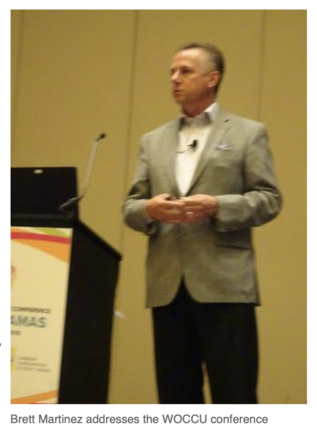
Few credit unions in the United States understand what it takes to help a community once again become sustainable more than Redwood Credit Union in Northern California. It has had to deal with several enormous wildfires that have destroyed thousands of homes, its communities, and affected its own employees. The $4.5-billion Redwood serves approximately 335,000 members, and its CEO, Brett Martinez, told the World CU Conference being a part of the community is about far more than just making loans when times are good.
“Doing the right thing is good for business, and doing the wrong thing is bad for business,” said Martinez. “I think as credit unions we do the right thing every day. I don’t think doing the right thing one time is good for business; doing the right thing all the time is good for business. It’s easy to be there for people when there is a birth of a child or a new house, but not as easy when there is a divorce or a death of a family.”
Unfortunately, noted Martinez, fires in California have become a “regular thing.” After the devasting fires of 2015, Redwood CU stepped up and created a Community Fund that helped distribute several million dollars to victims. But that turned out to be just a test run. In 2017, the North Bay Fires became the largest in California’s history, covering four counties and destroying more than 7,000 homes, including 5,600 that burned in one night within 2.5 miles of its headquarters. Twenty-three employees also lost their homes.
The Complicated Part
“The most complicated part has been identifying the victims. Trying to get the money to people as quickly as possible is really important,” said Martinez. “In the U.S. a lot of times, in disasters the regulator will declare an emergency and allow financial institutions to close. The reality is we had thousands of members who ran out their doors with what they had. What they need isn’t for their financial institution to be closed. We are aware our employees were impacted personally, but we were there for our members. We were fighting the battle, including getting cash from armored services that didn’t want to come into the fire zones.”
As CUToday.info has reported, over a four-month period Redwood CU offered to cover all the administrative costs of a relief fund; costs that eventually topped $1 million. Over four months it collected $32 million from 41,000 donors from all 50 states and 23 countries.=
“Raising the funds isn’t the complicated part; it’s doing what you said you were going to do,” said Martinez. “We hired nonprofits in communities to take applications from victims. Doing the right thing is good for business; it’s crazy. People come to work for our credit union, join our credit union, because of that. We hear that all the time. I told the board this will either take our brand to the next level, or we will destroy our brand.”
‘Everyone Has an Opinion’
That isn’t to say everyone is appreciative of the credit union’s good intentions and dedication to its community, Martinez acknowledged.
“When you raise $32 million, everyone has an opinion,” he said. “There is a lot of drama. We have had people come in and investigate our funds. We have opened up the books.”
The devastation in the community has also led Redwood CU to reluctantly enter a new line of business.
“We didn’t do construction loans, and we didn’t want to do them. But when you’re helping your community rebuild, you don’t always get to do what you want to do,” he said. “We had to hire that sophistication, and it’s hard, as everyone is hiring that sophistication. We continue to help our community rebuild long-term.”