


VIENNA, Austria–During a session at WOCCU’s World CU Conference titled “Growth Strategies in an Ever-Evolving Environment: An International Perspective,” here’s what David Matthews said Ireland’s credit unions are doing to address lagging loan growth.
Matthews, who is with the Irish League of Credit Unions, said the numbers make clear just what a problem lending has become among Ireland’s credit unions. In 2000, the average loan-to-share ratio was 70%. Today, it’s just about 30%.
Ireland’s credit unions are taking several approaches seeking to do something about the declining numbers, according to David Matthews of the Irish League of Credit Unions.
That lack of lending has meant significant surplus funds that are deposited in banks. As a result, the average 4.5% ROA Ireland’s credit unions were experiencing in 2000 has plummeted to 1.3% today.
“We’ve almost experienced a perfect storm,” said Matthews. “The return on surplus funds is at an all-time low, with 70% of the balance sheet earning 1.4% and that’s unlikely to change anytime soon. Competition is also heating up as banks fight back and target credit union core business. Our future is at risk and today is the new normal.”
Where Ireland's CUs Perform Well
On the plus side, Ireland’s credit unions continue to be most highly rated for service by consumers, and are a popular and trusted brand (even if all that has meant is attracting more savers, observed Matthews).
Ireland has 365 credit unions, most of which are performing well, but the Irish movement lacks a common strategic vision and remains fragmented. The result has been duplication in costs and efforts, he said.
But it is seeking to change that.
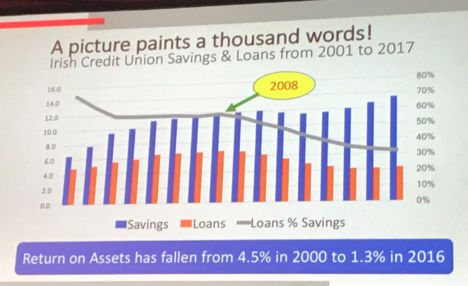
Chart shows decline in lending among Ireland's CUs.
“Our three strategic imperatives are to maximize impact and efficiency, grow income on a sustainable basis, and attract and retain younger members and borrowers,” he said.
Ireland has 3.5 million members, 40% of whom are over 40.
So what are the country’s credit unions doing? According to Matthews, Ireland’s credit unions are currently exploring expansion of home loans and business loans. He called the potential for home lending “huge,” even in a very competitive market.
“It might seem strange that a relatively mature movement like Ireland doesn’t have a presence in mortgage lending, but for a variety of reasons we don’t,” Matthews said.
Ninety-five percent of loans at Ireland’s credit unions are personal.
Ireland’s CUs also see home loans as providing more income over a longer term, and as an “anchor” product to attract and retain younger members and encourage current members to do more business with the credit union.
The Irish home loan market is expected to see 40% growth by 2020. “If we do it right, we can get a substantial share of that market,” said Matthews.
New Focus on Business Lending
Business lending is also seen as a huge opportunity for credit unions in Ireland, he said, even though most Irish credit unions currently lack the skill sets to do the lending. There are more than 250,000 small businesses in Ireland.
How will credit unions add the business lines and deal with complexities of both home and business lending?
According to Matthews, it will be done by centralizing the complex processes involved. A Centre of Excellence is being created around home loans to ensure all home loans issued are done in an efficient and compliant manger; to support development of culture of innovation, and to facilitate central branding and marketing.
Similarly, with business loans, Ireland’s credit unions are seeking to centralize much of the lending process.
“Our objective is to capitalize on the credit union difference, while also changing what we do,” said Matthews. “We are ‘credit’ unions, after all.”