

VANCOUVER, B.C.–Three credit union CEOs who have been through mergers recently (in one case, six mergers) related what they have learned about the process.
Offering their perspectives at the World Credit Union Conference were:
- Shelley McDade, CEO of Sunshine Coast Credit Union
- Larrey Davey, CEO of Access Credit Union
- Lisa Loughery, CEO of Brunswick Credit Union
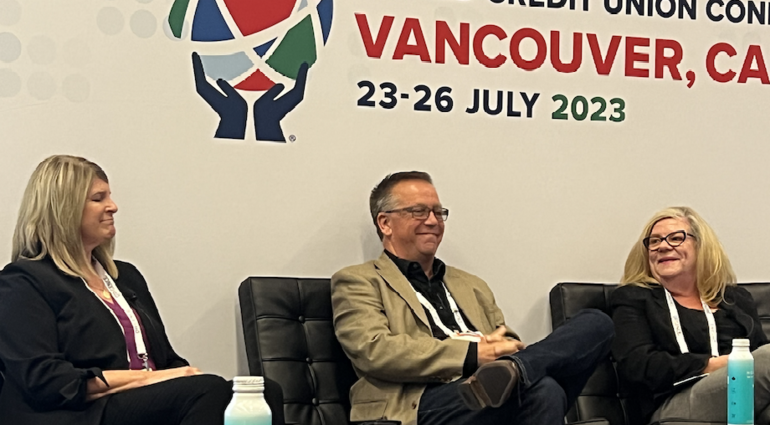
The session was moderated by Jay-Ann Gilfoy, president and CEO of Meridian Credit Union in Ontario, which is Canada’s second-largest CU.
Here’s a look at what each shared during their remarks:
McDade: First, Understand People Are Tired of Change
McDade said it’s important to recognize just how weary employees and organizations have become around change. She pointed to Gardner research showing that in 2016 organizations were going through an average of two planned enterprise changes a year; in 2022, that number had risen to 10.
“People are getting tired of change,” McDade said. “If they are looking beleaguered and tired, they deserve to be.”
McDade said Sunshine Coast CU has been working to prepare for the future and to enhance the experience for employees and members and how to improve productivity and efficiencies, which is why it went through a merger.
Productivity Increases
She said the credit union has seen a 50% improvement in overall productivity, a 70% reduction in average service pick-up time, and a 90% improvement in average issue resolution time.
This has come while 70% of employees are working remotely, which McDade said she and the credit union are still working to manage effectively. But the remote work has also helped it to recruit new talent.
McDade said the credit union has seen issues that are universal across organizations, including low adoption, poor morale and missed opportunities.
Not All are ‘In It to Win It’
“If you have 10 people, only four and a half are ‘in it to win it’ with you,” she said. “People often do what they always did and it confounds the whole process.”
While the credit union’s internal surveys generated good overall scores, McDade said the CU did encounter pockets of poor morale and a lot of it was employees who felt they were losing something.
“We missed a good opportunity to help engage our employees more in the process,” said McDade, before sharing the key takeaways her credit union has learned.
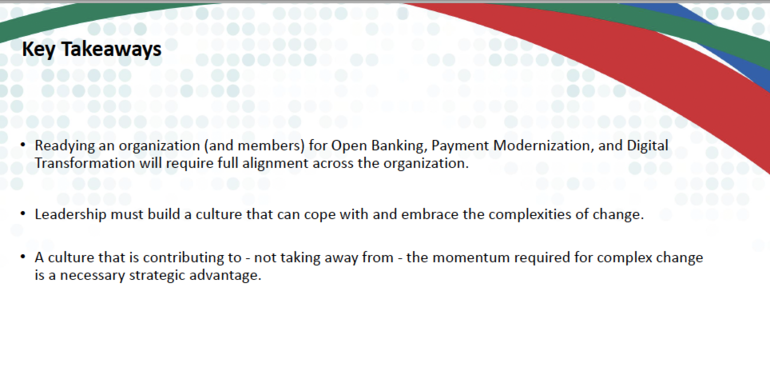
McDade offered these recommendations when it comes to managing change:
- Invest in mid-level leadership
- Ensure transparent and two-way communication
- Manage change fatigue. “The key takeaway here was leave enough space for us to fail and recover…Please show appreciation and gratitude for even small efforts made.”
Davey: A Half-Dozen Mergers, Countless Lessons
There are credit unions that go through mergers, and then there is Access Credit Union, which has merged in six other credit unions over the last three years.
That led its CEO, Larrey Davey, to joke that his staff had forbade him from speaking to anyone at the World CU Conference.
Davey outlined five steps in the pre-merger and merger process he said can help make the process further. Those steps include:
Phase One: Preparation
The first step, said Davey, is for the credit union to understand whether it wants to look at mergers or not. If the answer is yes, he said it’s important to let everyone know: the board, staff and members.
If it is an affirmative answer, the message needs to be, “Be prepared for change, because there is going to be change.”
Phase Two: Concept
The concept stage is where the credit union selects its potential merger partners, according to Davey.
“You develop a concept paper, and what we found is once you develop that concept paper and the board wants to move forward, you make that announcement to the staff and members that this is what is happening,” said Davey. “That opens it up for them to start bringing forth any concerns. We found it’s best to give members and staff a dedicated website, email addresses, phone numbers they can call to bring forward any concerns. Any questions you answer you have to post for everyone to see.”
Phase 3: Planning and Scoping
Once a credit union has scheduled a vote on a merger, Davey said it’s critical to ensure all staff are onboard and informed, especially when they are talking to members and are explaining the benefits they will see moving forward.
Davey said the credit union contacted members the week of the vote, especially since it’s those who are opposed who are most likely to show up at the meeting where the vote is occurring.
“With six mergers, our staff has done an unbelievable job for the membership to make sure we can get through this. It’s not easy,” said Davey. “We have a dedicated team.”
Davey said one mistake he made was pushing to get signage completed in a merger, which sent the wrong signal that the merger was complete even though staff had not been trained.
Phase Four: Transition
Phase four is the transition stage, which involves all of the pragmatic issues, but during which the communication must continue, he said.
Loughery: Three Key Lessons
On Jan. 1 of this year, Lisa Loughery, the CEO of Brunswick Credit Union, oversaw the merger of three credit unions into one.
Three key lessons from that process, she said, included:
- The strong pride felt in the way each CU operated
- Cultures can be similar but different
- There must be respect for existing processes
“We found the employees from each organization have a real strong pride in the way they operated,” said Loughery. “We didn’t really realize how that would affect us moving forward. Some of us are really great with change and others are not. To make changes really quickly was almost like saying to them ‘We don’t appreciate the way you did things before.’ It was important for us to slow down and talk to the employees.
“We thought our cultures were very, very similar,” Loughery continued. “We chose partners we thought would make things smoother. When we did come together we realized, yes, we are very much the same, but we are also very different. We learned we have to respect each organization’s way of doing things.”
In the case of the three-way merger, it wasn’t that one CU was dominant, according to Loughery. Instead, the merger partners sought to draw the best from each of the respective operations to create a brand new CU.
More Fear
“There was more fear than we expected. Employees were unsure of what their futures held,” Loughery said. “Communication was very, very key. There is resistance to change. Employees were anxious. They needed information and they needed it frequently and it needed to be relevant.”
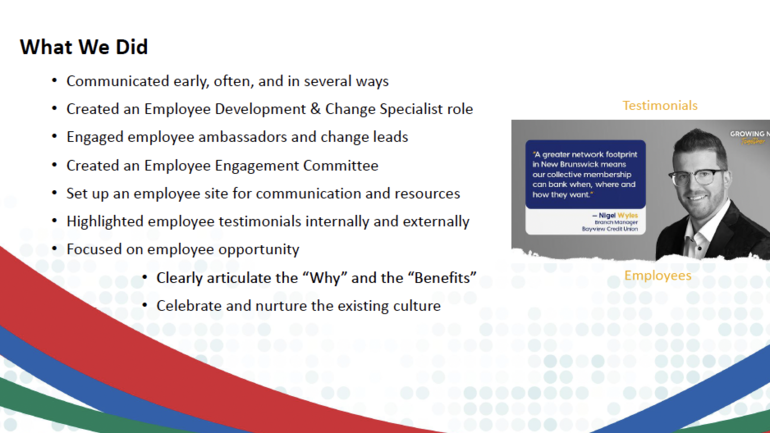
Loughery said the credit union learned a lot from the three-way merger, including the lessons outlined below.
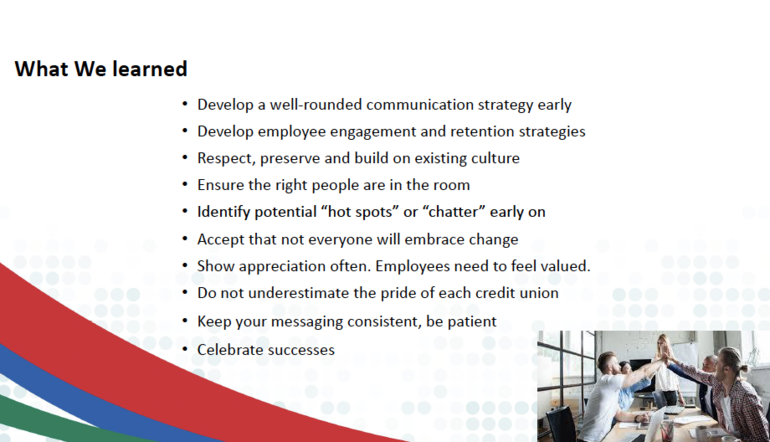
“It’s important to have change champions inside the credit union,” said Loughery, emphasizing the messaging must make clear, “We’re not trying to wipe away what was there. We are trying to build on the things each credit union had in place and we are celebrating that.”