

WASHINGTON–With the holiday (spending) season here, a new report has identified 2022’s Cities with the Most & Least-Sustainable Credit Card Debt.
The two cities where residents have the least sustainable card debt can be found in South Florida, followed by Knoxville, Tenn., Gulfport, Miss. and Missoula, Mont., according to the report from WalletHub. The leading cities for consumers with the most sustainable debt, according to the report, can all be found in California (see chart).
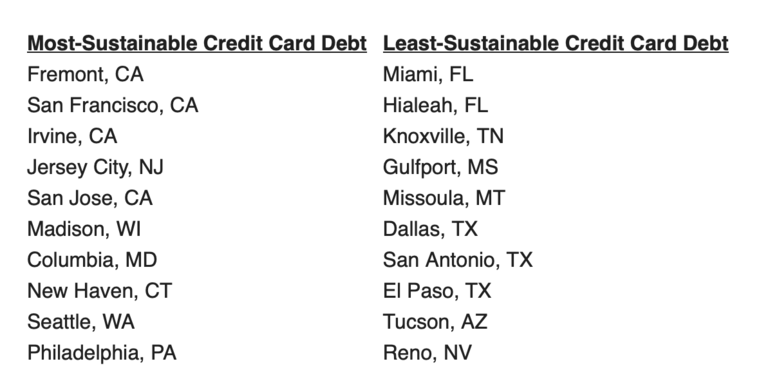
Among some of the key findings in the WalletHub analysis:
- Q3 Increase. U.S. consumers racked up $23.6 billion in credit card debt during Q3 2021.
- Bigger-Than-Usual Increase. The increase in credit card debt during Q3 2021 was 46% bigger than the post-Great Recession average for a third quarter.
- Huge Reversal From Last Year. Credit card debt fell by $82 billion during 2020, and WalletHub now projects an increase of $70 billion in 2021.
- Lower Charge-Off. The 1.67% credit card charge-off rate for Q3 2021 is 34.3% lower than last quarter and 50% lower compared to last year.
- Most and Least Sustainable. The city with the most sustainable debt is Fremont, California while the city with the least sustainable debt is Miami.
- Ease Your Debt. WalletHub urged consumers to investigate the best balance transfer credit cards that currently offer 0% APRs for the first 18-21 months with no annual fee and balance transfer fees as low as 3%.
High Cost of Daily Life
“The latest credit card debt statistics indicate that the high cost of daily life is unaffordable for many consumers, which forces them to rack up more and more debt. Household budgets clearly are under a lot of pressure,” said Jill Gonzalez, WalletHub analyst. “Statistics for Q3 2021 in particular tell us that consumers have returned to pre-pandemic behaviors in terms of spending beyond their means. After adding $23.6 billion in new credit card debt to our books during Q3 2021, consumers now owe more than $951 billion to credit card companies overall. At $8,006, the average household balance is not too far off from becoming unsustainable.”
Gonzalez added that debt levels are rising faster than last year because many Covid precautions and government stimulus programs have ended.