

COSTA MESA, Calif.–A new analysis has identified the top states for e-commerce fraud. 2017 saw an increase of more than 30% in e-commerce fraud attacks compared to 2016, according to a new report from Experian.
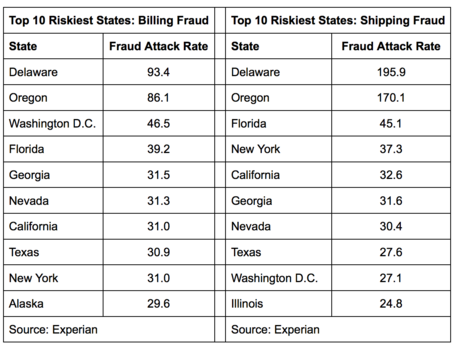
With 16.7 million reported victims of identity fraud in 2017 (6.64% of the U.S. population), it was another record year for the number of fraud victims, Experian said, as online and mobile transaction growth continued to significantly outpace brick-and-mortar growth.
As it has for the past three years, Experian said it analyzed millions of online transactions to identify fraud attack rates for both shipping and billing locations across the United States by examining several data points, including geography and IP address.
What Analysis Shows
According to Experian, 2017 e-commerce fraud attack rate analysis shows:
- Delaware and Oregon continue to be the riskiest states for both billing and shipping fraud
- Delaware, Oregon, Washington, D.C., Florida and Georgia are the top five riskiest states for billing fraud
- Delaware, Oregon, Florida, New York and California are the top five riskiest states for shipping fraud, accounting for 50% of total fraud attacks
- South El Monte, Calif., is the riskiest city overall, with an increase in shipping fraud of approximately 230%
- Shipping fraud most often occurs near major airports and seaports due to reshippers and freight forwarders that receive domestic goods and often send them overseas, Experian said.
- When a transaction originates from an international IP address, shipping fraud is 6.7 times likelier than the average, while billing fraud becomes 7.1 times likelier.
Where is e-commerce fraud happening?
According to Experian, typically, the highest-risk areas for fraud are in ZIP codes and cities near large ports of entry or airports.
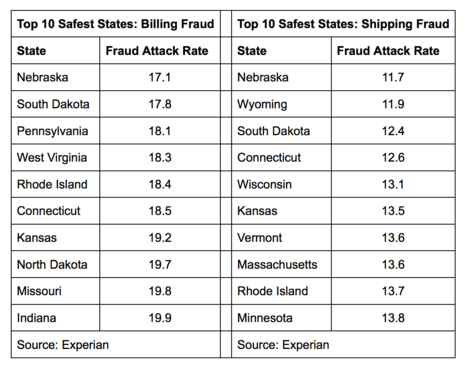
“These are ideal locations to reship fraudulent merchandise, enabling criminals to move stolen goods more effectively,” Experian said. “What’s more, many of the riskiest ZIP codes and cities experience a high volume of transactions originating from international IP addresses. In fact, the top 10 riskiest ZIP codes overall tend to experience fraudulent activity from numerous countries overseas, including China, Venezuela, Taiwan and Hong Kong, and Argentina. These fraudsters tend to implement complex fraud schemes that can cost businesses millions of dollars in fraud losses. Additionally, the analysis shows that traffic coming from a proxy server — which could originate from domestic and international IP addresses — is 74 times riskier than the average transaction.”
Experian said the uptick in data breaches, merchants’ continued adoption of EMV-enabled terminals to protect against counterfeit card fraud and the abundance of consumer data on the dark web means that information is even more accessible to criminals.
“This enables them to open fraudulent accounts, take over legitimate accounts and submit fraudulent transactions. Another reason for the increase is automation,” Experian said. “In the past, criminals needed a strong understanding of fraud methods and technology, but they can now bring down an entire organization by simply downloading a file and automating the submission of thousands of applications or transactions simultaneously.
“Since fraudsters need to make these transactions appear as normal as possible, they often leverage the cardholder’s actual billing details with slight differences, such as e-mail address or shipping location,” the company continued. “Unfortunately, the mass availability of compromised data and the abundance of fraudsters makes it increasingly challenging to identify and separate legitimate customers from attackers across the country.”
What Can A Credit Union Do to Help?
According to Experian, credit unions should urge their small business members to implement proactive strategies to detect and prevent attacks, as well as protect payment information.
“While no one single strategy can address the entire scope of fraud, there are advanced data sets and technology — such as device intelligence, behavioral and physical biometrics, document verification and entity resolution — that can help businesses make better fraud decisions,” Experian said.
For the full report, go here.