

TACOMA, Wash.–The increasing interest in diversity, equity and inclusion (DEI) initiatives among credit unions hasn’t always translated into equally strong knowledge over where to begin and how to proceed, according to one expert, who has shared “five pillars” on which to build those efforts and who made clear it’s not just about “training.”
Ronaldo Hardy, chief diversity and inclusion officer with CU Strategic Planning, told credit unions during a webinar sponsored by the company that those within credit unions who are pursuing DEI-related initiatives are doing so because they are change agents, want to make a difference, believe DEI is a moral responsibility, believe DEI can have bottom line impact, and are eager to get started.
The catch? They “don’t know how” to effectively put such initiatives in place.
“I believe we are going to continue to see an evolution in our industry and beyond for some time,” said Hardy. “Credit unions understand that but are struggling with what needs to be done. There are five key areas organizations must focus on in order to accomplish DEI successfully. Looking at this with a strategic focus, if a credit union does not concentrate on it, it will not work. This is way more than training.”
Before offering the five pillars, Hardy said it’s his belief that when history looks back on the current time it will document a modern day civil rights movement.
One Big Indicator
“One of the biggest indicators is when consumers came to understand the economic impact,” he said. “One of the biggest characteristics of the previous civil rights era was that understanding. Boycotts moved decisions. Consumers are returning to that. African Americans, women, the LBGTQ communities are elevating their voices, but the biggest thing is the understanding of economic impact and that dollars driving decision-making. This is not going to go away.”
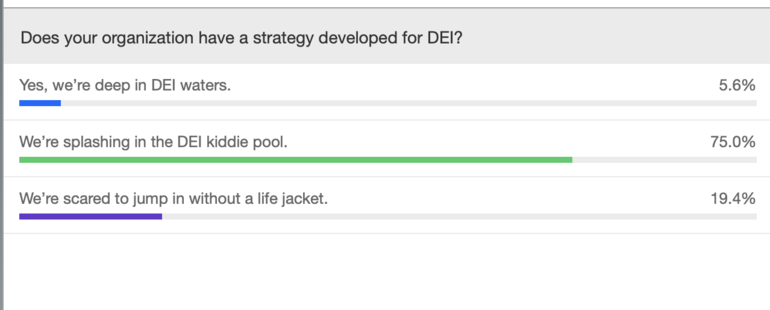
Hardy polled webinar participants on several questions, including that shown below, on where their current DEI efforts stand.
Pillar #1: Community Development
According to Hardy, community development is the DEI end-goal.
“We should have a deepened community connection, much stronger market penetration wherever we are,” Hardy said. “We should be able to see the needle moving. The end-goal should be the desire of your organization to be a part of your community.”
In the consulting work he does Hardy said he will often put credit unions through an exercise that asks if they weren’t a part of the community who would really miss the CU.
“Are you aware of what’s going on in your area? What are the socioeconomic challenges? What areas need concentration? How will your DEI strategy accomplish this? And how will your organization help?” asked Hardy. “Another question: What organizations should you be aligned with. There are organizations in your community having a meaningful impact. Are you doing asset mapping in your community?”
Pillar #Two: Board Governance
Hardy said it’s difficult for any organization to do anything meaningful in DEI without a concentration in board governance.
“This is so vital. It will absolutely determine what happens with your organization’s DEI strategy and approach,” he said. “It’s very difficult to execute something you’re not modeling at the top. If an organization is not considering board composition, it is inevitably going to experience some long-term failures.”
In another poll of webinar participants, Hardy asked about their own CU’s board mix. The results are below.
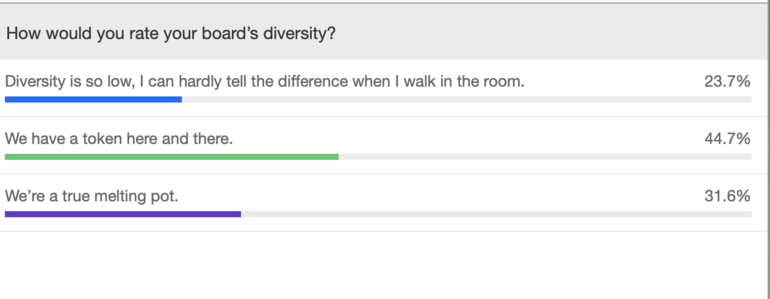
Hardy said credit unions need to look at the racial mix, generational mix, and gender mix of their boards and, if possible, dig even deeper into areas such as sexual orientation.
“Here’s the thing: If you don’t have the right blend from day one, it’s important to develop strategies for getting there,” said Hardy. “When people hear this, they often look at it from a place of exclusion. They ask, ‘Does this mean I will be pushed out?’ It’s not about exclusion, it’s about inclusion. Some of these things can be resolved with attrition.”
Hardy cited a CUNA survey that found 90% of credit union board members are white. That’s important, he said, because it affects strategic planning, CEO selection, policy development, community partnerships and other issues.
“If we don’t have the board governance part correct, we will inevitably have issues throughout the organization,” he stated. “You cannot get around board governance if you want to do DEI in the right way.”
Pillar #3: Management
Even with a strong board, management still often develops the vision, the strategies and the implementation plans, reminded Hardy.
“It’s imperative that the composition of the management team adequately reflect the composition of the community,” he said. “If we want to be a great representation of our membership base, then our management must reflect it. This requires robust and ongoing training. DEI never stops. As the composition of our country and specific markets continues to change this is going to continue to be a growing and evolving subject matter.”
But even with effective deployment and management of DEI, Hardy said what is also required is the ability to measure a CU’s effectiveness, and that takes time. “It’s our recommendation a credit union commit a minimum of three years to this level of transformative work,” he said.
Pillar #4: Brand
Brand, said Hardy, is how a credit union delivers on what it is externally.
“A lack of careful consideration of your brand can result in exclusive presentation of your brand,” he said. “You may or may not be communicating exclusivity, meaning you are excluding some and only including certain aspects of the community. This is an especially important if you are community chartered.”
Hardy noted research shows consumers want businesses to participate in the discussion around DEI and to back that up with action.
“Americans feel ready to call out companies that haven’t done the work and have only taken a stand and aren’t authentic,” he said. “DEI is so much bigger than a quick fix. It requires an understanding of the fact it will touch every aspect of the organization. Ethics matter more to consumers than competency.”
Pillar #5: Culture
Brand and culture have to work together, observed Hardy.
“Culture is how we deliver who we are internally,” he explained. “Current and potential employees need to see themselves represented in every level of the organization. This is not just about the front line, the MSRs. What does middle management look like? Upper management? The board? Depending on who is sitting in those seats will determine the organization.”
Inclusion, Hardy said, is the actual reflection of the culture of the organization, while equity is about representation at the table. If we don’t have the representation (diversity) and the seat at the table we can’t get to the inclusion piece. It makes sure the culture is built in the right way. We believe in having a culture of candor and care. You cannot be inclusive and not be candid. If we do this the right way we have to make sure inclusion is part of the culture and our emphasis as an organization is about doing this the right way.”