

WASHINGTON–The Consumer Financial Protection Bureau (CFPB) has issued a new report that has found many college-sponsored financial products have “higher fees and worse terms and conditions compared to typical market products.”
The CFPB report identifies college-sponsored deposit accounts with fees above prevailing market rates, which institutions are required to consider under Department of Education rules designed to protect students’ interests.
The conclusions are drawn from a sample of 22 different institutions, seven of which are credit unions: Wright-Patt CU, University of Kentucky FCU, Addition Financial CU, University of Pennsylvania Student FCU, Elevations CU, Fairwinds CU and Washington State Employees Credit Union.
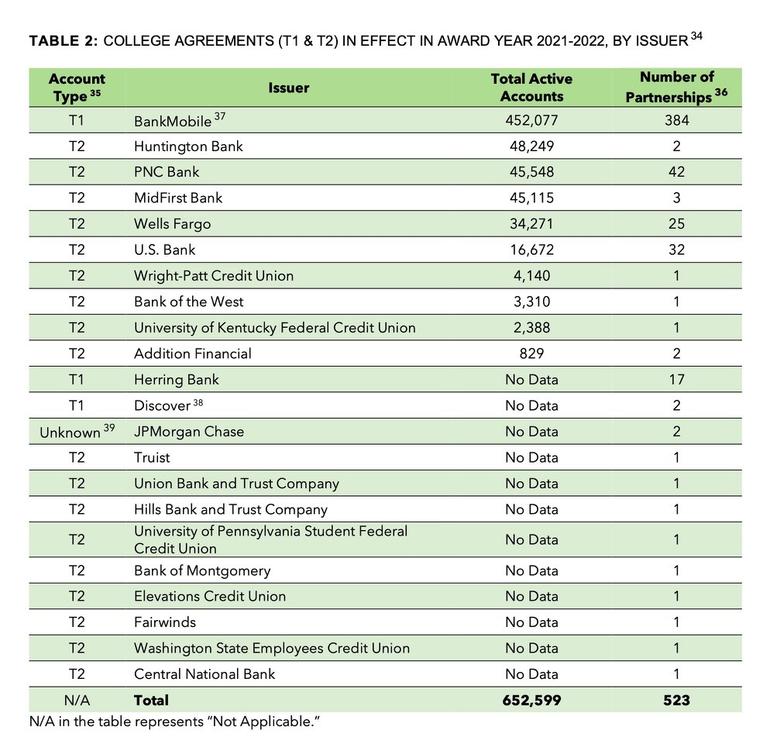
The report includes both T1 and T2 account types. In T1 arrangements, colleges typically pay the provider for the service of processing federal financial aid disbursements. In T2 arrangements, financial institutions typically pay colleges for access to the student population.
CU Leads on Fees
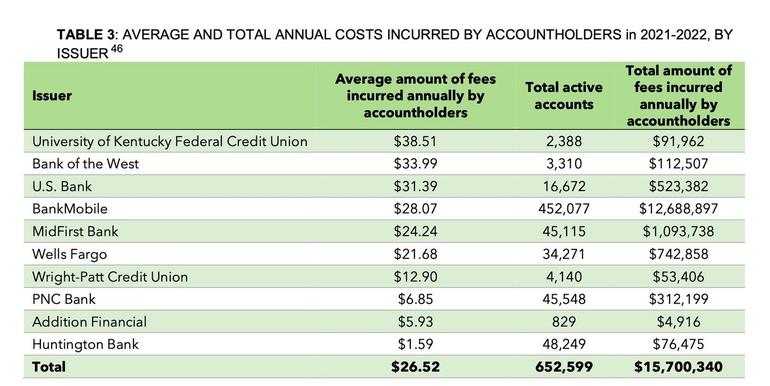
Under the category of annual fees charged per account, the CFPB said University of Kentucky FCU in Lexington had the highest average fee amount, $38.51 during the period examined. Huntington Bank had the lowest annual fees, averaging less than $2 per accountholder, the CFPB reported.
“The amount of annual fees charged appears to be driven by the presence of account fees such as overdraft fees, 49 non-sufficient funds (NSF) fees, and 50 monthly account maintenance fees,” the CFPB said. “Overdraft fees ranged from $0 at BankMobile to $36 at U.S. Bank. Three of the financial institutions (U.S. Bank, BankMobile, and MidFirst Bank) do not charge NSF fees, but the two financial institutions with the highest average annual fees per account, the University of Kentucky Federal Credit Union and Bank of the West, charged NSF fees of $29 and $35 respectively during the 2021-2022 Award Year. However, Bank of the West has since been acquired by BMO 53 and accountholders are no longer charged NSF fees.”
The Bureau noted that many colleges offer sponsored and co-branded financial products to students and alumni, such as deposit accounts, credit cards, and prepaid cards.
“Students may be likely to accept their school’s recommendation of a bank account or credit card when they arrive on campus, meaning that colleges and their financial institution partners may not face competitive pressure to lower fees or provide low-cost products,” the CFPB stated. “These arrangements can be lucrative for schools, as financial institutions pay tens of millions of dollars every year to colleges and universities, including flat-fee marketing deals and per-signup kickbacks.”
Earlier Findings
The CFPB noted its 2022 College Banking and Credit Card Agreements report described the high fees charged on student banking products endorsed by colleges.
“The report made clear that financial institutions and colleges may be steering students into expensive financial products,” the Bureau stated. “Today’s report found that many colleges continue to employ marketing strategies that may mislead students into accepting products that may not be the best choice for them.”
According to the CFPB, colleges’ financial product partners may charge students high or atypical fees.
“Although most of the largest banks have moved away from charging overdraft and non-sufficient funds (NSF) fees in recent years, some of the sponsored deposit accounts in the report do charge students those fees. Thus, students who follow their school’s advice may be steered into accounts that cost them much more than what they would pay in the open market. “
The Findings
Among the findings in the CFPB report:
- Fees paid by students often vary by institution type. “The average fee burden varies by the type of institution. The report finds that accountholders at Historically Black Colleges and Universities (HBCUs), for-profit colleges, and Hispanic-servicing institutions (HSIs) all pay higher-than-average fees per account.”
- Students face unexpected fees at graduation. “Some financial institutions impose additional fees when a student graduates or reaches a certain age, relying on ‘sunset’ clauses in the products’ terms and conditions. Students who sign up for a product marketed as free may thus end up being charged monthly maintenance fees, or overdraft and NSF fees they did not anticipate.”
Investigation to Continue
The CFPB said it will continue to examine these practices and identify possible violations of federal consumer financial protection law.
The full report can be fund here.
The Best Gift to Unwrap This Holiday Season
The biggest, best and freshest news reporting in credit unions remains free! Each morning CUToday.info delivers its daily Fresh Today news update offering the latest headlines and breaking news right to your email, with the easy-to-read headlines format allowing you to click on the stories that interest you most in order to learn more. So stop paying those bank-fee-like subscription prices from other so-called “news” publications!
If you haven’t yet signed up for the new email solution on which CUToday.info has partnered with ResponseGenius, you can do so here. Signing up requires less than one minute of your time—and it’s free!
Please note that after signing up you may need to go to your Spam/Junk folder and mark the morning headlines email as safe. CUToday.info does not provide its list of readers and emails to outside parties, and we will not be contacting you to sell you an extended warranty or sending you any links so you may cash in on an inheritance you didn’t know was coming.
And did we mention it’s free?