

LAKE TAPPS, Wash.—The third quarter of 2025 surfaced an earnings statistic that surprised many industry observers: A meaningful share of merged credit unions reported negative ROAA, while acquired bank targets appeared far more consistently profitable, pointed out Glenn Christensen.
“The headline is real—but the explanation is not mysterious,” explained Christensen, founder and presidentof CEO Advisory Group. “It sits at the intersection of who is in each ‘target pool,’ scale-driven operating leverage, and a structural headwind that smaller institutions face more acutely than most boards acknowledge: membership decline.”
The Headline Comparison: Merger Targets Are Not ‘Typical’ Institutions
The simplest place to start to analyze this statistic, said Christensen, is the target-pool comparison.
“From 2021 through 3Q 2025, merged credit unions show a persistently higher incidence of negative ROAA than acquired bank targets (banks acquiring banks),” he explained. “That gap is not just a one-quarter anomaly; it reflects the composition of the credit union merger population. Many merger targets are contending with limited scale, fixed-cost intensity, leadership depth constraints, and increasingly complex technology and compliance requirements. The pattern is persistent across years, reinforcing that this is about structural differences in the target pools, not a single quarter’s noise.”
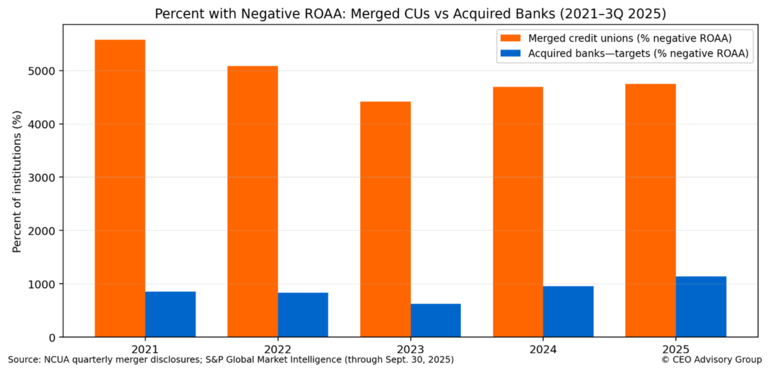
Percent with Negative ROAA—Merged CUs vs. Acquired Banks (2021–3Q 2025) (© CEO Advisory Group)
Scale Explains The Distribution—And It Explains Why The Merger Pool Looks ‘Worse’
“When you segment performance by asset size, the negative ROAA story becomes more intuitive,” said Christensen. “Smaller institutions show materially higher downside earnings outcomes; larger institutions show far fewer. This is what operating leverage looks like in practice. Fixed costs do not scale down neatly, and smaller institutions struggle to generate enough earning power to fund competitive delivery, talent, and technology investments. Negative ROAA is disproportionately a small-institution outcome, and it declines sharply as asset size increases.”
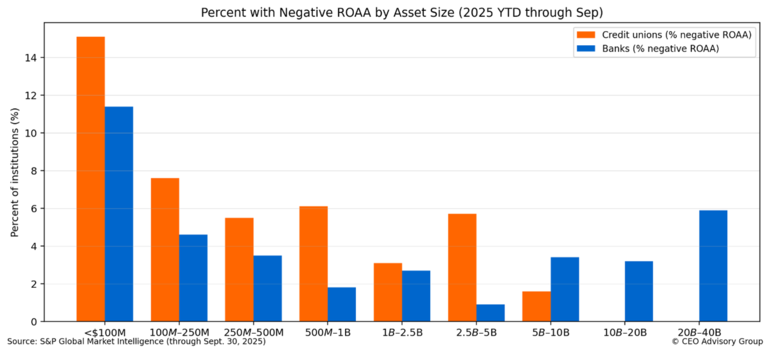
Percent with Negative ROAA by Asset Size (2025 YTD through Sep) (© CEO Advisory Group)
Membership Decline Is A Critical (And Under-Discussed) Structural Driver
Scale pressure is not only about expense ratios—it is also about demand and relevance, explained Christensen.
“When membership shrinks, the fixed-cost problem becomes harder to solve, and the path back to healthy operating leverage narrows,” he said. “Our membership analysis (ending 3Q 2025) shows that net member losses are heavily concentrated among smaller credit unions: roughly two-thirds of credit unions under $100 million in assets have fewer members today than five, 10, and even 15 years ago. By contrast, large institutions show far lower rates of sustained membership contraction.”
This matters, said Christensen, because membership decline quietly erodes the economics of independence: fewer members means less opportunity to spread overhead, less capacity to invest, and typically weaker strategic options over time.
“It also helps explain why ‘strategic’ mergers and ‘challenged’ targets can coexist in the same dataset—many credit unions are consolidating not only because of short-term earnings pressure, but because long-run membership trajectory makes scale the pragmatic solution,” Christensen explained.
Margins And ROAA: Mission And Incentives Matter
Margin comparisons between banks and credit unions require context. Credit unions exist to enhance member financial well-being; maintaining competitive loan and deposit pricing that benefits members can result in different margin outcomes than a shareholder-return model, said Christensen.
“Banks, by design, have stronger incentives to optimize spreads for owners. In other words, margin compression in credit unions can sometimes reflect member value being delivered through pricing rather than a failure of management,” he explained. “That said, margins alone do not determine ROAA. The persistent differentiator is the combination of operating expense structure and operating leverage—which brings us back to scale.”
The Efficiency Driver: Operating Expense Load Remains The Divider
Even when credit unions show margin advantages, higher non-interest expense relative to assets can absorb much of that benefit—especially for smaller institutions, said Christensen.
“Over time, this has been one of the clearest structural differences in the CU vs. bank comparison,” he said. “This is the operating leverage story (see chart)—expense structure is where scale becomes decisive.”
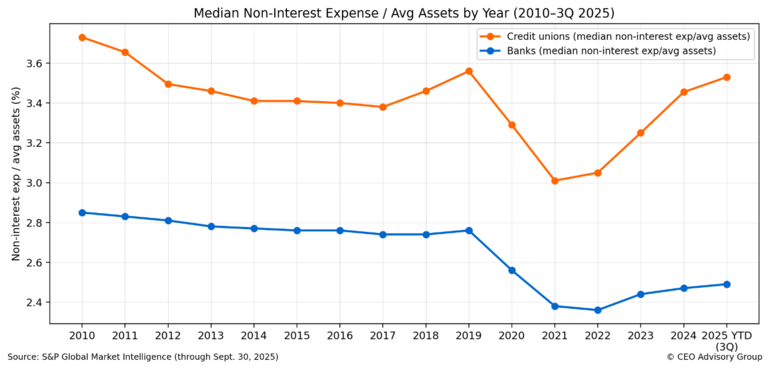
Median Non-Interest Expense / Avg Assets—Credit Unions vs. Banks (2010–3Q 2025) (© CEO Advisory Group)
Growth Capacity: Banks Can Raise Capital; Credit Unions Largely Must Earn It
Another structural difference is growth funding, said Christensen.
“Banks generally have broader access to external capital that can support balance-sheet growth,” he explained. “Credit unions are constrained primarily to retained earnings to build net worth and fund organic growth. In periods of investment intensity—technology, compliance, talent—this constraint can force sharper tradeoffs between reinvestment, member pricing, and ROAA recovery.”
Bottom Line
The 3Q 2025 “negative earnings” headline is real, but it is explainable, concluded Christensen.
“Credit union merger targets are disproportionately small institutions facing fixed-cost intensity, operating leverage limits, and—critically—membership decline that makes scale increasingly difficult to achieve organically,” Christensen explained. “Bank targets that transact are typically filtered by profitability, and banks have different incentives and capital tools that shape growth and earnings patterns. For boards, the practical strategic implication remains consistent: scale is increasingly the prerequisite for sustainable reinvestment, resilience, and long-run member value.”
To learn more:
Download the CEO Advisory Group Strategic Succession white paper: https://resources.ceoadvisory.com/strategic-succession-white-paper.html; and the Bank acquisition white paper: https://resources.ceoadvisory.com/bank-acquisition-whitepaper.html