

WASHINGTON–The ways in which consumers used payday, title, and pawn loans over periods in 2019 vs. 2020 and the reasons that contribute to why consumers use them have been detailed in a “Data Point” report released by the CFPB.
According to the Bureau, its findings are based on survey data from two “waves” from its “Making Ends Meet survey, conducted in June 2019 and June 2020. The first survey covered a six-month period and the second a 12-month period to examine consumers’ use of such services over time. The CFPB said the survey is associated with traditional credit bureau data, allowing it to examine other credit characteristics such as whether the consumers using such services, which the Bureau calls “alternative financial services” (AFS), appear to have readily available credit on credit cards.
According to the analysis, the “relatively few” consumers used payday, auto title, and pawn loans, but those who did tended to do so repeatedly. “Around half of users in June 2019 were still using these services in June 2020,” the report states. “More than 60% of AFS users have a credit card and around a third of consumers who owed money on a payday and auto title loan in June 2019 had at least $300 in available credit card credit. Yet many AFS users are credit constrained in other ways. AFS users typically have lower credit scores than other consumers and many have applied for credit and been turned down or decided not to apply because they thought they would be turned down. Many AFS users also experience sizable and costly shocks that exceed their available savings and credit card credit.”
The Findings
Among the findings included in the CFPB report:
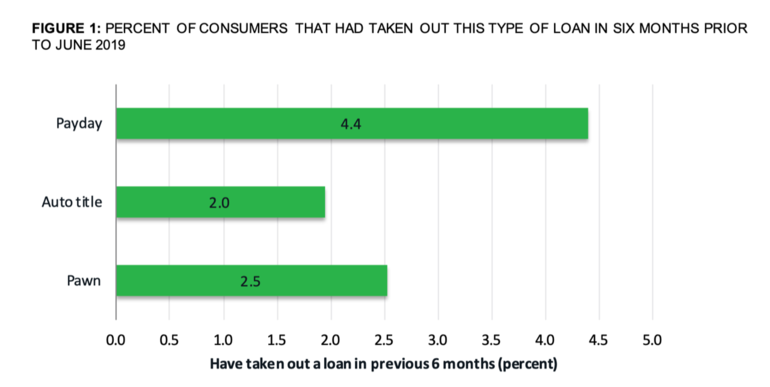
- In June 2019, 4.4 % of consumers had borrowed via a payday loan in the previous six months, 2% had borrowed via an auto title loan, and 2.5% had turned to a pawnshop for a loan. While the share of consumers who had used these services in the 12 months before June 2020 was similar, the CFPB stated the increased length of time considered and the start of the pandemic means the results are not completely comparable across waves.
- Consumers frequently roll over these loans or take out a new loan soon after re-paying the previous loan. In June 2019, of the consumers who had taken out a loan in the previous six months, 63% still owed money on a payday loan; 83% still owed money on an auto title loan; and 73% still owed money on pawn loans. In June 2020, the share of consumers who still owed money on a payday loan fell to 48% (from 63%), the share for auto title loans was mostly unchanged, and the share for pawn loans fell to 34% (from 73%).
- For each of these loan types, the CFPB said use tends to be consistent from year to year. Comparing across the two survey waves, 52% of consumers who had taken out a payday loan in the six months before June 2019 had also taken out a payday loan in the 12 months before June 2020. The corresponding numbers are 32% for auto title loans and 56% for pawn loans. By comparison, the CFPB said 81% of consumers who were revolving credit card debt in June 2019 were also revolving in June 2020.
- The report further found, not surprisingly, consumers using alternative financial services frequently have difficulty paying a bill or expense and are more likely to have experienced a negative financial shock. In the survey, 77% of consumers using alternative financial services experienced a shock and had difficulty paying a bill or expense during the same timeframe in which they also reported borrowing a payday, auto title, or pawn loan. For consumers who had difficulty paying a bill or expense, the average cost of that difficulty tended to exceed the amount of liquidity available immediately to them from savings and credit cards.
The Full Report
The full report can be found here: Consumer use of payday, auto title, and pawn loans: Insights from the Making Ends Meet Survey