

WASHINGTON–The average American saw an increase in their financial well-being between 2017 and 2020—most likely as the result of the government’s COVID-19 response and economic assistance--but also because most of those seeing improvement had higher incomes, according to a new Data Spotlight from the CFPB.
Still, approximately a third of Americans also saw a decrease in their financial well-being, according to the same Bureau report.
In the Data Spotlight, the CFPB defined financial well-being as “a state of being wherein a person can fully meet current and ongoing financial obligations, can feel secure in their financial future, and is able to make choices that allow them to enjoy life.”
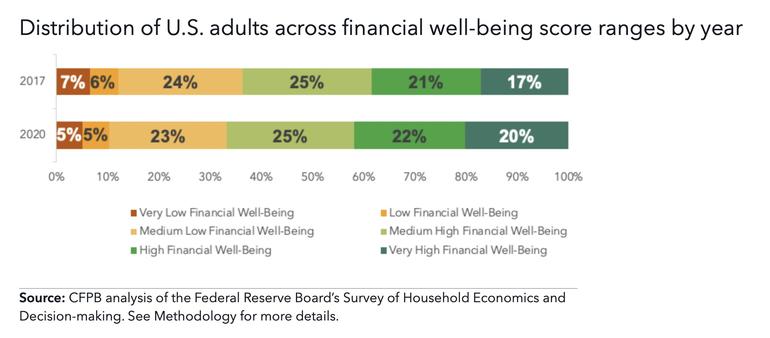
According to the CFPB, it created a “Financial Well-Being Scale” to better understand people’s day-to-day financial experiences and how their individual circumstances affect their ability to meet personal financial goals. The scale yields a financial well-being score – a single number between 0 and 100 –the “provides a holistic view of a person’s financial well-being,” the CFPB said.
The Bureau said it then groups the scores in six categorical ranges from very low to very high: very low, with a score ranging from 0 to 29; low, from 30 to 27; medium low, from 38 to 49; medium high, from 50 to 57; high, from 58 to 67; and very high, from 68 to 100.
Report Highlights
According to the CFPB, highlights in the Data Spotlight include:
- On average, financial well-being of U.S. adults increased slightly between 2017 and 2020, although one in 10 Americans had low or very low levels of financial well-being.
- Negative financial experiences or circumstances related to credit and banking were higher among adults with low or very low financial well-being.
- Those with low or very low financial well-being were more likely to face key pandemic-specific challenges.
- Those individuals with low or very low financial well-being in 2017 were more likely than the general population to receive government financial support in 2020.
- Despite the increases in financial well-being between 2017 and 2020, longstanding differences in financial well-being among some groups persisted in 2020.
- Between 2017 and 2020, U.S. adults of color, younger adults, and women had smaller increases in financial well-being than white adults, older adults, and men.
- Differences in income predict financial well-being, including differences among key racial and ethnic groups.
Has Everyone But You Heard the News?
Don’t forget to check your Spam/Junk email folder if you haven’t been receiving your free, popular and daily CUToday.info news headlines.
And if you haven’t yet signed up for the new email solution on which CUToday.info has partnered with ResponseGenius, you can do so here. Signing up requires less than one minute of your time.
CUToday.info has received very positive response from readers following the move to an improved provider of the daily headlines, but many also noted they did need to go to their Spam/Junk folder and mark it as safe.
The new email solution has not only improved every reader’s delivery experience, but it also features a fresh, new format that is easy to read, especially on mobile devices.
Please note and/or make your IT department or email administrator aware the emails will be coming from the domains CUTodayinfo.com and CUTodayinfoReply.com