

MADISON, Wis.–It’s a key question in front of many within credit unions as both decision-makers and consumers: “What can we expect for long-term interest rates during the next five years?”

Steve Rick
CUNA Mutual Chief Economist Steve Rick has offered his view as part of the latest Trends Report released by the company.
“As the economy recovers over the next few years and inflation runs above the Federal Reserve’s 2% average target, we can expect the 10-year Treasury to increase from 1.5% today to 3% by 2026,” Rick stated. “Moreover, the recent announcement by the Federal Reserve that they have begun to taper their quantitative easing program--printing up money to buy Treasury bonds and mortgage-backed securities--by $15 billion each month will increase long-term interest rates over the next year.”
So, what impact will this have on credit unions? Rick pointed to the chart, below, which he noted shows the strong correlation between the 10-year Treasury interest rate and credit unions’ yield on assets ratio.
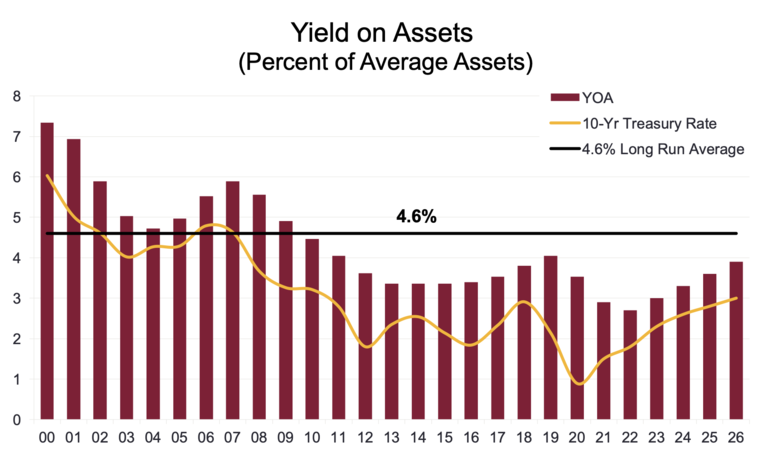
“As the market interest rate falls, so do credit union loan and investment yields, pulling down the yield-on-asset ratio,” Rick stated. “Historically there is a 1.3 percentage point difference between the 10-year interest rate and the credit union yield-on-asset ratio. This difference is the credit spread which accounts for the risk differential between lending to the credit-risk-free U.S. government and consumers.
“Even though we expect market interest rates to rise in 2022, we are forecasting credit union yield-on-asset ratios to fall to a record low 2.7 percentage points due to a one-year lag effect,” he continued. “By 2026, credit union yield-on-asset ratios are expected to climb to 3.9%, still below the 4.6% average reported by credit unions over the past two decades.”
The full Trends Report, including a “first in credit union history,” can be found here.