

MONTREAL, Quebec–NCUA Chairman Debbie Matz outlined six areas where she said she and the agency are focused in what she called “the year of regulatory relief.”
Speaking to NAFCU’s annual meeting here, Matz said NCUA has heard loud and clear from credit unions, and responded with changes in rules “During the next six months, you can look forward to seeing regulatory relief in at least six areas,” said Matz.
The six areas:
1. Risk-Based Supplemental Capital. “I’ve already heard many comments about supplemental capital. It turns out that under current law, NCUA could count certain forms of debt as supplemental capital for the risk-based capital ratio. For example, subordinated debt could be issued to members and non-members—but it would be uninsured. I understand the need for supplemental capital in certain circumstances. As part of modernizing risk-based capital, I am committed to counting supplemental capital in full. The proposed rule should be released for comment this fall. The effective date would coincide with implementation of risk-based capital in 2019.”
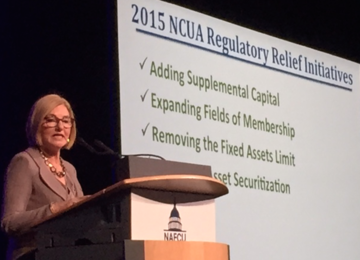
NCUA Chairman Debbie Matz speaking to NAFCU annual meeting in Montreal.
Matz noted that not every CU can wait until 2019 for supplemental capital, which is why she said she ahs created a working group to focus on low-income credit unions, which can already raise and count secondary capital. The goal, she said, is to increase access to secondary capital for low- income credit unions.
Matz noted efforts to streamline the low-income designation process has helped to double number of low-income credit unions, which now comprise 47% of all FCU.
2. Expanding Fields of Membership. “In the past, we had to approve every association you wanted to add to your fields of membership. This was a burdensome process for everyone, and it undermined your ability to serve members,” Matz said. “I felt strongly that you should not have to get approval from NCUA each and every time you want to add a well-established group. That’s why in April, we finalized a rule designating 12 categories of associations that federal credit unions can automatically add to their fields of membership. The final rule will take effect on July 6.”
Matz has also created a working group around FOM that is being led by NCUA Board Member Rick Metsger.
“Later this year, we’re going to propose sensible rule changes within NCUA’s legal authority,” said Matz. “The rule changes will be designed to broaden community charters, improve occupational charters, and streamline processes for federal credit unions to add new members.”
3. Elimination of the 5% Fixed Asset Cap. “We all know that an over-concentration in fixed assets is dangerous,” said Matz, who was applauded after making the announcement. “But when you run a business, there are certain expenses you can’t avoid…You should be able to run your business without needless red tape. I don’t believe that spending hours putting together waiver applications for routine business is a good use of your time. Decisions about fixed assets should be your decisions to make—and yours alone. Your credit union’s board of directors should have the freedom to set sensible fixed-asset limits that are appropriate for your operations. The good news is, this final rule will provide relief to 3,800 federal credit unions.”
4. Finalization of the Asset Securitization Rule. “As the credit union system grows in size and complexity, many of you have begun adopting more sophisticated financial innovations. We intend to allow larger, qualified credit unions to securitize their assets,” said Matz. “Remember, to be able to successfully conduct securitization, scale matters. Our final rule would permit the largest credit unions to tap new sources of liquidity and reduce interest rate risk by converting fixed-rate assets into cash.”
5. Easing of Restrictions on Member Business Lending. Pointing to the board’s recent vote in favor of easing rules on member business lending, Matz said, “We are moving away from a prescriptive approach to MBL rule limits, toward a principle-based approach that gives credit unions more flexibility to serve business owners. Rather than NCUA establishing business loan limits, you will have the freedom to set your own limits as you write your own policies.”
That announcement garnered applause, and Matz received more applause when she added, “We’re proposing to get NCUA out of the business loan approval process altogether. You won’t need to ask for business loan waivers any more. Determining whether to exempt a borrower from a personal guarantee is something that your loan officers should do, based on your prudent underwriting criteria. We also understand that prescriptive loan-to-value limits are sometimes an obstacle to serving members, so we’re proposing to remove LTV limits as well.”
Matz noted that all of the changes will require re-training of NCUA examiners, which will take some time.
6. Redefinition of what it means to be a “small credit union.” “Our analysis shows that credit unions with assets of less than $100 million generally offer just a few basic services and pose less risk to the Share Insurance Fund,” said Matz. “That’s why we are reworking the definition of ‘small.’ As a result, credit unions with assets up to $100 million will be considered for regulatory relief in future rulemakings. That’s 10 times more than the small-asset threshold of $10 million that was in place when I became chairman.”