

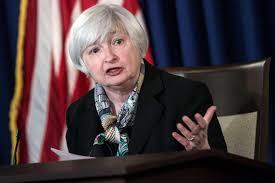
Janet Yellen, Federal Reserve
MADISON, Wis.–With wage growth and inflation expected to pick-up over the next year, CUNA Mutual is projecting that the Federal Reserve will raise the federal funds interest rate target another 0.75% to 1.00% in 2016.
After that – barring any negative economic shocks – the Fed will increase rates by 1% in both 2017 and 2018 to bring the federal funds interest rate close to their new neutral rate of 3.5%, the company added.
While its monthly Trends Report primarily summarizes data from the past, CUNA Mutual’s most recent Trends Report also includes a number of forecasts for what likely lies ahead.
CUNA Mutual pointed to the upbeat nature of the Fed’s statement regarding trends for the overall economy and the labor market, and noted that while Chairman Janet Yellen raised concerns that inflation – currently at 1.6% – was still running below their official target of 2%, she expects inflation should rise over the next couple of years as transitory factors – falling oil prices and a rising exchange rate – abate. “The pace of interest rate increases this time around will be significantly slower than the 3% per year pace set in 1994, the 1.75% per year pace set in 1999, and the 2% per year pace set in 2004, due to low actual and expected inflation,” said CUNA Mutual in its forecast. “Most credit unions will therefore face less interest rate risk during this tightening cycle compared to the aforementioned previous tightening cycles.”
Will rising short-term interest rates lead to falling credit union loan growth in 2016? According to CUNA Mutual, the “answer is a resounding ‘No.’” To support its forecast, CUNA Mutual pointed to figures showing credit union annual loan growth numbers for the past 23 years. In the years following interest rate increases – 1995, 2000, and 2005 – loan growth actually accelerated due to consumers reporting higher confidence and attempting to get out ahead of future interest rate increases, CUNA Mutual said.
Among its other forecasts:
- “We expect 2015 to be a record year for new auto sales, coming in at 17.5 million units. There is still some pent-up auto demand of around 2.5 million cars and light trucks due to the subpar economic performance during the last seven years. Expect auto sales to remain at the 17.5 million pace in 2016, and then declining to 17 million in 2017, and 16.5 million in 2018. By 2018, the economy should be to its natural pace of vehicle sales, the natural rate of output, the natural unemployment rate, and the neutral fed funds interest rate.”
- “In 2015, credit unions originated 8.5% of all mortgage loans in the U.S., up from 4.4% in 2010. The number of first mortgage loans as a percent of members in offering credit unions – the penetration rate – rose to only 2.4% in the third quarter, up slightly from 2.3% one year earlier. This indicates credit unions have a great unfilled opportunity in the mortgage market arena.”
- The contract interest rate on a 30-year, fixed-rate conventional home mortgage fell to 3.80% in October, from 3.89% in September, and below the 4.04% reported in October 2014. By mid-December, mortgage interest rates rose to 3.95% in anticipation of the Federal Reserve’s interest rate hike, the company said. “Expect the 30-year mortgage interest rate to increase 15 basis points each quarter during the next year, reaching 4.5% by year-end 2016. We don’t expect the interest rate rise to have a significant negative impact on housing demand due to the still historically low level of interest rates in 2016. Rising interest rates will lead to a pullback in refinancing applications, but improving consumer balance sheets and tightening labor market conditions should boost purchase activity.”
- CUNA Mutual said that credit unions’ cost of funds should rise in 2016 as the Federal Reserve raises the federal funds interest rate 0.75% to 1%. “Credit unions will follow suit and raise interest rates on share certificates and money market accounts similar to what they did in 1994 and 2004,” the company said.