

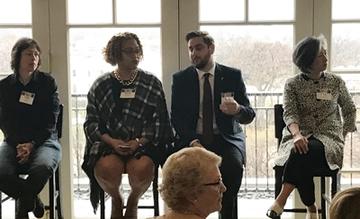
WASHINGTON–What ticks some people off when it comes to diversity, or the lack thereof? During the Underground Collision Conference, here’s what four people said gets under their skin.
Lucy Ito, president, NASCUS
“I don’t think credit union membership in the U.S. looks like America. It continues to be the case. The second thing that ticks me off is in our credit union marketing we continue to talk to people who already belong to credit unions instead of people who don’t.
“Being Asian, and having been with credit unions for 30 years now, from the beginning through today I wish that more Asian-Americans knew about credit unions. Why aren’t we reaching them? I get frustrated that my fellow Asian-Americans aren’t aware. I was pleased to see recently that San Diego County CU was celebrating the Lunar New Year, the Year of the Dog.
“As I heard Sarah Canepa Bang say once, we need to be able to reach the underserved and the over-tattooed. I don’t think most boards have someone like that; people who don’t look like the typical credit union member. So, I am encouraged, but still frustrated.”
Paul Norgrove, CEO, Police Credit Union, United Kingdom
“What ticks me off in the U.K. is board recruitment, because it is just nonexistent. I say to board members,
‘The credit union is not yours, it’s your thing to look after forever.’
“In the U.K., we launched a new program to get younger board members, and I heard one member of the trade association board say under his breath, ‘What do you guys know about credit unions?’ (Editor’s note: Norgrove is 30 and was recruited as part of the program.) We may not know how to run credit unions, but we do know what not to do. We know it appears to be not that attractive to be involved in. Why aren’t we plugging those people into career paths?
“When you need a board member do you reach out to all your members, or do you have a board member who says, ‘I know this guy, he’s a great guy.’ And you end up with a board that all looks the same–45-60, white, male. If you have hair, it’s gray. If you don’t, apologies.
“You need a multitude of skills and talents. The movement is only sustainable if it is diverse. Ease off on the tokenism and the next time you look in the mirror and ask are you mad or are you making a difference? And if you aren’t, just leave. It’s the only way to be relevant to our members.”
Stacey Walker, board member, Xcel FCU
“What pisses me off about diversity is that we talk a lot about diversity and we talk and talk and talk. But we don’t do much more than talk. The level of our actions doesn’t match how much we talk about diversity.
When I started it was all about how to get Gen X. Now it’s how to get Millennials. There needs to be an individual commitment level. Is your credit union committed to diversity? Do you have staff on board responsible for overseeing diversity initiatives?
“I think we also need to get to the source of what we believe. There are people on boards who will throw out seeds of doubt. I heard one person recently say, ‘Young people don’t want to volunteer; they don’t care to volunteer.’ I was appalled. I thought to myself I joined the credit union (board) 13 years ago. If you don’t think young people want to get involved, what do you think about my level of engagement and interest? Their actions reflect their beliefs, whether it’s true or not. They recruit people who look like them. It’s not about checking off a box. It’s about finding someone who is qualified.”
Linda Bodie, CEO, Element FCU, Charleston, W.V.
“I have been the CEO of a $31-million credit union in Charleston, W.V. for 20 years. And I’m gay, just so you know. That’s not anything I ever heard in 20 years of attending credit union conferences; it never came up. In my 20 years of attending conferences this crowd looks exactly the same as it did 20 years ago. There still isn’t anyone standing up and saying, ‘I am gay,’ not that they should.
“Charleston, West Virginia is a gay mecca—not. When I started in credit unions I was 30 and I was way gay before I was a credit union activist. As a small credit union in West Virginia I am in this foreign land. They are all white. The men run the big credit unions, and the women run all the small credit unions.
“I finally took some baby steps to do something ourselves. We became very involved with our gay population. We made up a t-shirt in 2010 that said, ‘Coming Out is Easy Compared to Dealing with Your Bank.’ It’s probably even truer now.
“Create products and services that relate to those people that make them feel accepted when during their entire lives they have been locked out of the system. The ‘gay agenda’ is people want to feel loved, like everyone else. The thing that pisses me off is people say if you are for something, then you are against something else. The point is it matters to our entire population, not just our staff, boards, CEOs—it matters all over. The gaydar thing is real and I haven’t been pinging much lately.”
During a Q&A, one audience member said he had a discussion recently with the credit union CEO who is gay and he was asked about participating in a local gay parade. The CEO responded, ‘Do you think my board would actually let me do that?’ I think that this is so uncomfortable in credit unions. Are we reaching out to other minorities? I think we need to ask our we really walking the walk or are we just talking the talk?”