ST. PETERSBURG, Fla.–While there’s been a slowing in overall debit and credit card usage by members, the trend is a bit misleading, as earlier numbers were abnormally robust, according to the latest analysis released by PSCU.
The company’s Advisors Plus and Data & Analytics teams has released year-over-year weekly performance trends, with the most recent installment comparing the eighth week of the year (the week ending Feb. 21, 2021) with week ending Feb. 23, 2020.
“While overall growth rates for both debit and credit spend appeared to continue to soften in Week 8, these trends may actually be normalizing given the high levels of February 2020,” said Glynn Frechette, SVP, Advisors Plus at PSCU. “In this week’s deeper dive, we take a look at the impact of the Texas winter storms. With historically low temperatures causing virtually the entire state to shut down, we saw significant declines in debit and credit purchases, along with double-digit declines in most merchant category sectors across Texas. As the effects of the second round of stimulus funds wear off throughout the country, we will continue to monitor the impacts on spending behavior as a third federal stimulus package works its way through approvals.”
Debit & Credit
According to PSCU, growth rates for both debit and credit continued to slow in Week 8.
- Debit card spend is up 8.6% in Week 8 and debit transactions finished down 5.4%. Debit purchases are lower than the previous four-week average of +18.6% and transactions are also lower than the previous four-week average of +3.1%.
- Credit card spend in Week 8 finished up 0.6%, below the previous four-week average of +3.8%. Transactions finished down 5.8%, lower than the previous four-week average of -3.2%.
Digital Transactions & Card Not Present
PSCU noted consumers continue to show strong adoption of digital payments, including contactless, mobile wallets and Card Not Present (CNP) alternatives, while using less cash.
Among its findings:
- Contactless “tap-and-go” transactions via dual interface cards continue to show strong consumer acceptance, with debit showing notable strength. Debit contactless transactions as a percent of Card Present activity on contactless debit cards have more than doubled from around 8.4% in January 2020 to 18.2% in Week 8 of 2021.
- Contactless credit transactions have also more than doubled, growing from 6.5% to 13.8% of Card Present activity on contactless credit cards in the same timeframe. “We continue to view these results as conservative, as the ratio considers the proportion of contactless activity to all card present transactions, not just those able to be tapped,” said PSCU.
- Mobile wallet (i.e. “Pays”) transactions and purchases for both credit and debit cards continue to show good growth with Card Present activity. Debit mobile wallet purchases finished Week 8 up 52.9% year over year, lower than the previous four-week average of +59.1%. Credit mobile wallet purchases are up 39.5% year over year, lower than the previous four-week average of +42.0%. These results represent six supported mobile wallets: Apple Pay, Fitbit Pay, Garmin Pay, Google Pay, LG Pay and Samsung Pay.
- We continue to see more volume conducted via Card Not Present (CNP) transactions. For credit, 54.8% of purchase volume and 44.4% of transactions are CNP. For debit, 43.9% of purchase volume and 31.4% of transactions are CNP. Purchase mix has held steady and is up 6.7 percentage points year over year for credit and 6.6 percentage points for debit. Transaction mix also remains steady, up 9.7 percentage points for credit and 8.0 percentage points for debit year over year.
- Cash withdrawal transactions at the ATM are down year over year. For the most recent week, the number of cash withdrawals was down 26.6%, below the previous four-week average of -20.4%.
Merchant Categories
From a merchant category perspective, PSCU said it continues to see strong results in Goods, Utilities, Service and Grocery Stores, while year-over-year performance for Restaurants remains down. Drug Store performance has seen a steady decline in the past few weeks. (All percentages are year-over-year weekly comparisons.)
Among the findings:
- Purchases in the Goods sector are trending downward, but are still positive overall, with credit spend up 15.7% and up 17.4% for debit; Utilities spend was up 15.5% for debit and up 13.6% for credit; Service spend was up 7.1% for debit and up 4.6% for credit; Grocery spend was up 3.0% for debit and up 13.6% for credit.
- Sectors struggling to return to positive growth include Drug Stores, which are down 5.1% for debit and down 3.4% for credit, and Restaurants, which finished down 3.3% for debit and down 15.4% for credit.
Regional Analysis
Using U.S. Bureau of Economic Analysis (BEA) data for regional analysis, PSCU further reported:
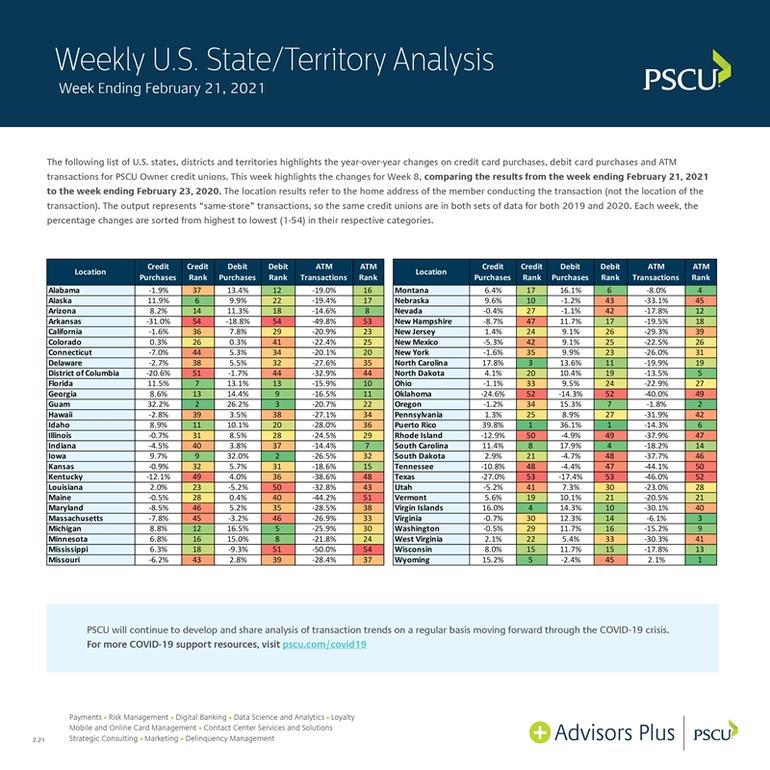
- Overall U.S. spend was up 0.6% for credit purchases. The Southeast (+7.1%) and Plains (+4.8%) finished as the strongest regions for Week 8. The Southwest (-17.4%) and New England (-6.1%) regions had the lowest credit purchase performance.
- Overall U.S. spend was up 8.6% for debit purchases. The Plains (+12.4%) and Southeast (+10.5%) finished as the strongest regions for Week 8. Hawaii (+3.5%) and the Southwest (-2.6%) region had the lowest debit purchase performance.
- PSCU reminded its Weekly U.S. State/Territory Analysis is available at www.PSCU.com/COVID19, ranking U.S. states and territories by year-over-year performance for debit purchases, credit purchases and ATM transactions.
The Deeper Dive
In its Deep Dive this week, PSCU took a look at the impact of the Texas winter storms, where record-low temperatures, snow and ice led to substantial power outages across the state and, along with the loss of tap water, affected most of the state’s 29.8 million residents. Among the findings:
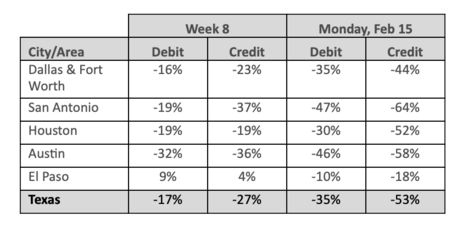
- There is a notable reduction in purchases beginning Sunday, Feb. 14, continuing into the next few days. For Week 8 in the state of Texas, debit purchases are down 17% and debit transactions are down 31%. Both credit purchases and credit transactions are down, 27% year over year for the same timeframe, PSCU said.
- For more context, PSCU broke out the major metropolitan areas of Texas. The most impacted day for purchases for each region during these events is Monday, Feb. 15, which was the day of the lowest below-freezing temperatures, PSCU said. Highlighted below is the year-over-year impact of purchases for both Week 8 and that individual day.
- For Week 8, the largest drop in debit purchases was in Austin, down 32%. For credit purchases, San Antonio and Austin were similarly impacted, down 37% and 36%, respectively.
- For Monday, February 15, San Antonio and Austin are again close, with debit purchases down 47% and 46%, respectively. For credit purchases, San Antonio and Austin are the most impacted, finishing down 64% and 58%, respectively.
- The city of El Paso, in west Texas, is one of the few locations in the state that posted positive growth figures during the winter storm week. El Paso did not experience power outages, as they are not a part of the Electric Reliability Council of Texas (ERCOT) power grid. For Week 8, debit purchases in El Paso are up 9% year over year, while credit purchases are up 4%.
For Week 8 in Texas, most sectors posted drops in purchases, with a few exceptions, according to PSCU.
Among its findings:
- The Goods, Service and Grocery sectors account for 55% of debit purchases and each had double-digit reductions, finishing down 14%, 31% and 12%, respectively. These same three sectors accounted for two-thirds of all credit purchases in Texas in Week 8. Credit purchases are down 24% for Goods, 38% for Service and 5% for Groceries.
- P2P Payments posted weekly increases. For Week 8, debit purchases were up 28% and credit purchases are up 9%.
- In the Utilities sector, debit purchases are up 1% and credit purchases are up 7%.