

WAIMEA, Hawaii–The future of auto lending is “A.C.E.S.,” according to one person, and credit unions are going to have no choice but to respond.
Speaking to Rochdale Paragon’s Volunteer Leadership Institute here, Tony Boutelle, president and CEO of CU Direct, the indirect auto lending CUSO that serves 1,100 CUs and which has relationships with 15,000 auto dealers, noted that today about 85% of all auto loans still take place at the dealer, primarily for gas-powered cars. But all that is changing, he said.
Boutelle noted CUDL credit unions as a group did more loans than any of the other auto lenders in the U.S. in 2021, finishing just ahead of Capital One. In 2021 it did $58 billion in auto loans, with about three-quarters of those at the dealership.
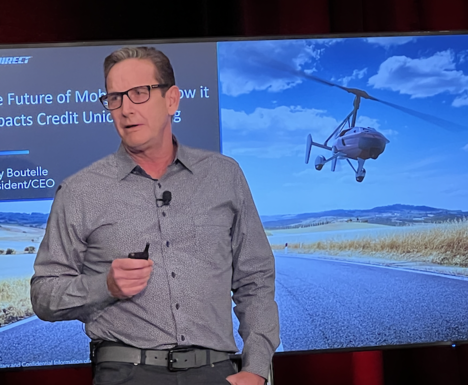
Tony Boutelle of CU Direct speaking to Volunteer Leadership Institute in Hawaii.
But regardless of the lender, the types of vehicles being financed is undergoing dramatic change. In early 2018, 1% of vehicles purchased were electric. By 2025 that number is expected to hit 25%.
“We need to build relationships with some of these players that are selling cars online,” said Boutelle. “We have had discussions with Carvana and Carmax, but the problem is they have their own lending operations.
“The other thing that’s going on is the sales experience is evolving and is no longer taking place at the traditional dealership,” he continued. “How Tesla sells cars is showrooms, and other luxury brands are starting to do this now. Due to franchising laws you can’t sell the car there, you have to go and buy it online. Tesla has made it very easy to buy online. We’re seeing the experience change. It’s probably a good thing from a consumer perspective, but from an indirect lending perspective that could be a risk to us and we need to pay attention to that.”
The Future is A.C.E.S.
The future is “A.C.E.S.” according to Boutelle, which stands for autonomous, connected, electric, and shared.
Moreover, the future is autonomous vehicles available on demand, Boutelle said. And that pace of change is also a risk, he noted.
"It’s amazing how fast things can change in a 10-year period,” observed Boutelle.
To illustrate the point he showed a picture of New York City in the early 1900s where there was one car on a street full of horses. Thirteen years later a photo of the same street showed one horse on a street packed with cars.
Boutelle shared with the audience a graphic showing a near vertical line indicating projections for the sale of electric vehicles.
Autonomous Vehicles
Billions of dollars have been spent on autonomous vehicles over the past decade, but the technology has not rolled out in the market nearly as quickly as many had predicted, noted Boutelle. The big reason? “This happened,” said Boutelle, pointing to a photo of a Tesla that rear-ended a fire truck while operating autonomously. “The issue with autonomous driving is there are so many factors you have to think about and account for,” he said.
But Tesla and others are pushing ahead. Tesla has three-billion miles of autonomous driving recorded. Other companies with similar data include Waymo (a unit of Google) and Cruise (a unit of GM and Honda).
Boutelle cited one KPMG study that measures autonomous readiness of various countries, with the United States ranked fourth in large part due to infrastructure shortcomings when it comes to the ability of vehicles to communicate.
Nevertheless, numerous states have approved legislation allowing for autonomously driven vehicles, he said, including Florida, Texas and California. Boutelle said he expects autonomous vehicles will first take hold with delivery vehicles, with Amazon being a major force behind the trend.
Overall, the new prediction for autonomous vehicles being widely available and deployed in the market is 2030, he said.
Electric Vehicles
Electric vehicles are growing exponentially, stated Boutelle. Eighteen of the 20 largest OEMs have committed to increase their offers and sales of EVs, he observed.
Where will the crossover take place when electric vehicles outsell combustion engine vehicles? Around 2035 is the forecast, he shared.
The impact on other businesses is going to be profound, particularly in service, which is where most auto dealers make most of their profits, said Boutelle, noting he has owned a Tesla for three years and has only changed the tires and replaced the windshield wipers over that time. “If I were a dealership right now I would really think about selling. You’re seeing many more sales happening to publicly owned companies, especially the mom and pop dealerships,” he said.
One other “crazy thing” reflective of a changing industry is valuations, said Boutelle. Tesla, which sells fewer vehicles than GM, has a higher market cap than the long-time manufacturer. Rivian, which has produced almost no vehicles, had a valuation north of $60 billion.
There have been barriers to electric car adoption, but those are all coming down, said Boutelle, pointing to battery range, availability of charging stations and charging time, and cost. All three are becoming much more consumer friendly, he added.
Shared Economy
The shared economy is often represented by Uber and Lyft, but it’s really about SaaS, or Sharing as a Service, according to Boutelle, who noted that approximately 92% of the time a car is parked and not used. In this category SaaS is about car sharing (in which owners rent out their own cars for others to use), managed fleets and subscription companies . The latter has not seen the success many had projected—although Boutelle said the Care by Volvo subscription plan is a “pretty good deal.”
Where Is Industry Headed?
Boutelle said “we’re not there yet” with the “big parts” of the transition to A.C.E.S, and that especially includes infrastructure.
“You will continue to see the increase in electric car sales and the shared economy. You will probably always own a car, but you will also probably only have one instead of two,” he said. “Having a car that can come and get you and take you where you want to go is a pretty cool thing.”
What does all this mean for lending?
“It means we’ve got to build relationships with other players,” said Boutelle. “But don’t panic. About 70% of the car loans on the CUDL platform are used cars. These are solid cars that are going to stay on the road, and another 16, 17 million coming on the road every year and we’re going to continue to make loans on that.
“Traditional financing, I think, is really going to be there for a while, but building relationships with the Carvanas of the world—and we are reaching out to these players—you have to get them early. We have talked to Tesla for five years and finally have gotten a direct lending role with them. We have ACH with Tesla; they hate getting checks from you, that’s a pain point for them we have helped to solve. We have reached out to Rivian and Lucid and the other new players.”