BANGKOK, Thailand–Could a payments model being promoted by Thailand’s government eventually expand to other countries? A new analysis finds the National e-Payment Master Plan in Thailand is having a slow effect on the use of cash.
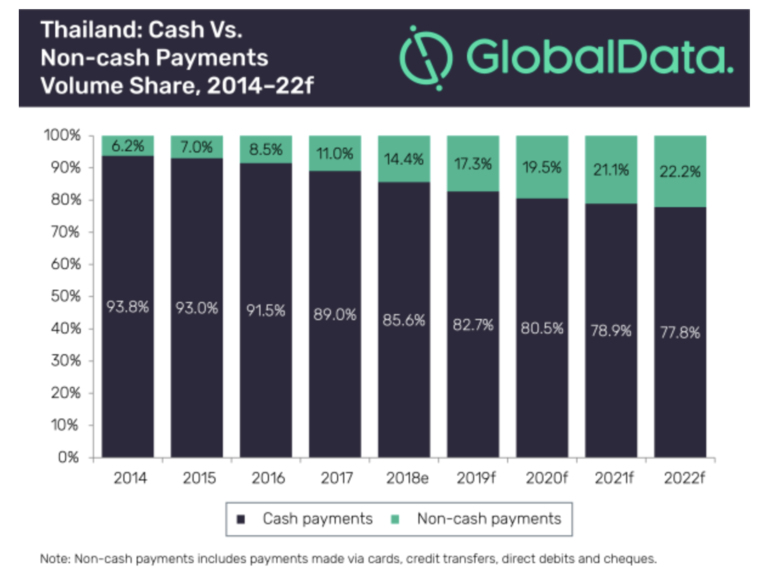
According to GlobalData’s “Thailand Cards & Payments: Opportunities and Risks to 2022,” the share of cash in the overall payment volume in the country is expected to decline from 85.6% in 2018 to 77.8% in 2022. During the same period, the total card payment value is expected to increase from THB1.8 trillion (US$56.1bn) to THB2.7 trillion (US$83.8bn).
“The government’s attempts to promote non-cash payments such as the introduction of faster payments and QR codes, mandatory issuance of EMV cards and push for point-of-sale (POS) adoption are contributing to the growth of electronic payments,” said Nikhil Reddy, Payments Analyst at GlobalData.
As part of the National e-Payment Master Plan, the Thai government launched a nationwide program in 2017 to drive POS installation among smaller retailers and government agencies. Merchants were offered benefits such as tax deduction, fee waivers on POS issuance and rental, and a cut down on merchant discount rates, GlobalData noted.
Half of Population
The report explains that in 2016 the Bank of Thailand launched a faster payment system, PromptPay, allowing users to make peer-to-peer transfers and payments through their mobile phone using only the recipient's mobile number or national ID number. As of December 2018, 46.5 million users, over half of the country’s population, had registered for the system.
In August 2017, the central bank collaborated with American Express, JCB International, Mastercard, UnionPay, Visa and other financial services providers to introduce the Thai QR Code Payment standard, with an aim to create an open, interoperable payments infrastructure, the report adds.
“Though cash will continue to remain dominant in Thailand, these measures will certainly propel electronic payments, thereby further reduce the usage of cash over the next five years,” said Reddy.