MINNEAPOLIS–In a surprising twist, regulatory compliance and risk management concerns have collectively dropped for the first time in a survey of financial institution executives.
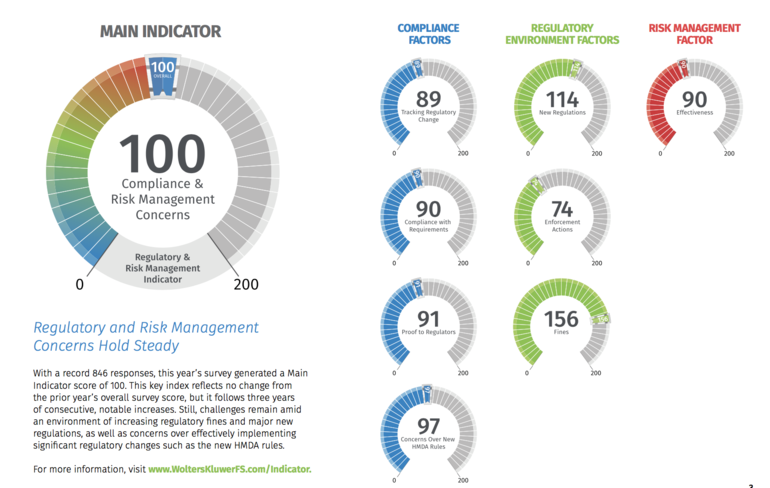
Wolters Kluwer is reporting that its annual Regulatory and Risk Management Indicator of U.S. banks and credit unions found that while the overall Indicator score remained unchanged from 2015, lower scores were tallied in indices measuring concerns in organizations’ ability to track regulatory changes, comply with regulatory requirements, and report on compliance to regulators. Risk management concerns also dropped from previous Indicator surveys, Wolters Kluwer said.
The Indicator was conducted nationwide Sept. 9-22, 2016 and generated a record 846 responses this year, up from 539 responses in 2015.
“After years of steady increases, the diminution in anxiety levels this year is most encouraging, suggesting that banks and credit unions feel they are more effectively managing their risk and regulatory requirements despite a regulatory climate that has not eased,” said Timothy R. Burniston, EVP-U.S. advisory services and regulatory relations. “While the survey doesn’t measure why concerns have leveled off, a strong possibility is that respondents have been arming themselves with better tools, resources and programs to help navigate through the wide range of complex challenges they face.”
Respondents’ concerns over their organizations’ ability to maintain compliance with changing regulations dropped from 73% last year to 66% in 2016; those concerned in demonstrating compliance to regulators fell from 71% to 64%; and concern over keeping track of changing regulations dipped nine points, from 72% to 63%. Anxiety about managing risk across all lines of one’s business dropped from 58% to 52%.
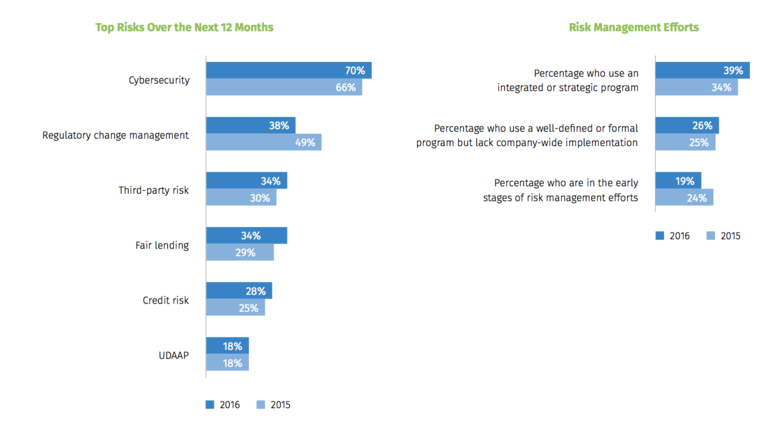
Burniston pointed to a 5% increase over 2015 results in organizations that reported having “an integrated or strategic risk management program.”
He also noted that a majority of respondents, 78%, cited confidence in the ability of their organization “to manage a regulatory change such as TRID, HMDA or URLA, and a nearly equal percentage, 77%, who were “confident in their organization’s compliance management system.”
“While these are notable, positive changes from past results, we need to interpret these findings within the larger context of overall concerns expressed by respondents in managing regulatory and risk challenges facing their organization,” Burniston said, “especially given a regulatory environment in which the number of new regulations jumped 14% from 2015, and a supervisory enforcement climate where the amount of fines and penalties imposed increased 56%.”
Wolters Kluwer said in its analysis that to further illustrate this point, overall concern levels regarding new HMDA data collection requirements have dropped from 73% two years ago to 59% today, likely due to the fact that the content of the revised HMDA regulation has been released by the CFPB since that time. But concerns about implementing the new rules still elicits a relatively high level of angst. Respondents’ worries over accurately capturing new HMDA data fields (64%) remained unchanged from 2015 scores, and there was a 6% increase to 45% in those citing staff training as “a major concern,” the survey found.
While 72% of respondents confirmed that their chief compliance officer has the ear of executive leadership, reporting directly to either the president/CEO or board of directors, 33% of respondents cited inadequate staffing, another 26% cited manual processes, and 21% cited competing priorities as major obstacles to effectively implementing their compliance programs, Wolters Kluwer reported.
Among other key findings:
- Cybersecurity was cited as among the top risks anticipated in the coming 12 months with a 70% score.
- That was followed by regulatory change management at 38%.
- In a tie, fair lending and third-party risk were rated as a top risk by 34% of respondents.
- Regarding fair lending examinations, 41% perceived “modest to significant increases in regulator scrutiny,” whereas 29% felt regulatory scrutiny was the same as in 2015.
For more info www.WoltersKluwerFS.com/Indicator