

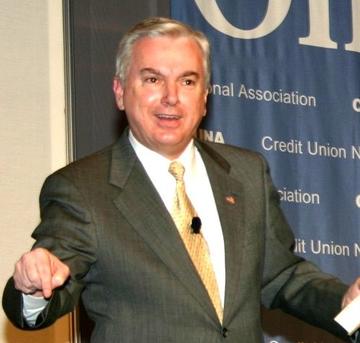
Dennis Dollar
BIRMINGHAM, Ala.—Dennis Dollar believes the American Bankers Association stands little chance of winning its lawsuit against NCUA over its new field of member rules, especially when considering the 1999 ruling against the trade association in a similar suit.
“The likelihood of a banker lawsuit against NCUA when they pass a new FOM rule is as certain as the likelihood of Hillary Clinton not inviting Donald Trump to her Christmas party this year,” said the former NCUA chairman. “Such a lawsuit has been a given since the FOM rule was first proposed.”
The Dollar Associate’s principal believes the ABA suit is driven by the trade group’s ever-dwindling market share of community banks.
“The ABA is using such legal actions in an attempt to remain relevant for their hemorrhaging number of members in a marketplace totally dominated by their big bank members by blindly blaming their shrinking community bank market presence on credit unions that have basically had the same percentage of the marketplace they had twenty years ago,” said Dollar.
Dollar predicts that the ABA lawsuit will face the same fate in court as did the 1999 ABA lawsuit when the NCUA was upheld completely on FOM rules that were much more expansive, Dollar noted.
“The 1999 rules had no population caps, no limitations of community charters to MSAs or CSAs and no concentration of facilities test for underserved areas,” explained Dollar. “This rule has all three of these very tight restrictions. Yet the court upheld NCUA on the 1999 rules even though they were much, much broader than these rules.”
Dollar said that if the courts look at their own precedents on FOM rules and recognize that NCUA is the agency given authority by Congress to define FOM rules for credit unions within the law, this case should be a clear, decisive win for NCUA.
“Congress never delegated the authority to define credit union FOM to the ABA or the ICBA, nor frankly to CUNA or to NAFCU. The authority to define FOM was given to the presidentially appointed and Senate confirmed NCUA board, and that board has approved these rules on a bipartisan unanimous vote in accordance with the flexibility the law allows them,” said Dollar. “NCUA, frankly, could have gone much further with these rules and been still well within the law.”