

CHICAGO–The war against the coronavirus has also led to a war against digital fraud, according to one new report.
A new quarterly analysis of global online fraud trends by TransUnion found that since the COVID-19 pandemic began, fraudsters have dramatically increased their rate of digital schemes against businesses.

In addition, TransUnion’s recent Global Consumer Pulse Study found that more than one-in-three global consumers have recently been targeted by digital fraud related to COVID-19.
TransUnion said its conclusions about fraud against businesses based on intelligence from billions of transactions and more than 40,000 websites and apps contained in its flagship identity proofing, risk-based authentication and fraud analytics solution suite, TransUnion TruValidate.
Big Increase
According to TransUnion, it found the percent of suspected fraudulent digital transaction attempts against businesses worldwide increased 46% when comparing the following two periods: Period #1, March 11, 2019 and March 10, 2020; Period #2, March 11, 2020 (when the World Health Organization declared COVID-19 a global pandemic), and March 10, 2021. In the U.S., this percentage increased 22% in the same timeframe.
“Fraudsters are always looking to take advantage of significant world events. The COVID-19 pandemic and its corresponding rapid digital acceleration brought about by stay-at-home orders is a global event unrivaled in the online age,” said Shai Cohen, senior vice president of Global Fraud Solutions at TransUnion. “By analyzing billions of transactions we screened for fraud indicators over the past year, it has become clear that the war against the virus has also brought about a war against digital fraud.”
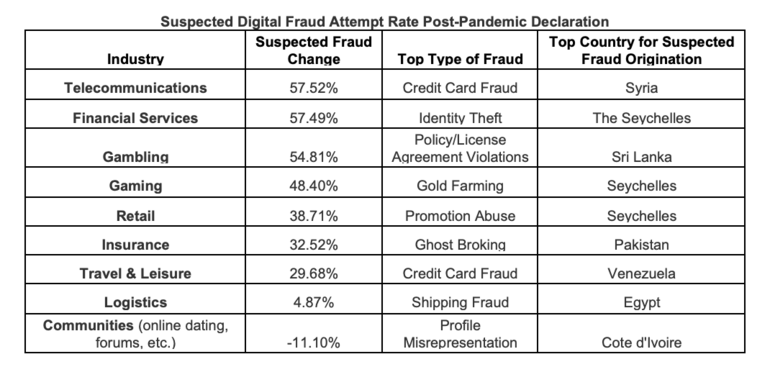
Looking globally across industries, TransUnion reported it found the countries with the highest rate of suspected fraudulent digital transactions during the pandemic (from March 11, 2020 to March 10, 2021) were: 1) the Seychelles, 2) Kazakhstan, and 3) Turkmenistan.
In the U.S. overall during that same time period, TransUnion found the cities with the highest percent of suspected fraudulent transactions were: 1) Tempe, Ariz., 2) Hamtramck, Mich. and 3) Colonial Park, Penn.
Consumers Targeted By COVID-19 Schemes
Meanwhile, TransUnion’s Global Consumer Pulse Study also found that as of March 16, 2021, the 36% of consumers who said they are being targeted by digital fraud related to COVID-19 in the last three months is higher than approximately one year ago. In April 2020, 29% said they had been targeted by digital fraud related to COVID-19. In the U.S., this percentage increased from 26% to 38% in the same timeframe, the company said.
Gen Z, those born 1995 to 2002, is currently the most targeted out of any generation at 42%. They are followed by Millennials (37%). Similarities were observed in the U.S. where Gen Z was most targeted at 53% followed by Millennials at 40%, TransUnion said.
“TransUnion documented a 21% increase in reported phishing attacks among consumers who were globally targeted with COVID-19-related digital fraud just from November 2020 to recently,” said Melissa Gaddis, senior director of customer success, Global Fraud Solutions at TransUnion. “This revelation shows just how essential acquiring personal credentials are for carrying out any type of digital fraud. Consumers must be vigilant and businesses should assume all consumer information is available on the dark web and have alternatives to traditional password verification in place.”
Examining Fraud Types, Impact on Industries
TransUnion reported it analyzed the below industries for a change in the percent of suspected digital fraud attempts against them, comparing the periods of March 11, 2019-March 10, 2020 and March 11, 2020-March 10, 2021.
Through the TruValidate solution, TransUnion said it documented a 19% growth in transactions among its global iGaming customers from 2019 to 2020, and recently researched its fraud impact in a special report. It determined that its online gambling customers experienced a 9% increase in the rate of suspected fraud when comparing 2019 to 2020 among the 576 million iGaming transactions TransUnion analyzed for risk indicators last year.
“Despite it being one of the hottest growing industries, TransUnion observed a decrease in the iGaming mobile transaction rate for the first time since at least 2016,” TransUnion said. “However, iGaming on mobile devices is still much higher than desktops with the percent of online gambling transactions coming from mobile devices at 69%.”
Added Gaddis, “We believe mobile online gambling transactions dipped because so many people used their desktops while working from home during the pandemic. However, we expect the long-term impact of mobile to continue to be paramount for business success. Mobile devices will be key to providing a seamless way for online gamblers to transact and businesses to assess risk with biometric-driven multifactor authentication.”