

MADISON, Wis.–Among the areas of expertise many credit union associations have had to build in the pandemic of the past 15 months is the ability to effectively host virtual annual general meetings.

During a webinar hosted by the World Council of Credit Unions, some of the best practices and lessons learned in annual general meetings were shared, much of which has been compiled in a new white paper from WOCCU titled “Considerations for Planning a Virtual AGM.”
Highlights of the white paper were shared by Kassandra Schroeder, manager, virtual engagements and special events with the World Council.
“You might think your first step is to find a meeting platform and start from there, but you want to really start with the end in mind and what the meeting’s purpose is,” said Schroeder.
But addressing a number of questions and considerations first, an organization can then develop the strategic meeting plan that identifies the core technical needs of the meeting, Schroeder explained.
Among the questions and considerations reviewed in the white paper and discussed by Schroeder:
Key AGM Elements
Schroeder said the key elements of any AGM include:
- Authentication of participating members
- Verification of quorum
- Acceptance/rejection of reports
- Acceptance/rejection of motions
- Voting
- Member queries
Answering those questions and others, reminded Schroeder, allows the AGM host to do a better job of selecting the best virtual platform for the meeting.
Schroeder reminded virtual general meetings are different from in-person events, with the former benefiting from scripted agendas and time management as well as directed questions and concise responses.
Overall, in assessing needs, Schroeder noted the white paper explains the areas that must be considered include:
- Meeting format
- Audience (if closed meeting, secure invite to members only)
- Voting (motions in polling feature, ballots offline)
- Language (many WOCCU member countries use multiple languages)
- User Experience (must be a mobile-friendly platform)
- Production (will there be prerecorded intros or presentation, from where will the chairman broadcast? etc)
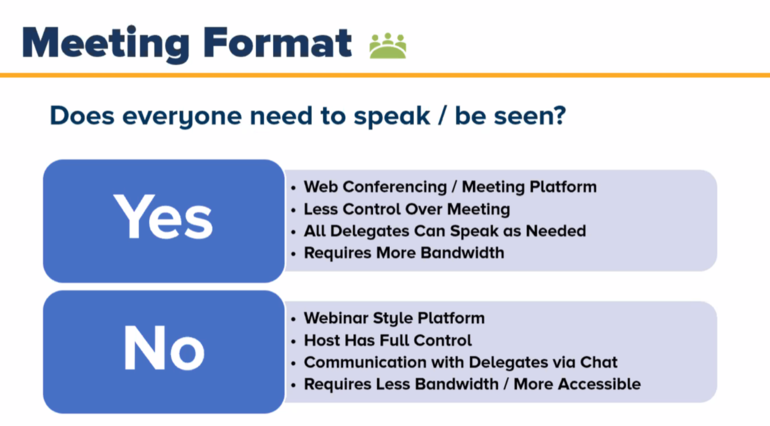
Meeting Format
With the meeting format, the key questions to ask are outlined below:
Audience
The next questions surround who will be in the audience and whether it will be a closed or open meeting. If closed, said Schroeder, then only delegates receive and invite, which guarantees that all participants are delegates. That makes it easy to identify a quorum and all participants can vote and/or participate in motions.
If it’s an open meeting, voting delegates and observing-only audience are both online, it makes it more complicated to ascertain a quorum, and there is a more complex voting system.
An open meeting also requires separate links for voting and non-voting participants, must be password-protected for secure user authentication, and requires more bandwidth, among other issues, she added.
In either case, said Schroeder, organizers must prepare for a higher-touch effort than might be required with a physical event, including sending reminders and making sure people understand the links to use.
Voting
When it comes to voting, agenda considerations must include, Schroeder said:
- How many items are on the ballots?
- Is there a need to announce results in real-time at the meeting?
- How many motions are expected?
- Are votes weighted?
- Will all participants in the meeting be allowed to vote?
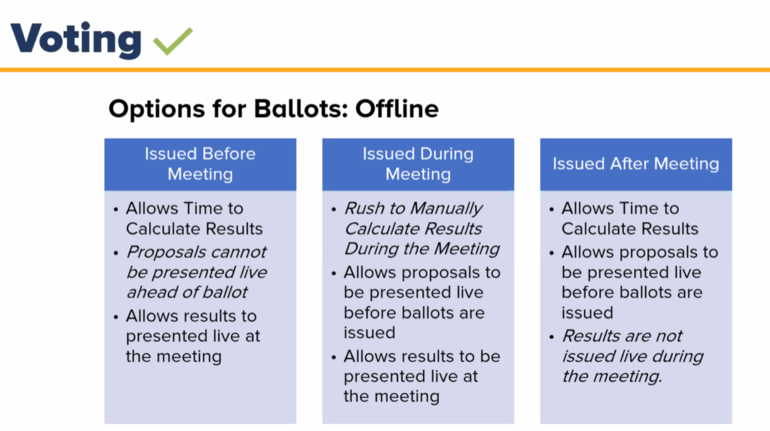
Options for motions also need to be considered, including roll calls, polling, and “nay only,” which can be expressed vocally or in the chat, explained Schroeder.
In some countries, Schroeder noted language can also be an issue to consider in virtual AGMs and those need to be included as part of the platform, such as the ability to handle multiple audio feeds. Live captioning is another option, available through a number of providers. “But this is likely to be machine-translated, so if you have uncommon terms you need to keep that in mind,” she said.
User Experience
There may be some great ideas for the events, but Schroeder said considerations to be kept in mind include personal device limitations, bandwidth limitations, ease of use and satellite groups.
Production
The last consideration is production, including the technical capabilities of speakers, and that involves lighting, setting, audio and connection.
Vendor Considerations
When it comes to negotiating with vendors, the WOCCU white paper said points to consider include:
- Is the rehearsal included in the price?
- If it’s a closed meeting with confidential matters discussed, there must be a confidentiality section in the contract.
- Ensure technical support available as part of the contract.