

LIMA, Peru—The World Council of Credit Unions’ (WOCCU) Economic Inclusion Project said it joined forces with USAID and the Superintendency of Banking, Insurance and AFP of Peru to stage an online event showcasing international experts who shared experiences and lessons learned on facilitating financial inclusion efforts for vulnerable populations.
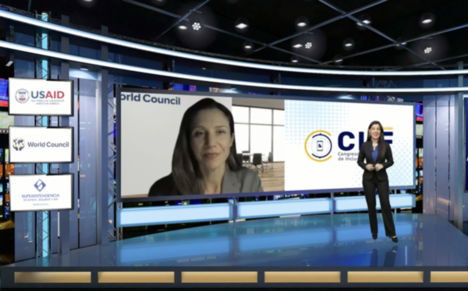
According to WOCCU, the main conclusion drawn from the International Congress on Financial Inclusion was that generating favorable conditions to facilitate and consolidate inclusive financial systems demands combined efforts at the regional level.
"Thanks to the joint work of USAID, WOCCU and the institutions that have committed to our Economic Inclusion Project, in the last year we have managed to include more than 38,000 people in the Peruvian and Ecuadorian financial systems, with 51% being women," said Danielle Spinard, a USAID officer.
‘High-Level Specialists’
WOCCU reported the virtual event featured 22 “high-level specialists who examined the implementation of different financial inclusion policies and strategies from across Latin America to formulate a blueprint for success that brings together the supply and demand of financial services and facilitates access to those services that are most suitable for the market.”
Nearly 1,000 financial service industry professionals from Peru, Ecuador, Colombia, El Salvador, Mexico, Guatemala, the Dominican Republic and elsewhere attended the event, which also focused on how past financial education and financial inclusion initiatives impacted populations that have historically been neglected by the formal financial system, WOCCU said.
“With funding support from USAID, WOCCU has been able to provide technical assistance that enables financial institutions to more holistically address financial services through the convenience of digital payments, targeted financial education and by promoting income-generating activities, including entrepreneurship,” said Elissa McCarter LaBorde, WOCCU president and CEO. “We’ve shown that post-pandemic challenges can also be opportunities for credit unions and the entire financial system.”
Challenges Remain
Added Socorro Heysen, superintendent of Banking, Insurance and AFP of Peru, “In Peru, progress has been the result of an articulated effort and the commitment assumed by various public and private institutions within the framework of the National Financial Inclusion Policy (PNIF), the public policy tool that directs and articulates the efforts of multiple state institutions in search of improving the economic well-being of the population through their inclusion in a formal financial system.”
But despite the advances, there are still challenges the Economic Inclusion Project plans to address moving forward, according to WOCCU.
"There are still segments of the population that are excluded from financial services, including women, youth, rural populations, migrants and refugees for whom adequate products and services are required, but that also must be sustainable for financial entities, which requires innovation, digitization and more channels to bring services closer to the population by reducing the transactional cost,” said Oscar Guzmán, chief of party of the Economic Inclusion Project. “We must also expand financial education to reduce the information gap between the supply and demand of financial services.”
Started in June 2020, the World Council said the three-year Economic Inclusion Project aims to help 100,000 Venezuelan migrants and refugees, and local vulnerable populations in Peru and Ecuador achieve socio-economic security.