

MADISON, Wis.–Credit unions around the world are going to experience “three waves” of fallout from the coronavirus pandemic, and they need to be prepared for each—and to “shine,” according to the World Council of Credit Unions (WOCCU).
During a webinar hosted by WOCCU titled “Credit Union COVID-19 Regulatory Advocacy Issues,” WOCCU CEO Brian Branch and WOCCU VP-Advocacy Andrew Price reviewed numerous issues related to the coronavirus’ effects on credit unions around the world.
Branch said in his discussions with credit unions globally he has seen some “patterns” emerging.
“We’re seeing three waves,” said Branch. “The first wave is the health crisis from the coronavirus that is impacting our members and communities. The second wave is the institutional stress, which we are beginning to see impact credit unions now, and we are going to see this on balance sheets. The third wave, which is starting to gain inertia now, is the global recession as the value chain has been interrupted.”
The First Wave
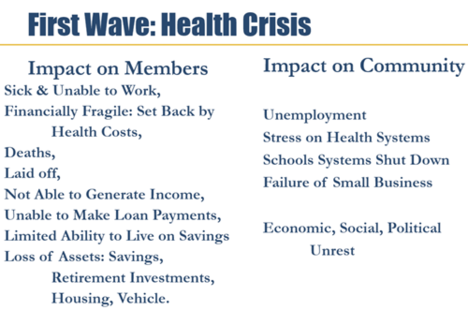
Branch said Wave One issues for members include:
- Sick and unable to work
- Financial fragile and set back by health costs
- Deaths
- Loss of work
- Not able to generate income
- Unable to make loan payments
- Limited ability to live on savings
- Loss of assets, including savings, retirement investments, housing and vehicles
Wave One issues affecting communities include:
- Unemployment
- Stress on health systems
- School systems shut down
- Failure of small business
- Economic, social, political unrest
“One lesson we’ve learned is the digitization priority we have talked about for years has really come home,” said Branch, who also reviewed the many steps credit unions have already taken to help members even as they come at a financial cost to the institution.
Credit unions in many areas, Branch said, have become important sources of health-related information.
The Second Wave
The institutional stresses credit unions are going to feel, according to Branch, include:
- Increased provisions costs and write-offs
- Decreased portfolio quality
- Decreased return/income on loan portfolio
- Increased provision costs
- Decreased liquidity as loans default
- Decreased liquidity as savings withdrawals increase
- Impact on liquidity as credit union withdrawals are limited in some countries
- Slower growth
- Reduced capital positions
The Third Wave
“The third wave is global recession, and we’re starting to see that,” said Branch. “We’re seeing it in the industrialized countries with the major stimulus and aid packages as they try to respond and mitigate this recession. We’re going to see ongoing unemployment, the failure of small businesses.
“This is one of those times when credit unions tend to shine,” Branch continued. “We have weathered these kinds of economic crises many times, and very often we find that when the other formal financial institutions stop lending, credit unions continue to lend. What we see as a result is liquidity comes back. In crises, people tend to flee to safety. We will see increase in significant liquidity coming to our institutions as we get through this recession, and then the challenge will be to get that liquidity back into solid loans.
“Our challenge is not just getting through these three waves of negative impact; our challenge is being prepared for that fourth stage when our institutions start growing again.”
Advocacy Issues
Meanwhile, Price said a number of advocacy issues have also emerged around the world as a result of the pandemic, and those include policymaker issues, operational issues, and advocacy strategies.
Price said the international standard setting bodies have already issued what he called “favorable” statements, including the Financial Stability Board, which has encouraged national regulators to “make use of the flexibility within the existing” standards.
As CUToday.info has also reported, the Basel Committee has announced a one-year delay in Basel III, an announcement WOCCU said it welcomes.
Some countries have already put moratoriums in place on foreclosures and debt collections, including various U.S. states, for short periods of time, although Price said some countries have put in place moratoriums through year-end, which could raise some significant challenges for CUs.
Price said operational issues credit unions will need to navigate include countries putting in place such moratoriums on payments or payments holidays and the resulting challenge around how to account for those new moratoriums, how to accrue interest (if it’s accrued), etc. Price said IFRS9/CECL offer some guidance on accounting-related questions.
Other Operational Issues
One issue credit unions have encountered in some countries is not being included in the definition of “bank” even in emergency legislation.
He said he has also heard of cases in some jurisdictions that “runs” on deposits have taken place.
In response to these challenges, Price said credit unions should:
- Analyze their cash/liquidity situation and place proper limits on cash withdrawals
- Consider that during a crisis regular payments may not occur, thus affecting cash on hand
- Analyze sources of liquidity and get in touch with their corporate or central bank to see what relief is available
- Educate members that their funds are safe in the CU and that hoarding cash at home is not necessary or safe
- Note the existence of deposit insurance/guarantee schemes
- Work closely with regulators to see if they will also impose moratoriums on withdrawals
- Consider that during the crisis it may be difficult to have cash replenished to ATMs and your credit union
Talk to Regulators
Price encouraged credit unions to talk with their respective regulators about deadlines for regulatory reports, such as AML/CFT reports, regular exams and audit deadlines.
In cases where credit unions isn’t viewed as important or essential, Price urged CUs to point to their members, and tell their stories of how the CU is a solution to meeting economic needs during the crisis.