

FRISCO, Texas–Credit unions here got a different perspective—in this case, from the banking industry—on what’s happening in fintech, why banks don’t have the advantages many in CUs believe they do, and on what’s coming at the market for which many are unprepared.
The viewpoints were shared by Carey Ransom, managing director of BankTech Ventures, and John Clausen, partner with Mendon Ventures Partners, during the VentureTech meeting here. Both of those funds exclusively invest in bank fintech, although there is some overlap with credit unions.
The session was moderated by Nick Evens, president and CEO of Curql Collective, which manages two credit union investment funds and which hosts the VentureTech event.
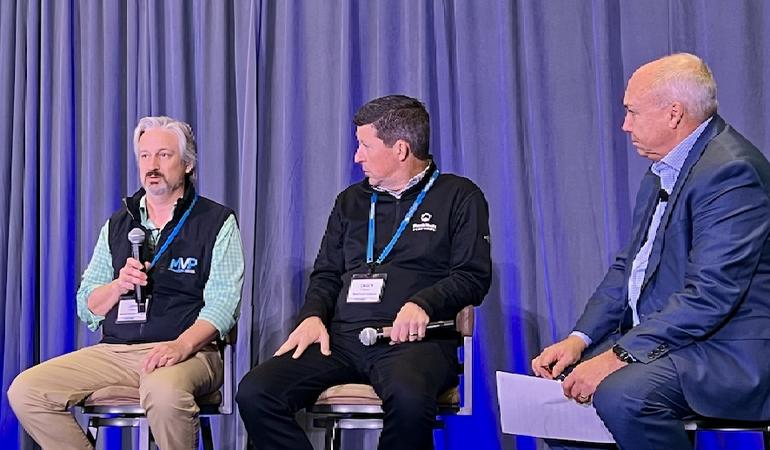
From left, John Clausen, Carey Ransom and Nick Evens
About Each Fund
First, some background. Clausen said all of the investors in Mendon Venture Partners are banks and everything it invests in is bank tech. The firm was launched three years ago, and introduced its fund of $50 million two years ago. It has made 10 investments and has been the lead on eight of those. The fund has an investment in Nymbus, as does Curql Fund.
Ransom said BankTech Ventures started in 2021, has 100 community banks in 33 states as limited partners, and has $100 million in its fund. It has 17 investments. It also has two active bankers as partners whom he said serve as a “good vetting” of whether its relevant to the industry.
The Q&A
Here's a look at what was discussed:
Evens: You have banks as LPs and as partners. How do they react when they know you are collaborating with a fintech that may be more credit union centric?
Clausen: They have political organizations to deal with that. As organizations, they’re not dummies. They are looking for the same solutions to serve their customers and to improve efficiencies.
Ransom: I agree. There are companies that are borne out of serving credit unions or maybe out of a credit union itself, but there is a lot of commonality in the types of business you operate.
My job is to find the best entrepreneurs solving key problems for the industry. We view ourselves not as a VC—we’re looking for great founders solving real problems for community financial institutions. If they start with credit unions and there is relevance to banks, great. If they start with banks and there is relevance to credit unions, great.
Clausen: Being part of an ecosystem can be highly valuable, not just for the returns to the fund, but for the knowledge that you gain from being part of that system.
Evens: Our fund manager at Curql is in collaboration with you, with TruStage Ventures. We’re all working together. What are you seeing?
Ransom: As a strategic investor, at the end of the day you’re trying to help the company solve problems for you, but also to put them into a position to succeed. That’s our number-one job.
We are asking our banks in this case to work with these companies. They can be put in the wrong direction with the wrong guidance. Our investors have said they are going to be much more upset if that business goes out of business, because they will have a business continuity issue.
It’s not about growth at all costs. It’s about being clear around what is the real opportunity for this company. One of the worst things any of us can do—and I’ve raised hundreds of millions of dollars—is give a company too much money at the wrong point. I can tell you, it will get spent.
Evens: Do banks have an advantage over credit unions?
Clausen: I wouldn’t say banks have any advantage over credit unions when it comes to technology. If you’re way too big you get mired in internal politics and bureaucracy and you move at a glacial speed.
There are arguments that credit unions are fast actors and pull the trigger faster. But guess what? You’re all slow to the fintechs moving in. And to regulators, you’re going way too fast.
The worst thing you can do is decide to invest in a technology and not utilize it. I see that over and over again. You need to embrace it from the top and make it part of the culture to leverage that technology spend.
Ransom: There is a legacy here and a view we’re going to adopt something and it will be in place for the next 10 or 20 or 30 years. I say do not plan for that. The pace of change is only going faster. You need to figure out how to effectively compartmentalize your risks but also be prepared to Implement and swap things out faster.
To your question, the banks’ advantage, if there is one, it is that they have been able to partner with a certain class of fintechs, like the consumer facing fintechs, so banking as a service has been advantage for banks. A lot of banks aren’t that tech-forward, it’s just that they have partnered with the fintechs and let them take the lead.
Evens: As you look at fintechs, what’s coming at us that we don’t know about? What do you see three years out?
Clausen: I know what you need to do now is take care of fraud. That to me is the biggest risk zone. We’re involved in a company trying to turbo-boost the ability to detect digital fraud. The fraudsters are definitely one step ahead of everybody.
Ransom: I think the biggest change I see coming that maybe we’re not all thinking about is this movement to taking my FI or banking to whereover I am. Being able to access my money as a utility, wherever. Increasingly, that means that banking is going horizontal. If you’re not a part of that, somebody else is going to fill that. It creates this different environment.
You look at the complexity of people’s lives today, all the payments solutions, the places to store money, and I don’t think most people want it, but it’s presented in a way that makes more sense to them in the context of whatever they’re trying to do. If we can start equipping people to take their FI with them, you can retain those customers and make their lives better by giving them more financial wellness and help.
What this actually means is still getting figured out.
Evens: Fintech founders have gotten a lot more sophisticated. To negotiate with them purely from an investment standpoint, most know what they’re doing. Are you seeing any kind of change in founders?
Clausen: The most progressive founders I know are really focused on not just selling you a product, but actually showing you the return you can get on this product from an ROI basis. An FI wants to know what it’s going to do to the bottom line. That’s a shift I’ve seen.
Ransom. I agree. I would add that the best founders in this space understand it’s a different game in many cases. They aren’t trying to play this VC valuation game; they truly care. If they have a shared belief that our country and economy is better with a significant number of FIs in it, that’s a great jumping off point. They understand they have to be committed to helping all of you get better. Intentionality is where you’re seeing more sophistication.