

FRISCO, Texas–The founders and leaders of dozens of fintechs, many of them new to the world of credit unions, were given insights into what the industry is looking for, while credit union leaders heard from one fintech founder of what companies like his are seeking—and are asking credit unions not to do.
The exchange came as part of Curql Collective’s VentureTech event here. Curql Collective oversees two venture capital funds that are funded by credit unions, and currently has investments in 26 firms. It has just launched a second fund known as Curql II after capping Curql Fund I.
One interesting note shared during the session, titled “If You Build It, Will They Come?,” was that the number-one thing fintechs are seeking from credit unions isn’t capital (that’s number two), but instead “pilot” CUs, those willing to “take a chance” and participate in piloting various solutions.
Participating in the discussion were Kent Lugrand, president and CEO of InTouch credit Union in Plano, Texas; Dave Lewis, founder and CEO of New Zealand-based Ranqx, and Melissa Pomeroy, chief revenue officer with the Cooperative Credit Union Association in Marlborough, Mass. The session was moderated by Barb Lowman, president of CUNA Strategic Services.
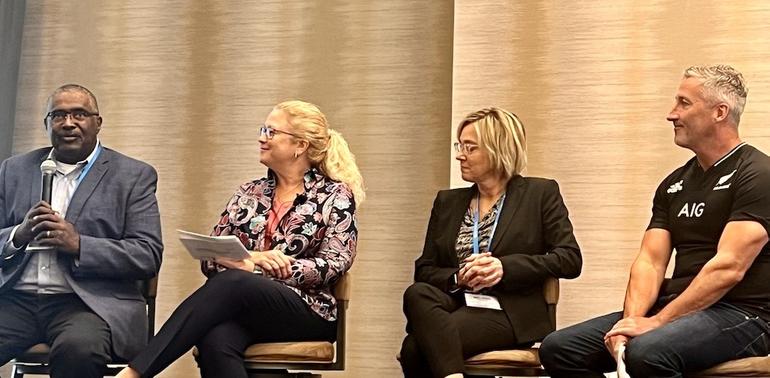
From left: Kent Lugrand, Barb Lowman Melissa Pomeroy and Dave Lewis.
Here’s what was discussed:
Lowman: As the former EDS CU, you have a long history of serving technologically savvy members, 87,000 in all. How do you go about prioritizing the investments that InTouch makes in technology and decide what will move the needle with staff, and members?
Lugrand: It’s interesting. You would think that with most of your members coming from tech they would want technology, but it’s the opposite. They work with tech all day. They don’t want change. They look to their financial relationship as the one point of control they have.
So, the one thing that’s important for me is that whatever we deliver delivers in the way they want. They do expect more in some sense. We survey our members, and one of the things we discovered, and it’s this way every year, it’s who our competition is. It’s us and BofA, us and Wells, us and Chase. You have to go down on the list to find a large non-bank, and it’s USAA. You have to go to number 17 on the list to find another credit union. Our members expect us to be on par with Chase or Wells. And because they are loyal to the credit union they want it cheap and free.
Lowman: It sounds like you have to do a lot of staging and testing?
Legrand: Another challenge is our members expect us to be perfect. I describe it this way: Imagine you’re a jungle guide and making the very first trek. You have to have a machete and cut a path. If you’re number 20 or 30 on that path, the path is cut.
So, when it comes to investments, I go back to the original question. If it’s something that is extremely critical in terms of our vision or direction or what we want to accomplish, then I don't mind making those investments. For those kind of fintechs that are culturally and strategically matched to us, I'll put on my safari hat and bring out that machete.
Lowman: Dave, it has been a whirlwind for you. You have been indoctrinated in CU movement very quickly.
Lewis: A fintech friend of mine said you have to apply to be a part of this VentureTech thing. About a month later Nick Evens called and said you are the only non-North American fintech at VentureTech. I came here and pitched and we won day one. (This is) an incredible ecosystem, one we don’t really have in New Zealand.
The biggest thing I’ve learned is the essence of what we do as fintechs is we have to have a partner, and it has to be reciprocal; there has to be a mutual benefit. I have worked with some amazing credit unions and CUSOs. This small business lending thing, which is what our platform does, is something credit unions can potentially win at. And you have to. That’s what we’re here to help solve. What I have learned this year as a fintech is we have to have a very different approach with credit unions than we do with banks.
Our biggest client in New Zealand is a very large bank. We have a big four and then nothing. (The U.S.) is an incredible environment where people don’t mind sharing success with each other, which you don’t get with banks. I call banks ‘technology tourists’; they love to look at things and then leave.
Lowman: As CRO at CCUA, you are responsible for helping CUs in your states understand what emerging solutions are out there. What are some of the ways CUs engage with CCUA to learn more about emerging solutions to better serve members?
Pomeroy: I've been with the Cooperative Credit Union Association for only three years, but even in those three years I think the league has evolved, and I think it needs to evolve even more dramatically. (Look at the) number of fintechs at this event. This is my third year at VentureTech, and just the difference in the three years in terms of participation and excitement about the event and, honestly, just the number of fintechs that want to come and interact with the credit unions.
I think the leagues have to take responsibility on themselves to really evolve and meet the fintechs and the credit unions where they are and be an asset to those credit unions.
The quick answer is for how credit unions can work within the league is to attend the roundtables or any situation where a credit union executive or leadership team member can put themselves in a room with other credit union executives and talk about what they're going through. I think it kind of speaks to what (Dave Lewis) said about what that cooperative model really is. Listen to what your peers are doing.
I think the best way credit unions can engage with the league is to be a pilot credit union. If a league is presenting to you a fintech and says ‘We think this organization can make a difference for you and the industry, what they really need is support and participation,’ help them to get their foot in the door.
Lugrand: It’s really important to understand the credit union industry, especially if you’re new to it. The one thing that is true, that is difficult for new players to understand, is the whole ‘coopetition’ idea. Credit unions come from a philosophical standpoint where they do not believe it is a zero-sum game. Credit unions believe in win-win scenarios every day, all the time. It’s why we don’t have any problems with partnering with leagues, with fintechs, with others. It’s really troubling in this world we’re in that for someone to win, someone else has to lose. Not true in credit unions. It’s important to understand if you want to embed yourself in this movement.
Lowman: You talked about surveys. Do you do any focus groups or other ways to engage with members?
Lugrand: We do do focus groups, but we also listen to the feedback and what they are willing to offer. We use the Eltropy platform to listen to what you need, what can we do better. It’s because of our competition. We want to stay viable.
Now, there is a difference between what members want and need. And there is a price to be paid for being first. We were first in our market a decade ago with multi-factor authentication. Our members ripped us a new one. I said, ‘Trust me: within a short period every institution will require this.’ But that didn’t stop the vitriol.
You have to constantly listen to what’s going on. I tell our staff you have to learn to listen with more than your ears. We try to sit on the same side of the table with our members instead of across from them. I’m trying to form the same kinds of relationships with fintechs that we have with members, to help solve problems we have, but also upcoming problems I don’t know we have.
Lowman: How do you pursue new fintech partnerships
Pomeroy: I remember when working inside a credit union the struggles of being so overwhelmed with the day-to-day and the operations and the worries around things that are changing so quickly, and it was very, very difficult to kind of step back from that and say, ‘OK, let me think about solving this problem and let me think about looking at different ways and different solutions.’
What I look for with the Cooperative Credit Union Association is to help credit unions (establish) valuable partnerships. I look for fintechs that offer solutions to very specific, very tangible problems that our credit unions are facing. Once we say, ‘OK, you understand the problem, you clearly understand the industry, and you have something tangible that will address that thing--whether it's a product or a service—it needs to be priced appropriatey and needs to be something that a credit union can react to and absorb.
Lewis: As a fintech and partner, don’t ghost us. A lot of us in the room run on fumes. My job as CEO at Ranqz is to sprint to that wall as fast as we can. There is nothing worse than being engaged by a credit union that says, ‘We love this solution, let’s move this forward,’ and then we can’t move it forward. Emails don’t get answered. Phone calls don’t get answered. (An ‘Amen’ was heard in the audience). Just tell us. If we are in this together, just don’t ghost us. I would much rather have a fast yes or no than a slow maybe.
As Winter Approaches, the Price for the Best Daily News Update in Credit Remains a Nice, Cozy Free!
The biggest, best and freshest news reporting in credit unions remains free! Each morning CUToday.info delivers its daily Fresh Today news update offering the latest headlines and breaking news right to your email, with the easy-to-read headlines format allowing you to click on the stories that interest you most in order to learn more. So stop paying those bank-fee-like subscription prices from other so-called “news” publications!
If you haven’t yet signed up for the new email solution on which CUToday.info has partnered with ResponseGenius, you can do so here. Signing up requires less than one minute of your time—and it’s free!
Please note that after signing up you may need to go to your Spam/Junk folder and mark the morning headlines email as safe. CUToday.info does not provide its list of readers and emails to outside parties, and we will not be contacting you to sell you an extended warranty or sending you any links so you may cash in on an inheritance you didn’t know was coming.
And did we mention it’s free?