

FRISCO, Texas—Fintechs and credit unions here got an update on where NCUA stands with its oversight and initiatives related to technology, as well as some insights into how the CFPB’s open banking proposal might affect CUs.
Sharing his perspective with the VentureTech meeting was Charles A. Vice, director of financial technology and Access with NCUA, who started at the agency in January of this year. He began his career with the FDIC, where he remained for 18 years before becoming the commissioner at the Kentucky Department of Financial Institutions from 2008-22, and then joining the agency.
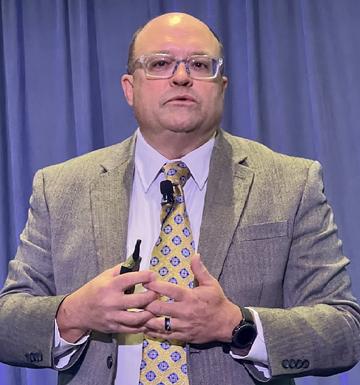
Charles A. Vice speaks to attendees.
Vice explained to those in the audience—many of whom were from fintechs and are new to the credit union market—what Access stands for, which is “advancing communities through credit, education, stability and support, which Vice said is all about expanding financial inclusion.”
Under the Auspices of Access
He told attendees the program is also looking at:
- Virtual examination procedures
- Distributed leger and blockchain (NCUA has a Digital Asset Working Group, as does FSOC)
- Digital identification
- Artificial intelligence
When it comes to fintechs, Vice said NCUA is looking at a number of issues, including focusing on how credit unions can use technology to improve operational efficiencies, enhance member-facing financial services, and promote financial inclusion.
It is also working to assess risks, barriers, and opportunities related to fintechs and credit unions, he said.
The Q&A
Vice fielded several questions from his audience, including:
Q: What advice do you have for CUs that are collaborating with fintechs when the subject of safety and soundness comes up?
Vice: When you are talking to a fintech provider or considering a new tool, ask, do your members want and need this? Does it fit into your strategic plan?
The due diligence piece is paramount. Make sure your policies and procedures are updated for whatever services you are going to be providing.
Q: As a fintech, are there things we could be doing better in our partnerships with credit unions?
Vice: I would offer two things. Number one, credit unions know their members, so when you are a fintech take time to get to know that credit union and their members so you are not just selling them something.
The second thing is, use me as an outlet to discuss. Let’s talk. I’m not in the supervisory line. I have a 33-year history of being a supervisor, so I have that mindset. But there is no direct tie from a conversation with me to what happens at that next examination. I think that conversation has been missing for a long time at NCUA.
Q: What are your thoughts about open banking and how that fits in at NCUA and oversight? The CFPB’s proposed rule does not distinguish between the size of credit unions.
Vice: First, let me say these are my opinions. Regulators are horrible about asking the industry to do something that is unfunded. To me this is a pretty significant lift. My hope is that when the final rule is passed the CFPB gets it right.
I think there is a lot of potential with this because it goes back to the concept of, ‘That information is mine. I am the owner. You are the safekeeper. So, I should be able to share that with whom I need to get the financial services I need.’
But the rule has to have a balance. There is going to be a significant difference relevant to compliance between large and small credit unions. Smaller CUs are going to need some help with this and there are going to be some costs with this.