

ORLANDO, Fla.—America’s Credit Unions President/CEO Scott Simpson offered a candid, wide-ranging assessment of the industry’s biggest threats and fault lines during a fireside chat with Velera President/CEO Chuck Fagan on Wednesday, telling credit union leaders the most immediate job in Washington is knowing the difference between a real crisis and a threat that still needs to be watched.
That message came through clearly on the issue that remains the movement’s most sensitive political flashpoint: the credit union tax exemption. Speaking during day 2 of VeleraLIVE at the Orlando Marriott World Center, Simpson said credit unions need to remain vigilant, but also disciplined, as Congress again toys with budget reconciliation packages and as some in the industry worry the CU tax break could re-emerge as an offset.
“This is different this year,” Simpson said of the current reconciliation debate. “It’s still a threat because, as you know, Congress can be unpredictable…but we don’t have expiring tax cuts and we are much closer to the election.”
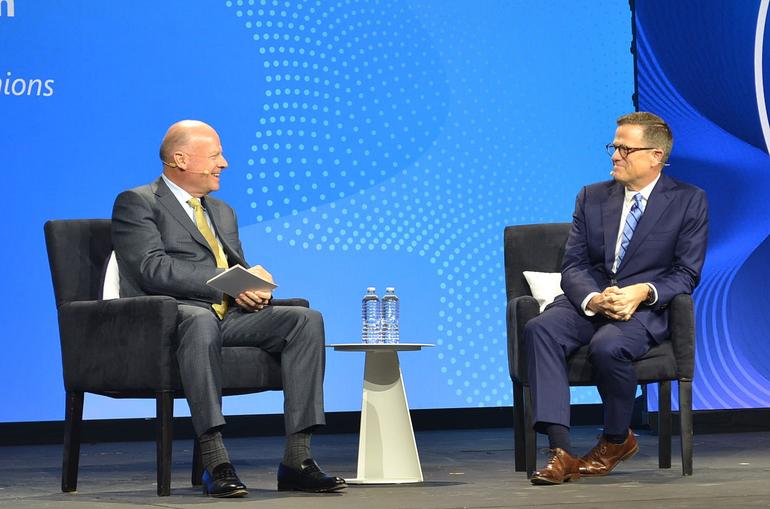
Chuck Fagan (L) with Scott Simpson.
He added that while “anything could change,” there is currently “not another soul talking about credit union taxation relative to this round of budget reconciliation,” and said America’s Credit Unions is intentionally staying “one click away” from launching a full grassroots campaign rather than treating every possible threat as “Defcon 5.”
If the industry sounds the alarm too often, he warned, it risks losing one of its most important advocacy tools: the ability to “deprive an issue of oxygen.”
Still, Simpson made clear the tax fight remains foundational, noting his long experience battling bankers in Utah and later at the national level. He said the grassroots response from credit unions in 2025 was enough to help “stem that little bump in threat” tied to last year’s reconciliation process, and he praised the movement’s ability to mobilize political energy from the ground up.
Simpson said credit unions are “wildly out-resourced in Washington,” but counter that disadvantage with “the undeniable will of 145 million people…voiced through 4,200 credit unions.”
On President Trump’s call earlier this year for a 10% cap on credit card rates, Simpson was direct, describing it as a populist political gesture that could backfire badly if it ever became real legislation. He said the Administration appeared to move first and then realize the consequences later, noting that even Treasury officials seemed to quickly understand “this is not what you think it is.”
Simpson said any rate cap would require Congress to act, and argued lawmakers on both sides of the aisle understand that such a move would ultimately “harm the very people they claim to want to protect.”
The same theme of caution surfaced in Simpson’s discussion of interchange, where he warned the bigger danger is not necessarily Washington in the short term, but the chaos merchants are trying to create in the states. He said Walmart and other large retailers know the federal status quo is hard to crack, so, the strategy has been to spread interchange fights across state capitals and then pressure Congress into imposing a national framework. That makes local advocacy especially important, he added.
Fagan and Simpson also touched on the GENIUS Act and stablecoin policy, with Simpson saying America’s Credit Unions has been focused first and foremost on ensuring credit unions have “equivalency in the marketplace” as federal agencies begin issuing proposed rules. He said the association’s job is to make sure credit unions are not boxed out of emerging frameworks for payments, privacy, digital assets and new rulemaking structures simply because lawmakers or regulators did not fully contemplate the cooperative model on the front end.
The conversation broadened to data privacy and CDFI policy, where Simpson said the challenge for credit unions is increasingly twofold: guarding against legislative efforts that shift too much liability for fraud or data misuse onto issuers, while also making sure new technology frameworks—from blockchain to stablecoins—do not create structural disadvantages for the movement. On CDFIs, he said the issue remains bipartisan in Congress even if it has become a political football inside the Administration, and he pointed to continued support on Capitol Hill as reason for cautious optimism.
On consolidation, Simpson was especially reflective. He acknowledged that the compression in the number of credit unions is real and ongoing, and said the movement has likely reached an “inflection point” as even larger institutions make merger decisions that would once have seemed unlikely. But he rejected the idea that scale itself is somehow a betrayal of cooperative principles, calling that “the falsehood on which every banker argument is based.” In a cooperative model, he said, scale can create more value for members rather than siphon it away for shareholders.
At the same time, Simpson did not sugarcoat the pressure on smaller institutions.
“It is not getting easier to run a small credit union,” he said, calling it one of the movement’s hardest realities. He said trade groups can help by pushing for more proportional regulation, ensuring small credit union voices are heard and supporting the resilience and collaboration that already exist in that segment.