

By Ray Birch
ORLANDO, Fla.— Velera executives used a Tuesday panel at VeleraLIVE 2026 to emphasize the company’s newly unveiled Velera Ecosystem is designed to deliver meaningful technology upgrades for credit unions without forcing the kind of large-scale disruption or wholesale platform changes many institutions worry about.
“The ecosystem isn’t something you have to migrate to or you buy—it’s already the foundation behind every Velera product, and we’ve built it to minimize disruption,” Cody Banks, senior vice president of Product Experience and Enablement, told attendees during the session.
The discussion followed Velera’s formal introduction earlier in the day of the Velera Ecosystem, including its cloud-native technology stack, Stellaris, and Atmos, its intelligence layer (see related story).
That point appeared central to the message Velera wanted to deliver to the more than 2,000 credit union leaders at the Orlando Marriott World Center: This is not a wholesale replacement pitch, but a foundational technology shift the company says will increasingly show up through product upgrades, faster onboarding, stronger fraud tools and more connected member experiences.
Banks said the best place for credit unions to start is not with a conversion plan, but by identifying their biggest operational challenge—whether that is fraud, payments, growth, data, attracting younger members or member experience—and then mapping how the ecosystem can help.
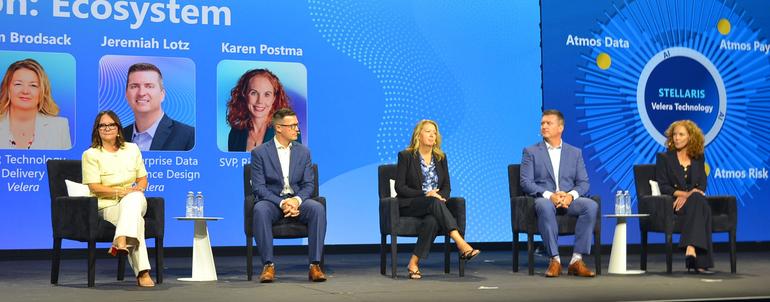
L-R: Denise Stevens, Cody Banks, Pam Brodsack, Jeremiah Lotz and Karen Postma
Denise Stevens, EVP and chief product and technology officer, decribed the ecosystem as the most significant result so far of the PSCU-Co-op Solutions combination. She said the merger did more than combine two organizations; it expanded what was possible technologically and allowed Velera to “double down” on investments into what she called a central, cloud-native ecosystem built specifically for the fast-moving payments market.
“It’s not just an ecosystem—it’s an engine,” Stevens said, adding that it was designed to power analytics, decisioning, fraud, payments and digital member experiences “no matter where you are in your payments journey, no matter the size of your credit union or what your tech stack looks like.”
A Foundation
Stevens and Pam Brodsack, SVP of Technology Delivery, said the architecture is built around Stellaris, the underlying technology stack, and Atmos, the intelligence layer that sits above it. Brodsack described Stellaris as the foundation that allows Velera to move away from outdated infrastructure and the “patchwork” of disconnected systems that slows innovation and creates friction. Its philosophy, she said, is simple: “build once, use everywhere,” allowing new capabilities to be deployed across products and channels without forcing repeated disruption on clients.
Banks said Atmos is where that foundation turns into something credit unions will feel more directly. By bringing together payments data, fraud signals and member activity through one orchestrated intelligence layer, he said, Atmos is meant to remove silos that have long slowed decision-making and personalization. He pointed to new-member onboarding as an example, saying the platform can help establish identity, strengthen authentication and begin surfacing “next best product” insights much earlier in the relationship.
He also said the new architecture is already speeding up launches: onboarding some new solutions that previously took nine months can now take just a few weeks because of the efficiencies created by Stellaris and Atmos.
Karen Postma, senior vice president of Risk Solutions, said one of the biggest benefits for credit unions may be in fraud and risk. She said Atmos Risk is designed to pull together data from payment channels, digital banking, contact centers and device signals so fraud teams are no longer fighting scams with fragmented information. Instead of relying mainly on isolated authentication events, she said, the system is built to understand behavior and context, helping identify anomalies and allowing what she called “intelligent friction”—brief pauses on high-risk activity that give teams time to intervene before money leaves the institution.
Competing For Younger Members
The panel also tied the ecosystem directly to Velera’s broader effort to help credit unions compete for younger members and keep pace with faster-moving payment expectations. Executives pointed to digital instant lending, smarter rewards, subscription-oriented payment experiences, gamified financial wellness and stronger cross-channel authentication as examples of how the platform could help.
Banks put it in more strategic terms when discussing Atmos Payments, saying the winners in payments will not simply be the institutions that move money fastest, but those that use intelligence to make payments a competitive advantage.
“The payments winners won’t just be those that are faster,” he said. “They’ll be those that are smarter.”