

ORLANDO, Fla.—At VeleraLIVE on Wednesday, futurist Mike Walsh delivered a blunt message to credit union leaders: the AI era will not be defined by who has the smartest people or the newest tools, but by which institutions redesign how decisions get made—and who is willing to lead through that change.
Speaking during the second day of the conference at the Orlando Marriott World Center, Walsh—CEO of Tomorrow, a global innovation consultancy—argued that artificial intelligence is no longer just another technology cycle. Instead, he said, credit unions and other organizations are entering a world where “intelligence is no longer scarce,” meaning the real competitive advantage will come from how institutions organize human and machine decision-making to create value for members.
Walsh said the winners in the next decade will not simply layer AI tools onto existing workflows, but rethink how work is structured, where decisions sit, and how humans and machines should interact. In that sense, he suggested, the opportunity for credit unions is not just greater efficiency, but the chance to redefine service and value in ways that fit the cooperative model.
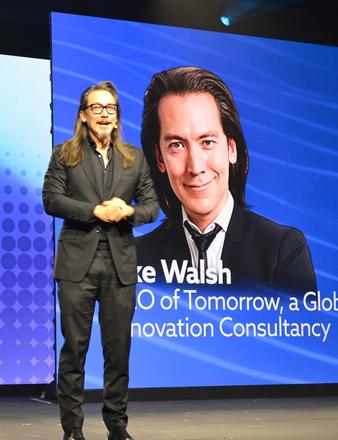
Mike Walsh
Walsh repeatedly pushed the audience to think beyond chatbots and basic automation, arguing the next phase is “digital labor”—AI systems and agents that can perform work once handled by people, but at software scale. He described a near future in which AI becomes the interface for nearly everything, from frontline operations and member service to internal analytics and decision support. That shift, he said, will be especially important in financial services, where institutions that can combine human judgment with machine speed will have a major edge.
He also urged executives to stop viewing AI as a simple headcount reduction tool. While some companies are already using the technology to justify layoffs, Walsh argued that approach misses the point. The smarter move, he said, is to use AI to expand what an organization can do, not just shrink what it costs. For credit unions, that could mean using AI to handle repetitive work, surface member insights faster, strengthen fraud detection, improve service responsiveness and free staff to focus on higher-value conversations and relationship-building.
One of Walsh’s strongest themes was that leadership itself must change. In a world of abundant intelligence, he said, leaders will no longer be valued for having all the answers. Instead, their job will be to set direction, define intent, build trust and design systems that consistently generate better decisions. For credit union leaders and senior teams, that means letting go of the idea that leadership is tied to being the smartest person in the room and instead becoming what he described as architects of how work gets done, he explained.
That, Walsh said, should start personally. Walsh challenged attendees to think about how much of their own work could be delegated to AI, agents or automation over the next 12 months—and then ask how they would use that reclaimed time. If leaders do not model that behavior themselves, he said, they should not expect the rest of the organization to follow. The point was not just adoption, but cultural permission: if the CEO is not changing how he or she works, the institution likely is not changing either, Walsh explained.
Walsh also argued that credit unions need to rethink what human work is actually for. As AI gets better at handling analysis, drafting, summarization and even complex decision support, Walsh said the most valuable human contribution will shift toward judgment, context, curiosity and system design. He warned against confusing mastery of old tools with real strategic value, saying institutions that cling too tightly to legacy habits may find themselves outpaced by teams—and younger employees—who are far more willing to rethink the work from scratch.
Walsh closed by urging leaders to embrace uncertainty rather than retreat from it. Borrowing from a phrase used during an episode from the TV series Ted Lasso—“be curious, not judgmental”—he said this is not a moment for institutions to wait until the path is perfectly clear. For credit unions in particular, Walsh suggested, that may be the real takeaway: the institutions that thrive in the next decade may not be the ones with the biggest budgets or the flashiest AI demos, but the ones willing to rethink service, leadership and decision-making before the rest of the market catches up.