

By Ray Birch
ORLANDO, Fla.— Erica Dhawan opened the first day of VeleraLive 2026 with a message likely to resonate with many credit union executives: the challenge now is not simply adapting to disruption, but using the lessons of the last several years to “create a better normal” as digital communication, AI and changing member expectations reshape how teams work and how institutions serve members.
Dhawan, a best-selling author and leading authority on 21st century teamwork, collaboration and innovation, argued that the credit union movement’s historic strength—human connection—must now be reimagined for an era in which much of that connection no longer happens face to face.
She said the industry has always excelled at what she calls “connectional intelligence,” but warned that in a world of texts, emails, Slack messages, AI-generated communications and hybrid work, productive collaboration can actually feel harder even as communication becomes easier.
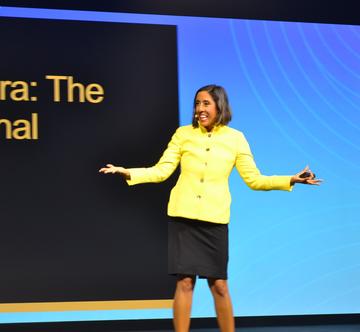
Erica Dhawan
Dhawan emphasized to credit union leaders that speed alone is no longer the goal.
“Velocity” in the current environment, she suggested, is about knowing when to slow down, when to pause and when judgment matters more than speed. That is especially relevant for credit unions balancing branch operations, call centers, digital channels and member-facing teams while trying to maintain the personal touch that has long differentiated them.
To make the point, Dhawan shared a story about a manager and employee whose short, ambiguous emails turned what should have been a quick conversation into hours of confusion and stress. Her takeaway: in today’s environment, “reading messages carefully is the new listening,” and “writing clearly is the new empathy.”
For credit unions, she suggested, that has clear implications not just for internal operations, but also for how they communicate with members during vulnerable moments such as fraud, financial stress or service disruptions.
New First Impressions
Dhawan repeatedly returned to the idea that the new “first impression” is often no longer a handshake or a branch interaction, but the first email, text or digital message—sometimes one drafted with AI.
She said that means leaders need to train teams to be “maniacally clear” about what is being asked, who needs to act, what the priority is and when a response is needed. Dhawan said even simple communication norms—such as using subject lines that clearly state the ask, or setting expectations around urgency—can materially reduce wasted time and misalignment across teams.
She also offered a notable warning on AI that CU executives are likely to find timely: institutions should use AI to augment judgment, not replace it. Dhawan described a “think sandwich” approach in which teams first define the member outcome they are trying to achieve, then use AI to challenge or improve ideas, and finally reinsert human judgment to verify facts, identify missing voices and ensure the message still sounds authentic. In an industry built on trust, she cautioned against what she described as “AI slop” or “zombie content” that may be efficient but erodes credibility.
Beyond communication, Dhawan pushed leaders to rethink where good ideas come from. Using examples from Colgate, a law firm and Frito-Lay, she argued that organizations often solve problems faster when they reach beyond the “same five people” they always ask for help. For credit unions, she suggested, that translates into looking across silos—branches, operations, call centers, lending, digital teams and even frontline staff—to find insights on issues such as digital onboarding, loan application drop-off or member engagement.
Key Lessons
One of her key lessons for attendees was that underserved insights are often sitting inside the institution already. She emphasized that real collaboration today means designing ways for quieter voices, junior employees, remote workers and cross-functional teams to contribute, rather than defaulting to the loudest or most senior people in the room. In a movement built around service to underserved communities, that message landed as both a management lesson and a strategic reminder.
Dhawan constructed her presentation around four “laws” of connectional intelligence—value visibly, communicate carefully, collaborate confidently and trust totally. And the thread tying them together: credit unions do not need more meetings or more messages. They need better-designed interactions, clearer expectations, stronger cross-silo collaboration and more intentional trust-building, especially in hybrid and AI-assisted environments.