

NASHVILLE, Tenn.–How can credit unions bring payments, lending and deposit strategies into “perfect harmony.”
That question was put to a panel during the Velera THINK Conference here.
The panelists offering answers included:
- Norm Patrick, VP-Advisors Plus Consulting with Velera
- Sean Briscoe, director, products and payments, Alliant Credit Union
- C.J. Klump, senior director, Consumer Credit Products, Visa
The session was moderated by Beth Phillips, VP-strategic growth and data analytics with Velera.
Here is what was discussed during the Q&A session:
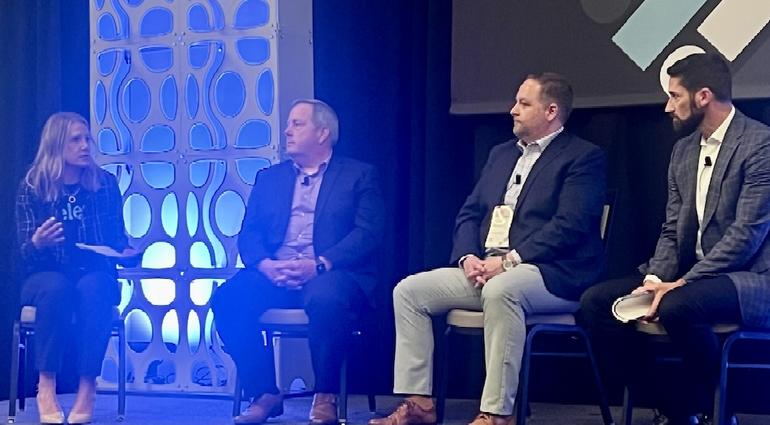
From left, Beth Phillips, Norm Patrick, Sean Briscoe, C.J. Klump.
Phillips: In terms of the economy and growth, what are areas of opportunity perhaps not considered in the past?
Patrick: Look at your credit card products. Make sure they're resonating and they're priced correctly. If you have rewards on the program, communicate the value proposition.
The real big battlefront right now in acquiring new credit card accounts is (the market has moved from) rate the into rewards.
I think the same holds true on the debit checking side. It’s elementary--without the checking account you do not have the (primary relationship account).
Communicate that value proposition to your members and get them into the correct product at the right time
Phillips: On deposits, liquidity is a concern. How can credit unions grow deposits?
Patrick: Rate was the big lever we had to play with and a lot of credit unions used it. We saw some share deals under 12 months approaching by 5.5% annual yield. I think that attracted a whole lot of hot money, and as the rat environment changes and some of those certificates term out we're going to see an outflow of those funds, which kind of gets you back to the blocking and tackling with the checking account.
The transactional account builds the relationship with your lowest funding cost.
Phillips: What other components should be considered?
Patrick: You can’t go exclusively off credit scores. That can be a one hand over the left eye type of approach. You have information you can gather, such as outflows of their payments currently. You can tap into resources to look at rent payments to make sure those are coming in on time. You can collect some of the less-traditional types of cash flows, such as gig work. You might have measure your proof of income differently. The world's changed, and I think it all comes around to gathering these data sources and continuing to augment your other (data).
Phillips: When you are considering payment and lending strategies, what is critical?
Briscoe: Where we have found a lot success is being very targeted and clear about our target audience and what their needs are. Understanding what is important to them and the demographics are critical. It can be tempting to jump on the things that are new, such as BNPL. But do they really fit your membership? It all starts there.
Combining what you know with the data that backs up the channels you are using is important to aligning with the long-term value.
Phillips: What are strategies to consider for immediate deployment with lending, savings?
Briscoe: I think, again, you start with what are we trying to accomplish for members. We have tried to align three pillars: product, pricing and marketing. We will look at where we see the opportunity relative to members’ needs. What are the products that align with that? Do we have the right features or do we need to make changes? Are they priced appropriately? What is the strategy for deploying through marketing?
We have had those in different silos where they were not aligned and you don’t get the same effectiveness.
Making sure the product, price and marketing strategy are aligned to what your members’ needs are is what is important. The focus piece is really key. If you have a very clear value propositions and stay focused on it you can get through scope-creep.
Phillips: What is a critical first step when thinking of revamping a product set?
Briscoe: I think it starts with understanding what’s working and what’s not. We all do competitive analyses, but getting as simple as a SWOT analysis on what we offer today. Who’s using it and how? What do we want to keep? What do we want to augment? What do we want to throw out and start over?
And then you find the right products to solve for those gaps. If you are staring from a point of we want to have this kind of product or pricing, you are really starting from the dark there. You want to start with the data.
Phillips: How can you capture, diversity and retain members with payments? How important is the digital space?
Klump: How many devices do you have? We see not just that growth in devices, but how often and the ways they are using them. We know that purchases made on a mobile phone are 40% of all ecommerce transactions.
The research we’ve done splits it out by how often they use digital. It’s important for financial institutions to focus on those who are digitally engaged. They spend the most on credit and debit, have the highest incomes.
Phillips: If you were starting from zero in growing out your product set, where would you start?
Klump: If I was starting from scratch I would think about it thematically. What do consumers values? Ease and convenience. I would introduce products based on that, like P2P and digital instant issuance, which resonate with Gen Z. I would also think about notifications around potential fraud. And finally, BNPL. Our consumers today are growing up in a BNPL environment. I’m very bullish on BNPL becoming more of a table stakes initiative.