WAIMEA, Hawaii–What does the credit union board of the future look like?
It will not just be different have a different composition in terms of age and/or gender, it will also have no choice but to change the composition of how it considers various issues if the credit union is to grow and prosper, according to one governance expert.
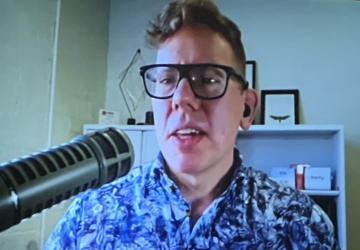
Matt Fullbrook speaking virtually from Toronto to VLI meeting in Hawaii.
Speaking to Rochdale Paragon’s Volunteer Leadership Institute, Matt Fullbrook, manager of the David and Sharon Johnson Centre for Corporate Governance Innovation at the University of Toronto and who is transitioning to his own company, Fullbrook Board Effectiveness, said he has fielded more questions about the “board of the future” than any other issue over the past few years.
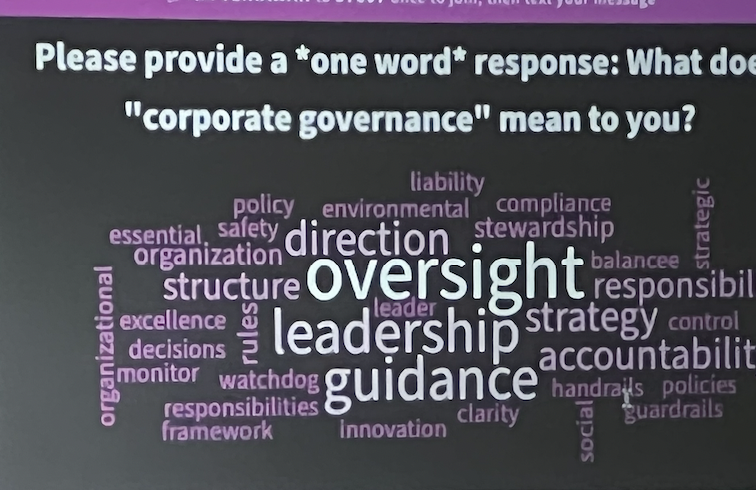
At the heart of those inquiries is the concept of what “corporate governance” actually means as it undergoes an evolution. To uncover how the volunteers in his audience define the term, he polled the group and generated the word cloud seen below.
Fullbrook, who appeared virtually from Toronto, said what makes governance so challenging is it’s a mix of both the abstract and the concrete, both of which are important.
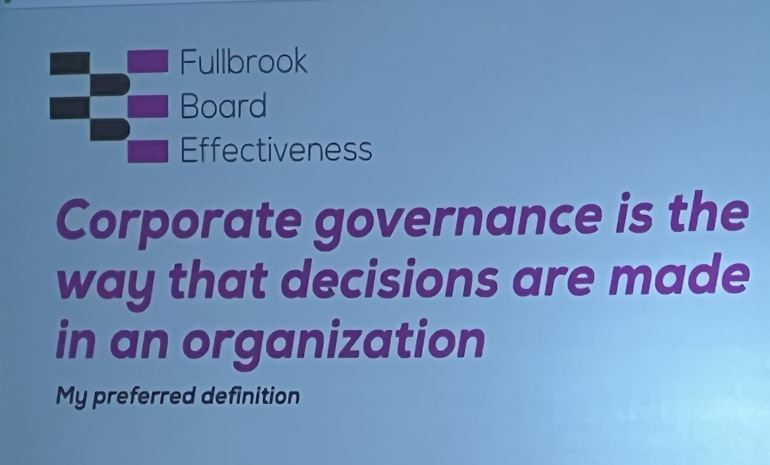
“I'm not trying to convince you that this is the right definition, but I'll explain why it works well for me. My preferred definition of corporate governance is that it's just the way that decisions get made in an organization,” he said. “Now, what I haven't said are basically any of the words that you used. I know the definition here is quite general, but let me tell you where this came from. I spent a lot of time talking with business owners and entrepreneurs and whenever I use the word governance they just completely shut down. The stuff that comes to mind for them when I talk about governance is ‘slow bureaucratic nonsense’ or ‘bunch of stuff that costs me extra money’ or, even worse, they think ‘I'm gonna start losing control here and this is my company.’ I thought, what if corporate governance is something that is a little bit less threatening than that? What if governance is just the way that decisions get made in an organization?
“That gives us the freedom as leaders to take the puzzle pieces that we've got and put them together in the ways that our organization needs to make the best decisions we can. So, we take the board, we take the senior management, we take our membership, we take the employees and staff, we take everything that we've got and use all those things in ways to create rules and policies and processes that we need to unlock value.”
Fullbrook said it may seem simple that the membership has delegated authority to the board of directors to make decisions in their best interest, and, in turn, the board has delegated authority to senior management to carry out the operations of the credit union.
“That's simple, it's factual, there's nothing weird about that. But sometimes it's helpful to remember that that delegation of authority goes in each direction equally. Management is accountable to the board and the board is accountable to membership,” Fullbrook explained.
Fullbrook called on credit unions to recognize the board of the future needs to reject some of the orthodoxy and routines they have adopted around governance.
“The law only says there are two to three things we have to do (as boards) and then we have the leeway to select the best path for ourselves,” Fullbrook said.
Fullbrook acknowledged it may seem easy to simply define good corporate governance as doing what is in the best interests of the member, but the questions in front of the board are actually much broader.
The reason, he explained, is doing what is right for the member involves more complex and longer-term issues, such as DEI and climate change.
“One of the reasons this is important is any of these things has the potential to affect your membership more than growth. The board of the future needs to be oriented in this multi-stakeholder environment.”
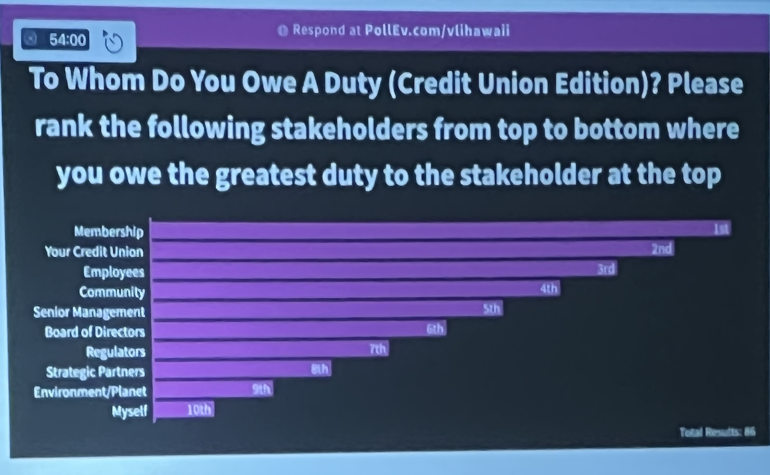
As an example, he said boards need to consider the constituency/constituencies to whom they feel the most/least duty, including the board itself, the credit union, community, employees, environment/planet, membership, regulators, management and more. In an audience poll, “membership” was voted as the primary constituency.
Fullbrook encouraged board members to bring the questions below back to their credit unions and consider them:
- What does “duty” mean to you?
- What’s the difference between a credit union and its members?
- Do directors really have a duty to the planet?
- Do directors have a duty to senior management or is it the other way around? Same goes for regulators.
- I don’t have a duty to myself, do I?
A Multi-Stakeholder World
“What does it all have to do with the board of the future? Now you’re operating in a decisively multi-stakeholder world,” said Fullbrook. “There are already organizations out there thinking about a multi-stakeholder world and they are moving quickly. This means that boards need literacy in many complex areas.”
Fullbrook offered the following “practical advice” and encouraged discussion around the points below:
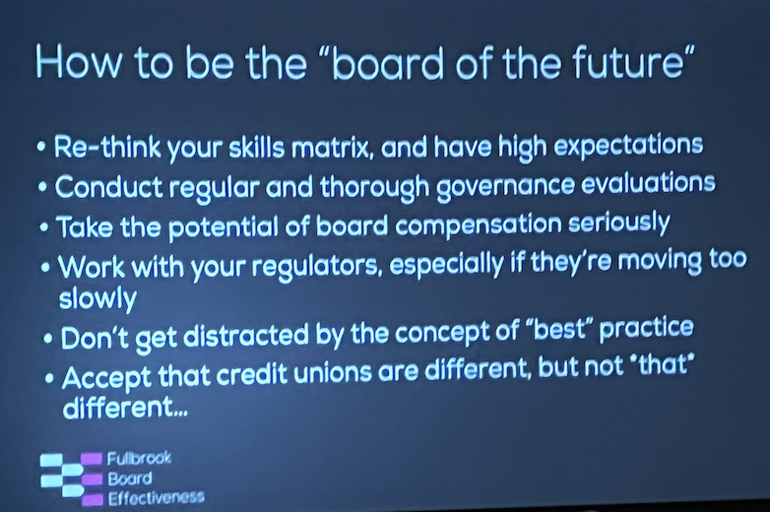
To the last point above, Fullbrook said credit unions often think they are so “special” that they reject the lessons and examples that can be found in other organizations, including banks, when it comes to governance. But there is much to be learned from those organizations and should not be rejected out of hand, he advised.
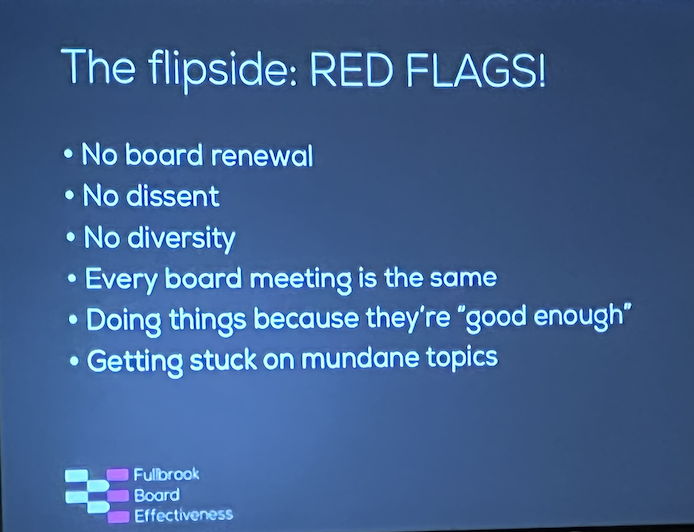
Finally, Fullbrook offered these red flags indicating an ineffective board, below.