

WAIMEA, Hawaii–Effectively responding to the “Great Resignation” will require many credit union leaders to “drop their tools” and rethink numerous assumptions, according to one expert.
Speaking to Rochdale Paragon’s Volunteer Leadership Institute, Dr. Sekou Bermiss, associate professor of strategy and entrepreneurship at the University of North Carolina-Chapel Hill and a Filene Fellow, shared his insights during remarks themed, “Drop Your Tools: Shifting Battle Tactics in the War for Talent.”
The “drop your tools” reference is to the book “Young Men & Fire” by Norman MacLean, which documents the 1949 tragedy at Mann Gulch, Montana, where 13 firefighters were killed while fighting a wildfire after they ignored unconventional instructions from their foreman.
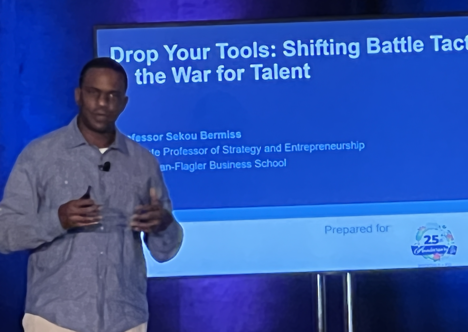
Dr. Sekou Bermiss speaking to VLI meeting in Hawaii
In that famous case the smokejumpers were walking toward the fire when the foreman saw the fire jump the gulch and start heading toward them, causing the crew to start running. The foreman could see they would not be able to outrun the fire, and he instead told his crew to drop their tools and huddle with him in the grass where they would burn a small fire around themselves for protection.
But the time “it made no sense at all” to the firefighters, said Bermiss.
The Real Lesson
The crew, trained to never drop their tools, did not follow the instructions, attempted to outrun the fire, failed and perished.
“The lesson for navigating tumultuous times is that what you are asking them to do may be antithetical to what they believe, and they will not follow. In other words, they will not drop their tools,” said Bermiss.
It’s a lesson from which credit unions should learn when it comes to the ongoing “Great Resignation,” according to Bermiss.
“People are leaving jobs and organizations are scared they will lose their best workers,” said Bermiss. “So, how do you think about building an organization that is resilient to the Great Resignation?”
The Four Keys
Bermiss said there are four keys to building a resilient organization– including being a more attractive employer–most of which will require CU decision-makers to drop their tools: Improvisation, virtual role systems, respectful interaction and attitude of wisdom.
Improvision
Allowing creatively and innovation under pressure helps organizations to become more resilient, according to Bermiss. But it also has other benefits, as what that looks like inside an organization is new ideas continually being proposed, discussed and vetted, he said.
“It means saying, ‘Let’s hear some proposals, no matter how crazy they may seem.’ It means allowing ideas to fail. One of the big demotivators of creativity is being written off. You had an idea, it didn’t work, we don’t want to hear from you again,” he related.
Virtual Role Systems
“This really just means how people construct reality in their heads and individuals thinking collectively,” Bermiss explained. “The benefit is you start to introduce people in the organization to how all the pieces all fit together. It means the member service rep understands what happens in lending. An organization starts to reach that place when it thinks about task realignment, which requires a good sense of how the whole organization works.”
Respectful
“We need dialogue to understand what is happening. It’s one thing to have emails that come down from on-top? How often do you read the full email? But if you have an interaction with a fellow board member or fellow exec, those interactions really are meaningful,” Bermiss said. Organizations improve their resilience when they have their employees interacting and in dialogue with each other, Bermiss added.
Bermiss said he has always been fascinated by working to create “network maps” in organizations. After the traditional intra-organizational relationships are mapped out, he said he likes to ask, “But who do you go to when you are stressed? Who are your emotional hubs? Those people tend not to be centralized, not very high in the organization, but man, are they important.”
The other benefit is “less-mitigated” speech, he added, meaning people feel more confident.
Attitude of Wisdom
“Ignorance and wisdom grow together. The more you learn, the more you realize how little you know,” he observed. “The attitude of wisdom is saying there is a lot I know, but there is also a lot I don’t, so I question things. It means you’re saying, ‘I have an assumption but I am also willing to say I may be wrong.’”
As an example, Bermiss said many CEOs had firm assumptions about what would happen within their organizations when the pandemic struck and people began working remotely, but found themselves “pleasantly surprised” that things went much better than expected.
“It means experimentation and making changes in a productive way,” he said.
Bermiss recommended two books: “Everything is Obvious Once You Know the Answer,” by Duncan Watts, and “The Signal and the Noise” by Nate Silver. Both books explore decision-making and the pro’s/cons of expertise and challenges related to forecasting and managing, he said.
Intuition Vs. Evidence
Bermiss said intuition vs. evidence comes into play particularly in human resources. Ideas about how to manage and deal with various scenarios within HR are drawn from experience and intuition, not data, even though the experience may be flawed and the intuition is wrong, said Bermiss.
How to Approach an Attitude of Wisdom
Bermiss said experiments are especially useful for taking ideas, testing them, and gaining insights.
The reason, he told the meeting, is related to an assumption he translated from the Latin phrase as, “After this, therefore, because of this.”
“This is a fallacy. Often people believe B happened because A happened, but that isn’t the case,” he said. “The primary difference between what I’m talking about with experiments and piloting is piloting is often done without random assignments. You have self-selected a group, tested them and you’re not going to find out anything. What you really want is a random group.”
Analytics Approach
In taking an analytics approach, Bermiss said the questions to ask include:
- Can I measure this thing, this outcome? If not measurable, at this point a new approach is necessary, as there can be no measurable outcome.
- If an outcome measure is in place, what are the theories organization has around an issue, such as retention? “What we end up getting is a whole lot of hypotheses.”
- Look to identify a predictor variable to determine if that is true.
- At this point, a statistics model can be created, which he emphasized must be the “last step,” he said.
- Analysis model findings can then be reviewed.