

KOLOA, Kauai–There are a considerable number of “if’s” involved in what lies ahead for the U.S. and world economy, but a recession is not on the near-term horizon—but neither are tools to react to one, according to one expert.
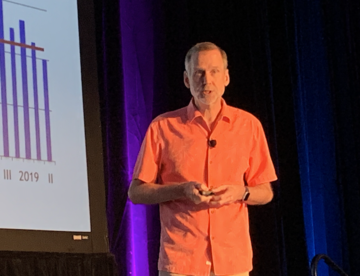
Byron Gangnes
Dr. Byron Gangnes, professor of economics at the University of Hawaii at Manoa, told credit unions here U.S. expansion is weaker, but growth is not over; growth has abated after the tax cut-induced pickup; and the trade wars and global issues are weighing on conditions and the outlook, but on the other hand healthy consumers mean the longest expansion is not yet over.
Gangnes told the Volunteer Leadership Institute meeting here he has no idea when a recession might arrive, although one always does. The bigger question, he said: “Will we be ready?”
“We have seen a remarkable synchronized slowdown in the global economy. There is broad-based weakness across all world regions. The trade war is impacting the business investment, and we’re seeing slack auto sales and a slowdown in China,” Gangnes said. “For the U.S. we’ve also had exchange rates moving in the wrong direction. The dollar has risen over the past two years. So, a weak global economy and a stronger dollar is a recipe for manufacturing problems. In fact, manufacturing is now in recession.”
Gangnes noted that after the Trump tax cuts, business investment had only a brief pickup, with fixed investments by business actually negative in the third quarter of 2019.
‘Not the Way It’s Supposed to Be’
“This was not the way it was supposed to go. We had tax cuts that went into effect in January of 2018 and we were supposed to see a big response as companies had more money to spend on fixed investments. But we got a little bit of a bump, and now that has died off,” said Gangnes, adding much of the money corporations derived from the cuts went into stock buybacks.
So where is the growth coming from? Consumers.
“The good news is the household sector is in very good shape,” said Gangnes. “Luckily, the labor market is very healthy. Unemployment is now the lowest since 1960s. Very low unemployment has finally led to decent, if unspectacular, income growth. You have to look hard to find any sign of weakness.”
He said wage growth has been in the 1%-2% range after adjusting for inflation, and U.S. consumers remain very confident about the future, although sentiment did fall off a bit at end of last year. Home values are also up, so people feel richer.
“Households are in position to keep carrying the ball for this economy, at least for now,” he said.
Housing has seen a rebound in sales and in home building (with the latter at highest rate since 2007 during November), and rate reductions on mortgages are helping fuel the market.
“The housing picture is pretty positive,” said Gangnes. “Residential investment is a bright spot right now and it will likely keep contributing to the economy in the next few years.”
Monetary Policy
Looking to the Fed, Gangnes said inflation continues to fall short of the Fed target of 2%, with both CPI and the PCE Deflator slightly below that target.
“Prices are still weak, which allows the Fed to keep rates relatively low,” he said. “After nine increases, the Fed has made insurance cuts back to 1.5%-1.75%. The Fed has signaled no further rate cuts in the near term unless economic conditions worsen.”
Gangnes said there has been a fundamental shift in economists’ views in what long-run interest rates need to be.
The Rest of the World
Looking to global markets, Gangnes said:
- There will be some strengthening in the European economy in the years to come but it won’t be robust.
- Japan, “which always seems to have some issues,” will slow in 2020 but see a rebound in 2021. An aging population is also restraining the country’s economy.
- East and South Asia economies have been trending slowly down (including China), which is expected to continue for the next several years.
- Latin American economies will steeply decline before beginning to recover over the next several years, but growth will not be dramatic.
Recession
This is the big question, Gangnes acknowledged, saying recession risks are a “mixed picture” and that the usual excesses that contribute to recession are not (much) in evidence. For instance, household debt burden is very low in historical terms.
Corporate debt, however, is more of a concern, and equity markets remain pricy.
“Synchronized global slowdowns are always dangerous,” said Gangnes. “When some countries are slowing and others are growing, you can diversify as an exporter. But when all are declining you can get clobbered.”
But there is strong upside potential, according to Gangnes, and there could be a forecast surprise to the upside. That would require the resolution of uncertainties over trade and politics, and more favorable financial conditions could boost investment more than expected, he said.
“I don’t think we’re heading into a recession, but don’t ask me, I don’t know. At some point we will have a recession, as we have not abolished the business cycle. Are we ready for the next recession? Hint, the answer is no.”
The Federal Deficit
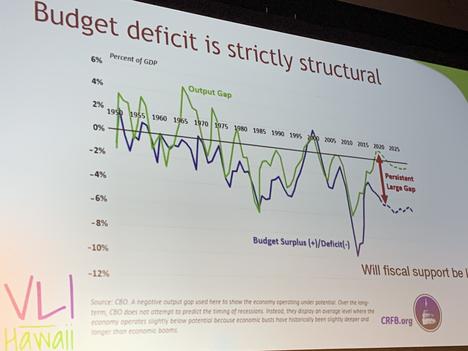
Gangnes pointed to federal revenues and outlays, which have been diverging again. Outlays have been going up a little big over long-term trend, while revenues are below long-term trend due to tax cuts, so they are going in the wrong direction.
“Why do we care?” asked Gangnes. “Typically, at this point in the business cycle, we would want to be running a budget surplus. In 2020, we shouldn’t be running a deficit, we should be running a surplus. Deficit is running at about 5% of GDP and it’s expected to be at that level through at least 2030. It’s due to structural problems with the tax and revenue systems we have in the U.S. The question is (will the federal government) be in a position to make moves during the next recession, and I think that’s very speculative.
“On the fiscal side, we will not have the toolkit we had in the last recession, at least not like we had. On the monetary side, won’t have much room to cut further,” he added.
Prospects for Growth Remain Good
According to Gangnes, the overarching issues to watch include:
- 2019 may very well be the bottom of the global growth slowdown
- The “insurance cuts: by the Fed and financial market gains (both stock and bonds) will be a support
- End to sources of drag will help: trade war, Brexit, sliding corporate profits
- But risks are bigger this year than last, including pronounced global weakness, political uncertainty and coronavirus
Effect on Credit Unions
What does all this mean to credit unions? According to Gangnes:
- Conditions are very favorable for lending. “Interestingly, lending standards for home lending remain relatively tight,” said Gangnes
- Small spreads will continue to challenge net revenues