

LAHAINA, Maui–With the standard credit union balance between balance sheet income and non-interest income (NII) potentially about to be turned upside down, one person here offered some insights into how credit unions can find new opportunities in NII. And that includes overdraft programs.

Paul Dionne addresses the meeting.
Speaking to the Volunteer Leadership Institute here, Paul Dionne, research director at Filene, shared this observation made by one CU leader: “Typically, the credit union gets 70% of income from balance sheet and 30% from NII. That model will have to be turned on its head.”
Dionne noted that auto and home lending, the primary sources of revenue for credit unions, will remain the “pillars” of the balance sheet, according to Dionne.
“But you need to put on a different mindset when you shift over to non-interest income,” he advised. “You have to take (the traditional business line) hat off with non-interest income. It’s a different creature.”
The Trend Lines
Dionne reviewed some of the trends in non-interest income and margins, that can be seen in the chart below.
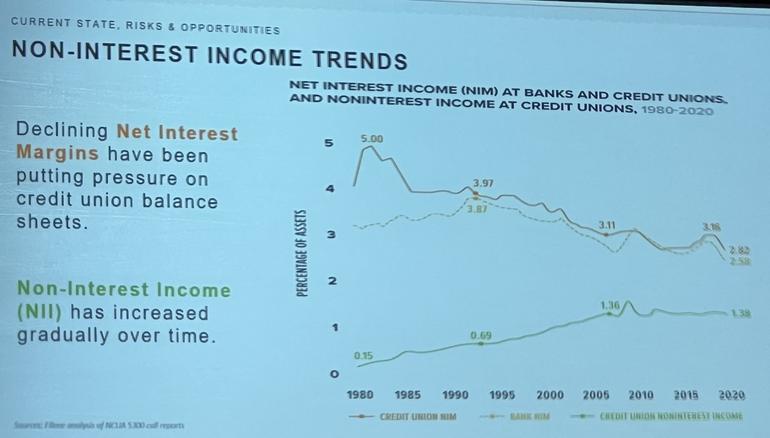
“One of the interesting things we found when we dug into this is it’s actually flattened as you look at non-interest income, which has not matched the growth in assets,” said Dionne, who noted NII can include insurance revenues, auto repair coverage, NSF and other transaction fees, CUSOs and more.
Operating non-interest income has grown around 7.7% over the last 10 years, according to the Filene research.
The NII Opportunity
The non-interest income opportunities, Dionne said, include:
- Many NII sources provide recurring revenue
- NII reduces reliance upon net interest income (and the yield curve)
- Many NII sources require no regulatory capital, so they are not a burden on risk-based capital rules
- NII proves a way to grow without straining net worth and instead improves it
“We consider non-interest income oxygen for your balance sheet,” said Dionne.
Overdraft Protection
Competitive pressures and shifting consumer behavior and expectations are sparking a public reevaluation of fee-based services such as overdraft protection, Dionne noted. In addition, there is shifting consumer attitudes, there is increased regulatory scrutiny, growing litigation risks, a disparity of impacts on consumers, and the competitive landscapes of financial services has changed.
Overdraft programs were created at a time of paper checks, prior to debit cards, and the objective was to keep consumers from being billed twice for a bounced check. In that era, OD programs were not significant drivers of non-interest income.
Today, members are using debit cards more often than checks, and the cost of an NSF has dropped for the FI. Moreover, consumers can become fee averse.
A Need to Rethink
“Credit unions built these programs in a different world,” said Dionne. “It’s likely you need to rethink this.”
That rethinking involves moving from viewing NSFs as a risk and instead seeing the programs as an opportunity, Dionne said, acknowledging the income stream has become critical for many CUs.
“It feels like we are out of balance with overdraft protection in some cases,” Dionne said.
In terms of the competitive landscape, it is a “different game today,” Dionne said, noting it isn’t just banks with which credit unions are competing for checking, it’s fintechs, Walmart, Google and more. “We’re competing with platform providers.”
Dionne said Filene has been tracking all the pressures on the credit union business model, which has led to thinner margins, as the result of new delivery models and more, much of which has led to increased expectations by members and consumers.
All of that has led to what Dionne called “financial fragmentation.” The challenge for CUs as a result, he said, is figuring out how to help members “reaggregate” their finances.
Opportunity For Payments
Credit unions are locally rooted, offer people first relationship banking, have a foundation of trust, are long-term strategizers and are agile adapters. All of that contributes to the opportunity credit unions have in payments, according to Dionne.
“The opportunity for non-interest income is there,” said Dionne, referring to payments.
Urging CU directors to consider some of these ideas, and not all of them, Dionne said:
- Credit unions are rich with data, but information poor. Using better analytics will allow CUs to make better use of all the data they have, and a great place to get those insights for better serving members is from payments.
- Deposits. A lot of CUs are feeling the deposits pinch, Dionne noted, and payments can be a strategy for bringing deposits back.
- The CU card is a “touchpoint” that reminds the member of the brand and what the CU provides.
- A rewards program is likely needed to spur card usage to raise interchange.
New Revenue Streams
These can include:
- Getting creative in new products and services that have fees.
- Evaluating what consumers are purchasing elsewhere to ID potential offers.
- Exploring how to bundle together new products into subscriptions or link them to a fee-based checking account.
- Offering personal financial management services such as budgeting, insurance and investing.
- Updating the overdraft program to understand users of programs and their engagement levels to better know why some members overdraft accounts. That can include shifting heavy overdrafters into other products.
- Embedding insurance and other offers related to mortgages in the offering.
- Identifying members who are using wealth management services elsewhere. Dionne noted that $84 trillion in wealth is expected to change hands between now and 2045. This should also include considering wealth management services for members of modest means.
The Next Generation
Dionne also urged credit unions to take more advantage of “next generation CUSOs.” Those CUSOs, he said:
- Closely resemble fintechs
- Represent a renewed focus on collaboration and innovation
- Provide speed and agility on products/services
- Provide access to entrepreneurial approaches and talent without massive internal cultural change
- Allow credit unions to better leverage their assets
- Drive growth
- Offer a new kind of investment opportunity
When it comes to driving non-interest income, Dionne said a credit union must align its decision with its growth and business development strategies.
“We have to ensure the products and services we provide are member friendly. Let’s not lose sight of that,” Dionne said.