

WAIMEA, Hawaii–Regulators at both the federal and state levels have shared their views on issues ranging from examinations to whether it’s a good idea to record exit interviews to the potential for regulatory or legislative action on overdrafts.
The comments were expressed during Rochdale Paragon’s Volunteer Leadership Institute here, with NCUA Board Member Rodney Hood and NASCUS President Brian Knight offering their insights. The discussion was moderated by Dennis Tanimoto, who will soon retire as president of the Hawaii Credit Union League.
Supervisory Priorities
Tanimoto noted NCUA has just published its supervisory priorities for 2022, two of which are new to the list, payment systems and risk-based capital, and asked for additional guidance. (CUToday.info has separate coverage of a new Letter to Credit Unions from NCUA.)
“What we are looking at should be no surprise,” said Hood. “We are going to be looking at cybersecurity, no matter if you are a multibillion-dollar institution or a small CU operating in the basement of a church. NCUA is going to be doing its level best to keep credit unions safe and protect the data of your member-owners.”
Hood said the agency is also looking at credit risk even though the industry has recently reported 112 basis points in ROA, as he noted much of that is the result of credit unions reducing their loan-loss reserves. There will also be more focus on interest rate risk and duration risk, he said.
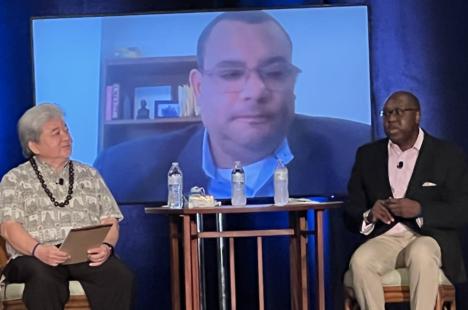
From left: Dennis Tanimoto, Brian Knight (appearing virtually) and Rodney Hood during VLI meeting in Hawaii.
“Another area that is important is payment systems,” said Hood, specifically citing relationships credit unions are building with fintechs. “We want to make sure you are being appropriate, are vetting and doing due-diligence. Are you protecting the member-owners?
In terms of capital adequacy, Hood reminded that many CU ratios were driven down by the inflow of deposits from government stimulus during the pandemic. But that’s not true in all cases.
“We are going to continue to look at some of the capital levels that have deteriorated that had nothing to do with share growth,” he said. “In those cases there are performance measures that perhaps need to be addressed. At the end of the day it is about safety and soundness, but it not a game of gotcha. I’d rather address these issues head on. Your examiners want to hear from you.”
Hood also cautioned his audience that the agency will be scrutinizing consumer financial protection as credit unions seek to bring more financially vulnerable people into the financial mainstream.
“People have been disproportionately affected by the pandemic, particularly people of color,” he said. “Are folks being treated fairly and equitably? We are going to look at that. I can say that credit unions do not take advantage of their members.”
State System Priorities
In response to a question from Tanimoto over whether state regulators will be looking at similar issues, Knight said there is some overlap, including that state agencies will also be looking to distinguish between those institutions that suffered a little from serving their communities during the pandemic and those that had issues that preceded the pandemic.
“I would say two other areas for state regulators are third party vendor due-diligence and management,” said Knight. “That is going to be a big area going forward, especially with digital assets and CUSOs.”
Most state agencies have third party vendor oversight authority, which NCUA lacks. The federal regulator has been urging Congress to expand its oversight in that area.
“And cybersecurity has a huge third party link,” said Knight. “Risk often comes from a vendor or software they don’t control. We will also looking at BSA and AML. We’ve seen an uptick in enforcement actions in the bank and non-bank space. I think 2022 will usher in a new focus on that.”
Point/Counterpoint on Videotaping Exams
Tanimoto said one issue he finds a bit “weird” is NCUA allowing exit interviews between its examiners and credit unions that are conducted virtually to be recorded.
Hood responded by saying as the federal regulator expands its virtual examination program, especially under its new MERIT framework, which he described as a fintech tool in a cloud-based environment, it sees benefits in the recording of meetings.
“There are times when folks can agree to disagree and quibble,” said Hood. “Often, there is disagreement over the CAMEL rating the credit union thought it was going to get. It was thought it would be nice to have a recording. Please note the point of this is not to have a chilling effect on conversations. Instead, it’s perceived as a best and guiding practice moving forward so as not have this ambiguity. I think it is something we are going to be pursuing and has already helped in a few instances.”
Not on Same Page
State regulators, however, disagree.
“That is one place where there is a little daylight between us,” said Knight. “We have 45 states and many of the states don’t think (recording) is going to be beneficial. They do think it creates a chilling effect. They either do not allow it or discourage it intensely. There is a footnote (in the NCUA letter) we wish been a bit more prominent.”
He noted the option to record does not apply to state-chartered credit unions if the exam is led by the state.
Knight added state regulators have developed expertise in virtual exams but are looking forward to returning to a normal schedule of on-site exams, although the virtual scenario does allow for reduced costs and for examiners to spend less time on the road away from family.
“We also hear from credit unions that don’t want 10 examiners for two weeks, but they do like to have the exit exam in person,” said Knight. “So, I think you’re going to see the hybrid approach going forward.”
Limits on Overdraft Fees
Finally, Tanimoto asked his two panelists about an issue on which CUToday.info has reported extensively, the ongoing moves by large financial institutions to eliminate or significantly reduce their overdraft pricing. Could there be any regulatory or legislative action when it comes to ODs?
Hood praised credit unions again for their work in making small-dollar loans or participating in NCUA’s PALs program, but said he doesn’t believe the agency needs to prescribe overdraft policies.
“I really think that is something that should be left to you all to decide as business decision-makers,” he said. “I am not one that micromanages. I am not one who believes in regulatory overreach, and at the end of the day I think it's beholden to you all people to decide what best fits your member-owners. I do hear that there are some large money-center banks that are making millions of dollars from it. I do care about helping people of modest means and helping communities of color.”
Hood said studies show communities of color are disproportionately impacted by overdraft fees.
“We have tools that we can use to really punish those bad actors. I know this is a very hot topic now, but I am a free market capitalist,” Hood continued. “I believe that you all make the decisions” and that as long as consumer protection laws are followed it is not NCUA’s role to impose any limits.
Hood also said he has heard the discussion that some in Washington want to regulate overdraft history but is unsure where that might go.
Feeling the Squeeze
NASCUS’ Knight said he does not believe any state regulators are planning any action related to overdrafts, and further noted there is a “lot wrapped up in this issue,” as it sits at the nexus of profitability, inclusion, and criminal codes.
“It’s not just policymakers in Washington, but also beginning to feel pressure from the marketplace itself. I imagine that income is being made up somewhere else but that’s not what shows up on the front page,” he said. “ I think good due diligence by credit unions that run these programs and make noninterest income is going to be needed. We do need to think about what the world will look like if net interest income gets squeezed by the marketplace or by Congress.”
Overall Positives Are Seen
Overall, Hood praised the performance of credit unions during the pandemic, credited CUs for making small-dollar loans to help underserved communities, and made clear he will not be calling for any NCUSIF premium assessment anytime soon.
Overall, he described himself as “bullish” on the future for credit unions.
Knight, who recently was named as CEO of the National Association of State Credit Union Supervisors (NASCUS), similarly said the state system has “performed admirably,” while he called the partnership between state and federal regulators “fantastic.”
Knight noted there are approximately 1,868 federally insured, state-chartered credit unions and another 107 privately insured state charters operating in 10 states, for a total of 1,975 state-chartered credit unions.
State charters operate in 45 states (there are no state charters in Hawaii, Delaware, Arkansas, South Dakota Wyoming), and they make-up approximately one-third of credit unions in terms of units and just over one-half of assets and members.
$9 Trillion Being Supervised
“Rodney mentioned the $2 trillion in the credit union system. Our 45 state agencies not only supervise credit unions, they supervise state industrial savings and loans, banks, money transmitters and other entities, so they actually supervise a little over $9-trillion in assets,” Knight explained. “So, there’s a lot of familiarity there with some of the most sophisticated financial services transactions, products and services being offered. For example, we’re very familiar with derivatives transactions. Our state regulatory agencies are intimately familiar with Tier 2, Tier 3 alternative forms of capital that are quite commonplace in the banking system. With commercial lending it was actually state regulatory agencies in the late 90s that began to drop the regulatory requirement for their credit unions to have to get a personal guarantee on every commercial loan. That kind of expertise flows out of the state system and I think it benefits the entire credit union system.
Knight called the service and performance of state-chartered CUs throughout the pandemic worthy of praise.