

KOLOA, Kauai–With nearly 500 credit union volunteers in the audience, NCUA Chairman Todd Harper and NASCUS President and CEO Brian Knight participated in a Q&A across a host of issues, including what the Supreme Court’s review of the Chevron doctrine might mean, why boards may not have the full picture of losses from fraud, how regulators can help innovation, and more.
Here is some of what they were asked and how they responded during Rochdale's Volunteer Leadership Institute:
Q: What about the implications of the Supreme Court Chevron ruling and NCUA regulation
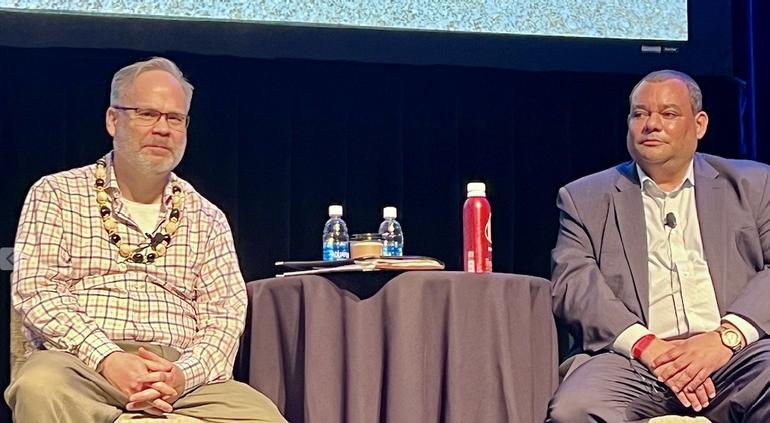
Harper: First, of all the case is pending, and I can’t read the tea leaves necessarily to where it’s going. With the Chevron doctrine, if there is ambiguity in the statue the agency can interpret the rule. I don’t know what the new standard would be. But we are watching the case carefully. We strive to stay within the four corners of the (FCU) Act. I don’t necessarily think there could be a tremendous change for NCUA, regardless of where the Supreme Court comes out on it.
Q: What is the position of NCUA or NASCUS on having a competitive and fair playing space? We have so many members that use these apps and transact over the same rails, and when they run into trouble we are required to jump in and cover those transactions. We have to dedicate time and trouble to this and (fintechs) don’t have to comply with the same rules.
Knight: You are raising the kind of broader issues that have been moving in the financial services sector space, particularly with the rise of fintech.
You saw several state banking agencies sue the Comptroller of the Currency over the proposal for a fintech charter. As the financial services space transforms, we are looking at very, very serious policy questions and the implications. What does it mean to be a depository institution? Who gets access to the payment rails? What does it mean to be regulated? It is giving people some pause.
A lot of these service providers are regulated at the state level. Whether they are money transmitter or some of these other types of entities; they fall under state regulation and state supervision.
The question is a policy debate and I still think it is being sorted out around what is a level playing field? What are the expectations for the amounts of money a consumer can leave sitting in some kind of virtual wallet? What is an uninsured, non-depository entity and who should regulate that?
Some of the states have begun to fill this in with regulation either directly or indirectly, with crypto in particular.
Q: As chair of our supervisory committee, I spend a lot of time with regulators talking about internal fraud, and yet at same time we’ve also seen a dramatic increase in external fraud? Can regulators help us fight external fraud?
Harper: I was recently speaking with an examiner who is one of our regional information specialists, and he shared that in institutions he's going into we're actually seeing that the losses due to external fraud are higher than losses on loans. But many credit unions are not recognizing those losses as being a problem because of the silos that are built within the credit union itself. It may occur on credit card or auto lending or a debit card, but they're not consolidating what's happening.
Your losses due to external fraud may be higher than your losses due to loan-loss reserve. How much of your time do you spend thinking about loan-loss reserves?
Boards should work with their management to develop a consolidated report. We're not requiring this at this point in time, but there should be some type of consolidated report so that boards can have a better bird's eye view as to what's happening with that external fraud.
Knight: NASCUS’ state regulators are also focusing on education and training and, in particular, as the chair mentioned, the silos within an organization.
Also, show me a credit union with a program that has been bought into at the top with a culture of compliance from senior management, and I'll show you a credit union that probably is doing pretty well managing some of that external fraud.
Q: We hear a lot in CU boards and management that innovation is great, but regulations and regulators get in the way. Can you speak to that?
Harper: We know that evolution is happening. If your credit union is considering a brand new technology, talk to your examiner.
We have an office at NCUA that specializes in fintech and access issues. Come talk to us. We can help think through the issues with you so that you do it in a way that is broad-thinking and addresses the risks.
If you are on a board and you're looking at innovation, make sure that you're developing the risk-based policies. Set parameters around that risk. Make sure you're addressing consumer financial protection items overall.
Knight: I think it starts with open communication. Let's be honest: most of our regulators are fairly conservative by nature, and if you are coming forward with a new way of doing something, talk to your regulator.
We have a fondness inside of NASCUS that when folks talk about risk we always correct them: it’s material risk. You're in inherently risky business; demonstrate to your regulator that you understand the material risk, that you understand the downside, that you have a Plan B.
You can’t surprise regulators. The first time they encounter something can’t be what I call ‘out in the wild’ when the examiner walks through the door.
(Knight noted many state regulators have an authority NCUA is seeking, vendor supervision authority, as a result of supervising banks.)
Q: What do you anticipate in terms of priorities with new NCUA Board Member Tonya Otsuka:
Harper: I understand the political aspects of the question, but we are an independent agency and we strive for consensus when possible. It doesn't mean that you always get to it, but I certainly strive to get there. I think that’s because my dad was the Republican superintendent of schools and my mom was the teachers union’s Democrat president. I took from them that you can take ideas from both sides and come up with better policy overall.
Tonya Otsuka is going to bring the certain initiatives to the table. She's very interested in competition, for example, and how can small credit unions compete? I expect that we will do some evolution of our programming in those areas.
The Best Daily Newsletter in Credit Unions—And Now With Free Shipping!
The biggest, best and freshest news reporting in credit unions remains free! Each morning CUToday.info delivers its daily Fresh Today news update offering the latest headlines and breaking news right to your email, with the easy-to-read headlines format allowing you to click on the stories that interest you most in order to learn more. So stop paying those bank-fee-like subscription prices from other so-called “news” publications!
If you haven’t yet signed up for the new email solution on which CUToday.info has partnered with ResponseGenius, you can do so here. Signing up requires less than one minute of your time—and it’s free!
Please note that after signing up you may need to go to your Spam/Junk folder and mark the morning headlines email as safe. CUToday.info does not provide its list of readers and emails to outside parties, and we will not be contacting you to sell you an extended warranty or sending you any links so you may cash in on an inheritance you didn’t know was coming.
And did we mention it’s free?